
Stranded Together
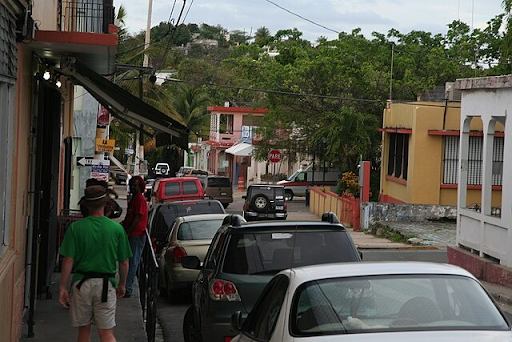
People walking on the streets of Vieques, Puerto Rico. Photo by Steven Isaacson via Wikimedia Commons
It was the summer of 2019. I was 18 and did not know how to drive. Out of equal parts naivety and curiosity, I found myself on the small island of Vieques off the coast of Puerto Rico with no public transportation and no plan. I walked the winding highways under a scorching sun, searching for an elusive taxi, certain this was how I would spend my days here — hot, slow, and stuck. Instead, people stopped almost immediately. Cars and golf carts pulled over without being asked. Strangers offered rides, phone numbers, and their time. “Call if you get stuck anywhere on the island,” they said, as if it was inevitable.
I got around on the generosity of those people alone for several days, reaching places and getting invited into homes that no self-sufficient traveler with a rental car and an itinerary would ever find. When I asked why they extended such warmth to a stranger, they looked at me the way one would look at someone who just asked why the sun sets. “That's how island culture works,” they said.
Vieques has only about 7,000 residents. If someone's car broke down or an electrical wiring got fried, everyone had to take responsibility because no one else was coming.
That experience made me notice how insularity and proximity, usually treated as limitations, can produce something that sprawling, well-connected cities rarely generate: the certainty of being able to rely on each other.
Mobilizing in Times of Need
This dynamic has played out at far larger scales. Gander is a small town on the northeastern coast of Newfoundland with a population of around 10,000 in 2001. On Sept. 11, 2001, when the United States closed its airspace after the attacks, 38 commercial flights carrying more than 6,000 passengers were rerouted there. The passengers could not leave Gander for nearly a week. They arrived in shock, wearing the clothes they had boarded in, with no clear sense of what had happened to the world they had taken off from.
The town mobilized without waiting for instructions. School bus drivers, who had been on strike, returned to their routes to ferry passengers to community centers, churches, and legion halls converted overnight into dormitories. The Community Center's ice rink became the largest walk-in freezer in the country, storing food that poured in from surrounding towns. Volunteers cooked around the clock. Residents filled prescriptions without charge, organized bowling matches and town tours, and introduced visitors to stewed moose. Derm Flynn, mayor of the neighboring town of Appleton, invited strangers to sleep in his home.
What the residents found remarkable was that no one found it remarkable. Local newspaper reporter Janice Goudie, when asked about the effort, said: "For us, it was just every day. You don't turn your backs on people in need."
Collective Stewardship
I spent a summer in Viroqua, Wisconsin, in an ecology program, and found the community-first instinct that has shaped the region.
The Driftless Area, where Viroqua sits, escaped the last glacial advance that flattened most of the Midwest. Its steep bluffs and narrow valleys made large-scale industrial farming nearly impossible, and small farms survived here long after they vanished elsewhere. That geography shaped the culture. In 1988, seven farmers in nearby La Farge, realizing they had to cooperate to be competitive, founded what became Organic Valley, now a cooperative of more than 2,000 farms and the largest organic dairy cooperative in the country. The community that formed around them developed a fierce, practical sense of collective stewardship.
On one farm I visited, the farm owner and his family, and the Amish women and Mexican laborers he hired worked side by side through the afternoon, pulling garlic from the soil — dig a bulb loose with a harrow, grip the stalk, shake the dirt from the roots, do it again. The farmer told me he wished he could pay his workers more, although their wages already exceeded Wisconsin's minimum. He had recently helped organize a fundraiser for the wedding of one of the Mexican laborers. This was a departure from the picture of exploitation one usually conjures when thinking of immigrant farm labor. When you work alongside each other on acres of land for a season, lending a hand becomes second-nature, Jason, the farm owner, said.
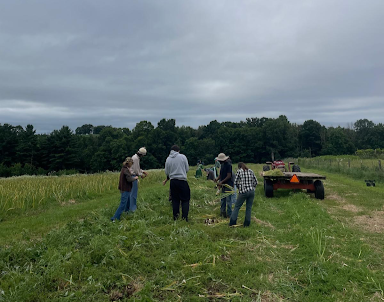
Students and workers pulling out garlic on a farm near Viroqua, Wisconsin. Photo by Carol Chen
Enforced Proximity
What did Vieques, Gander, and that Wisconsin farm share? Each had removed the possibility of evasion. On the island, geography enforced it. In Gander, the closed airspace did. On the farm, the daily demands of shared labor did. Once the possibility of exit was removed, need became visible in a way that made indifference require active effort. People did not help because they were more virtuous than urban strangers. They helped because they could not look away.
In cities, where most of the world now lives, that enforced proximity rarely develops. Part of the reason is the erosion of the civil institutions that once simulated it. Robert Putnam documented this in Bowling Alone: union membership peaked in 1953 at 32.5% of American workers and has since fallen to around 14%. The share of Americans who trusted their neighbors fell from 55% in 1960 to around 35% by the 1990s. When the union hall, the parish, and the civic association thinned out, so did the involuntary encounters that built a felt sense of shared fate.
And yet, place those same people on an island, ground their planes, and the understanding that human life is essentially a communal one returns.
The work, then, is not to change human nature but to engineer its conditions: a community garden where you share plots with your neighbors; a food cooperative where the people who grow what you eat have faces and names; or a neighborhood network where someone feels responsible for the elderly woman living alone. Through the deliberate construction of what Gander produced by accident – bounded spaces where exit is discouraged and need is impossible to ignore – one can restore access to how we are fundamentally reliant upon each other.
We are already stranded together on something larger than any island. The task is to build communities small and tight-knit enough to understand it.
*The opinions of contributing writers are their own and do not necessarily represent the views of We Are One Humanity. Submissions offering differing or alternative views are welcome.



Listening to many roots in a restless, unfinished democracy