
Passing on the Right Things
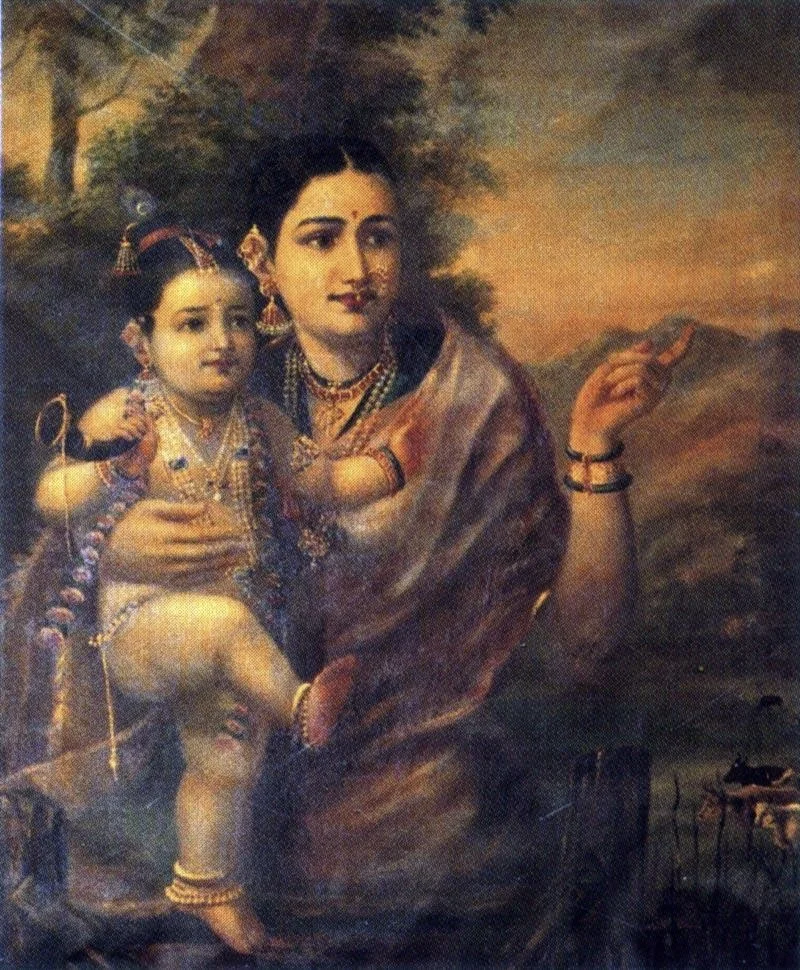
Raja Ravi Varma (Wikimedia Commons)
When my sister and I were children, my father would spin beautiful Kannada prose to enchant us with bedtime stories from the Mahabharata and Ramayana. These stories contained lessons on morality and cultural values, so they served us well. My father was a new immigrant to America, which is a lonely experience, and passing Kannada onto us was his way of constructing not one, but two friends.
On the eve of childbirth, a fear has arisen in me. What if I am unable to teach my daughter Kannada? What if I am the lone Kannada speaker in our household?
Parenthood, I am beginning to understand, is an oscillation between fear and generosity, selfishness and selflessness.
Inheritance Without Domination
I used to think about language in quite an egotistical way, if you will. I thought myself superior because I am bi-lingual. Language was an art form to master, through which I could have maximum command over my heritage, unlike my peers.
Now, thirty-seven weeks pregnant and on the brink of motherhood, I am not so interested in teaching my daughter Kannada so that she can impress relatives or outperform classmates with her big brain. I want Kannada to be a source of self-knowledge for her. A path for her to connect with her people and new paradigms of emotion and expression. I believe what I am shedding, on her behalf, is a residual competitiveness that is rampant in Indian-American communities. You might say “how wise”, but really I have pregnancy to thank. It has made me feel softer, gentler towards all things, including language. Now, I am lifting the lid on the ways language can be a medium for care and understanding.
Aside from the type of language she knows (Kannada, English, or my husband’s mother tongue Telugu), I am concerned with the style of language that will envelop her.
I grew up in a raw ecosystem, you see. My parents’ shared their unfiltered thoughts with us, which certainly created a closeness in the family, but sometimes, when words flew like bullets, I did not make it out unscathed. Outside of the home, I am able to recall, with clarity, the ways in which the world told me I was wrong. The wrong size, color, and demeanor, as many girls around the world are told everyday by their families, communities, and institutions.
“If only you could be more dignified, decent, and selfless” was a catchphrase of several uncles.
To my disappointment, nowadays I am all three, and I do not know if it is of my own desire or theirs. Am I calm and well-spoken because I want to be, or because I kept bumping into the guardrails of patriarchy? I have no way of knowing, but I am damn certain my daughter will have the freedom to find out.
In India and America we still see, all around us, attempts to control young women, be it their opinions or body, both of which shape their destiny.
What Ends With Me
When Ruth Bader Ginsburg died of metastatic pancreatic cancer on September 18, 2020, my sister was curled on the floor and I sat beside her, rocking back and forth nervously. A woman had passed away and taken with her a constitutional protection. Such was the tenuous nature of women’s rights in modern America.
As we predicted, the Trump-appointed Supreme Court overturned Roe vs. Wade and millions of women lost a fundamental right. My sister and I live in California, so our reproductive rights are intact, but what of American women across state lines? Women in Alabama, Arkansas, Idaho, Indiana, Kentucky, Louisiana, Mississippi, Missouri, North Dakota, Oklahoma, South Dakota, Tennessee, Texas, and West Virginia, to be exact.
Imagine a woman living in South Carolina and, after weeks of agonizing amid nausea, fatigue, and other first trimester symptoms, she decides to terminate her pregnancy at thirteen weeks. She takes a pill and has a painful miscarriage. She flushes her fetus down the toilet. By this point I would bet she is pretty broken inside. A few days later the police are at her front door, there to arrest her for breaking the law.
There is a boundary between me and her, and between my daughter and I. Once she is born, she will be the first in her lineage to be granted comfort in her body. No one within earshot of me will tell her how she should feel about her own body. This I will make certain. Yet I am up against powerful forces in the country, forces which filled the vacuum Ginsburg left behind. They seek to blur the boundaries between myself and the woman in South Carolina and reinforce the one between myself and my baby in utero.
The Weight of Other Mothers
We all intellectually know that we are born and will die, and this phenomenon is an unknowable miracle, but to house another life is an embodied way of knowing such a thing. Just as I can physically feel I am a link in a generation, I can feel myself as a link in the circle of life. This sense of responsibility and wonder is accompanied by grief and indignation at how flippantly we treat human life, especially some lives.
As of early 2026, thousands have died in Ukraine, Palestine, Sudan, Myanmar, and, most recently, Ethiopia. So many in these conflicts were so lovingly carried to term by a mother who had dreams for that baby to be safe and loved. When considering the horrors these mothers and fathers endure, whatever feeling lay beyond grief, I am there. Surely there is someplace I can put this grief? Into action, perhaps?
The conundrum of pregnancy is that it makes you more and less radical, if such a thing is possible. On one hand, it is harder for me to attend local protests or canvassing efforts. I am much less involved at the grassroots level. However, because I am home most of the time with my feet up, I am reading and writing more, not to mention more alarmed by climate change, wars, and other disasters that would make the future uninhabitable for our children. My grief, then, metabolizes into a sense of responsibility. Why are we building technology that reduces the cognitive function of our children, I wonder? How can our society stomach the mass deportation of families, I fume. Yet, I am more aware than ever that having “radical politics”, whatever that means in our deeply privileged bubbles, is also a risk. I have a child on the way, after all, and a responsibility to her. Does she need me to stick my neck out more or less? I do not know. Putting myself on the frontlines once seemed glamorous, and now is frightening.
Yet again I oscillate between fear and generosity, selfishness and selflessness. Where I am certain is, be it wars, global warming, or the erosion of a literate society, there are men who pray several times a day, only to open their eyes and wield power in ways that harm our children. They might pray for absolution or wisdom, receive neither, all the while pregnant women like me pray to no God but gain an audience with Him anyway.
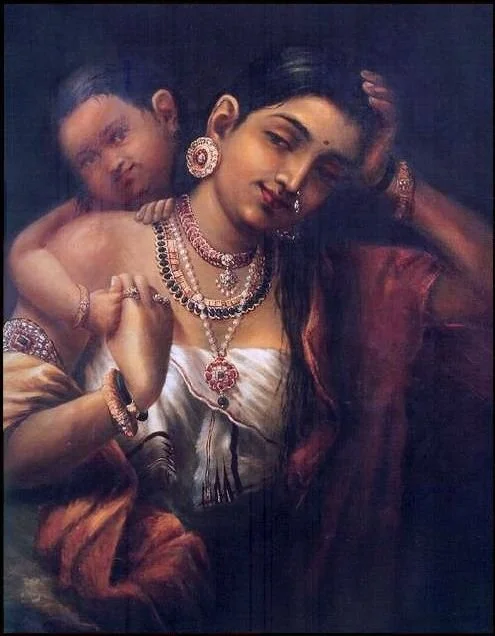
Raja Ravi Varma (Wikimedia Commons)
Nonviolence, Outside and Inside
I grew up in a Gandhiwadhi household, strayed from it temporarily, and, in part during my pregnancy, have returned home. A core tenet of Mahatma Gandhi was ahimsa, or non-violence, which has never seemed less in vogue on the political right or left. Older generations may be surprised to hear this, but, from what I can tell, millennials and Gen Z do not buy-in to civil disobedience as an attitude. Ahimsa is seen as soft, polite capitulation. If the Right is sending the Proud Boys to the march, we are sending Antifa. If they want to colonize us with force, we will rise up and decolonize. The “by any means necessary” approach is embraced.
You might say it is easy for a pregnant woman to espouse ahimsa. After all, I am in my most vulnerable state, therefore, I crave peace, but it is not peace I crave, it is justice. Justice through just means, such that our environments are not dominated by fear or suspicion.
Just as Gandhiji intended, I aim to practice ahimsa in public and in private. The language and rhythm of our home will have peace and justice, even if the outside world cannot always provide it. Ahimsa can become a spiritual and social practice for my daughter as well, one which she can beckon at a moment’s notice.
This week I am preparing myself for childbirth. I have been told it is a painful and, essentially, violent experience to the body. This may be so for some women, but I want to imagine a different possibility for myself. I imagine my baby telling my body she is ready to leave. My cervix joyfully widens to allow her to pass, and my uterus passionately squeezes her out. She then joins us on this side. I know that if I breathe, relax, and trust both body and baby, it is quite possible the birthing experience will be as it was intended; a release, a relief, and the greatest of all first encounters.
My daughter will be swaddled in my arms, and I will tell her in the dulcet, folk tones of her mother tongue:
ninna tande matte nānu ninagāgi kāyuttiddevu
Your father and I have been waiting for you
*Read more of this author’s writing on her Substack.
*The opinions of contributing writers are their own and do not necessarily represent the views of We Are One Humanity. Submissions offering differing or alternative views are welcome


Listening to many roots in a restless, unfinished democracy