
Disappointment is Inevitable
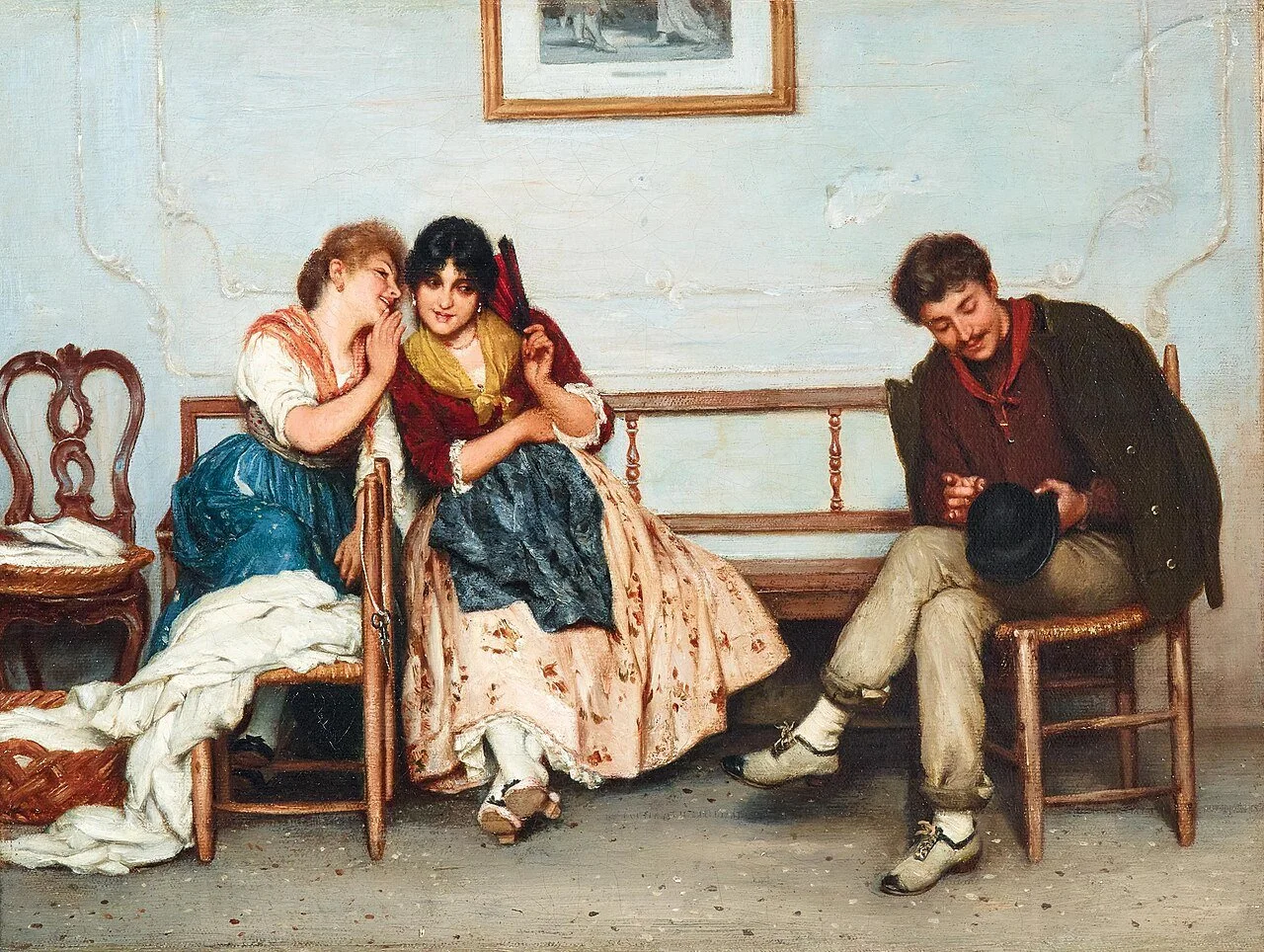
Eugene de Blaas: Secrets (Wikimedia Commons)
Today was a disappointing day. One of those “oh dear, that nightmare became real” kind of days that feel surreal. At thirty-one, I have accumulated enough disappointments to look back on and see patterns. I have found that true disappointment lies not in what the universe dishes out, but in how I respond to the dishing. Did I pause or lash out? Did I learn, forgive myself, and move forward or wallow in a stew of self-pity and shame?
Life is full of disappointments. I do not mind them, nor do I expect otherwise. What I do mind is that, in American culture specifically, we keep our disappointments to ourselves. In Indian culture, people are quicker to express their disappointments. They are known to flippantly say, “I got married too young and I was never able to realize my ambitions.” Heavy, isn’t it? And yet it is shared freely, without shame or caveat. Such statements are not followed by “but my life turned out great.” There is an acceptance that some aspects of life have no silver lining and that is just fine. It is my belief that when we share our disappointments with one another, we accomplish much. Firstly, we rob them of their power because often what we keep secret remains a source of shame. Second, it humanizes us, both to ourselves and to others. Expressing disappointment is an act of vulnerability and, usually, if we allow ourselves to be seen by others, they are more likely to show themselves to us as well.
I am all for positivity, and am by no means advocating for everyone to constantly weep and complain. In fact, I dislike when people overshare because it feels performative, just like false optimism. I am simply interested in those genuine and intimate moments where we let down our guard and admit to another that we are neither perfect nor invincible, and indeed we too are capable of being sucker-punched by life.
I would go so far as to say that if one cannot express their disappointments to another, they are likely unable to metabolize disappointment at all. Now, if we cannot metabolize personal disappointment, how in the hell do we expect our society to metabolize disappointment? What I mean is, when our leaders and institutions — be they educational, media, financial, religious, governance, or health-related — let us down, if we each mourn and suffer privately and not together, how are we supposed to learn and evolve as a society? What are we to do when it’s not “a child left behind” but all of us?
If we do not metabolize disappointment publicly, we risk silent grief, which morphs into rage and populism. Disappointment is inevitable, but silent grief, also known as loneliness, is not.
Metabolizing Disappointment
During disappointments in life, I am prone to feeling a deep amount of sadness. It sits in my body, sometimes for days or weeks. I mourn my idealism and the loss of trust, but I do move on, sometimes in a mere 24 hours. Then I bumble through what happened, what was fair, unfair, and in my control. Then I share my disappointment with someone I trust, to think it through with them but also for comfort and companionship. Lastly, I sift away the sand and dirt to find whatever nuggets of gold or silver I unearthed in this effort. This the currency I take with me into the future.
I want to share with you, dear reader, two institutional disappointments I have felt recently.
Silicon Valley, Social Media, and Generative AI
In Silicon Valley, we encourage one another to look forward and never look back.
The only thing that matters is the future… I don’t even know why we study history. It’s entertaining, I guess—the dinosaurs and the Neanderthals and the Industrial Revolution, and stuff like that. But what already happened doesn’t really matter. You don’t need to know that history to build on what they made. In technology, all that matters is tomorrow.
– Anthony Levandowski, co-founder of Waymo and Google X (Source)
Not only is this attitude a denial of reality, it is a misunderstanding of Waymo itself. Waymo is not some spontaneous new phenomenon; it is an evolution in transportation. We evolved from vehicles pulled by horses to gas vehicles driven by humans to electric vehicles driven by a computer, and every change in transportation has had ripple effects on other aspects of human life, from the design of our cities to the way we think about distance, travel, and time. I so wish these teams had in-house philosophers or sociologists to shape the technology and its release into the market with more intention.
Mr. Levandowski is not alone in his mindset. Silicon Valley only ever wants to press onwards, come rain or shine. I am not opposed to this type of resilience, but sometimes I think we mistake pigheadedness for resilience. If we only ever “look forward”, we skip the important emotional work of pausing, reflecting, and learning from failure. A healthy society sits with its disappointments. We share them, and we learn together.
I have personally been the most let down by Facebook. It was the Silicon Valley success story while I was at Stanford between 2012 and 2016. Everyone wanted to work there because it had the secret sauce. You would get to build a more connected and democratic future with smart, passionate people while getting rich (I can still picture President Obama sitting next to a young Mark Zuckerberg at the Facebook Town Hall in 2011).
Unfortunately, this was too good to be true. In their desperation to be a billion-dollar company, they designed the business model for how to surveil users, frack attention, and sell data at scale. The degradation of democracy and human rights was avoidable — including the disastrous information ecosystem we find ourselves in.
Have we heard Meta’s leaders express regret or disappointment? I want to hear their grief and regret, but I also think we need to create the cultural conditions for this to be possible. In our current climate, another’s vulnerability becomes leverage, which only leads to more people with their guard up, grieving their failures in isolation.
The mistakes that were made with social media were, in part, moral failures which we clearly have not metabolized as an industry because I see us making the same mistakes with generative AI. However, instead of banning the technology altogether or flying “full steam ahead”, can we consider two lessons from the disappointment that has been social media? The first lesson being, addictive digital products alienate people from themselves and one another. They cause more loneliness and less community. The second lesson is that data privacy is nonnegotiable in a free society.
The American Dream
I can name person after person who is living the American Dream. I see it all around me. I am not speaking only of economic mobility, but rather of agency and the opportunity to experiment and forge a unique life path. My parents, in-laws, and extended family have done exactly this, which would not have been possible in India. I know so many immigrant women who want to live in America, not their motherland, because of that so very coveted agency and dignity that all people seek.
For many, however, the American Dream has failed them. Whether it is economic or cultural disenfranchisement, the institutions have let them down. I have not experienced disappointment on such a catastrophic plane, but I can imagine it causes immense cynicism, rage, and apathy. The people’s disappointment needs to be taken seriously, and not just the disappointment of factory workers in the Midwest but the disappointment of women who want access to abortions, parents who work multiple jobs to provide for their children, Black and Latino youth who want access to high-quality education and employment, college graduates who were promised stimulating careers in knowledge work, and so many more Americans that I need not explicitly name.
My wish is for all this disappointment to be aired out in peaceful and life-affirming ways that bring people closer to one another. This care we can show for each other is cultural kindling for national hope.

Eugene de Blaas: The Veiled Woman (Wikimedia Commons)
I Simply Cannot Do It All
I am still afraid to be fully seen in my disappointment. I put positive spins on failures rather than admit that, sometimes, life just sucks. A great disappointment recently was realizing that, while on the cusp of motherhood, I simply cannot give attention to everything and everyone all at once.
I am limited to watering one priority at a time.
With my new baby comes less time and energy for writing, reading, family, friends, civic engagement, hiking, cooking, travel, you name it. So here I am, grieving with you publicly, dear reader, on the limitations of reality. I simply cannot do it all. Will you forgive me?
*Read more of this author’s writing on her Substack.
*The opinions of contributing writers are their own and do not necessarily represent the views of We Are One Humanity. Submissions offering differing or alternative views are welcome



Listening to many roots in a restless, unfinished democracy