
Dominance and Contradiction: The Pitfalls of Right-wing Politics
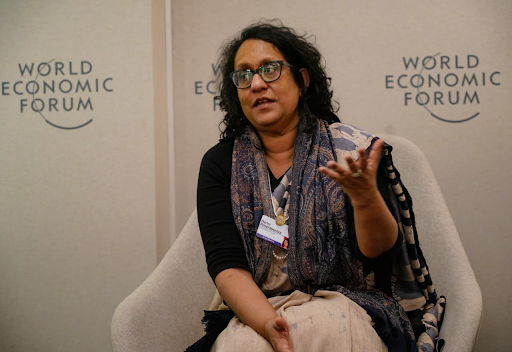
Sri Lankan Prime Minister Harini Amarasuriya at Davos (Photo: Office of the Prime Minister of Sri Lanka)
Listening to Sri Lankan Prime Minister Harini Amarasuriya at the recent World Economic Forum in Davos, Switzerland, I was heartened to hear remarks about inclusivity, women’s participation, and open-mindedness, which I think are missing from political discourses in the Global North. The World Women Davos Agenda 2026, in particular, featured important interventions from her, including her point that patriarchy has ruled the roost in world politics and the shifts we are seeing today.
Patriarchal right-wing politics has always had a particular vision of and for the world. You may contest it, as I do, but that vision has, especially over the last 10 or 15 years, congealed into a certain pattern. The bottom line among most right-wing politicians today is this: that empathy is for weak, stupid people, that inclusion is woke, and that power is the ultimate aphrodisiac. That last line isn’t mine, incidentally: it’s Henry Kissinger’s.
This is why Prime Minister Amarasuriya’s remarks were a breath of fresh air. Sri Lankans have not heard leaders making these interventions for a long time. That shows how the ideas of the right have gained ascendancy – ideas which, for better or worse, have dictated not just our conception of the world but also influenced voting choices. It also reveals the essential weakness of those ideas – how easily they can be ruptured.
“I Like Power”
Of these ideas, the most pervasive is the notion that empathy is meaningless. This is what drives much of the anti-immigration rhetoric of the West and anti-minority rhetoric of certain countries in the Global South: that for too long, these countries have kept their borders open to the worst elements from the rest of the world. When we are generous and kind, we are actually being weak. The role of popular politics should hence be to reverse these trends and shut down our humanitarian instincts.
Growing up in Sri Lanka, which has a history of right-wing and populist politics, I have found it hard to reconcile what I learnt as a child with what I encountered on political platforms and spaces later on. It’s as though being open and having an empathetic mind toward “others” was perceived as a sign of weakness.
Perhaps that’s just as well, because the current discourse on the right is that being inclusive is a drawback; that women’s issues, or minority issues, do not matter; that what matters is power and power alone, no matter how you get it.
At one rather memorable event months before the 2024 presidential elections in Sri Lanka, the then President was asked what he liked: “Beer, whiskey, wine, or gal [a local alcoholic drink]?” The question was raised by two popular male podcasters. Pat came the reply, which I felt was typical at the time: “I like power.”
The Contradictions of the Right
Perhaps the biggest critique one can make about right-wing political ideas, of the sort that have taken precedence in the US under Donald Trump, or the UK under Nigel Farage, is that they have a vision of the world, but no vision for the future. Those on the left, and even the center, frame the future along concrete lines: the left with their discourses of equality and social justice, the center with their emphasis on compromise as the way forward. For all their belligerent machismo, this is exactly what the right lacks.
I can speak with some authority about how all this is impacting Sri Lanka. Here, too, I come across troubling signs of online misogyny, indeed misanthropy, becoming a norm. Videos of prominent right-wingers – including Andrew Tate and the late Charlie Kirk – are more popular and pervasive than the statistics will tell you. At the heart of this popularity is the view that dominance is the only way to power.
This is the only point that explains the contradictions at the heart of outfits like Make America Great Again (MAGA). The Pam Bondi hearings were a painful, if necessary, reminder of just how incapable right-wingers are in talking to the room. Deflection is a strategy that right-wingers resort to time and time again: no less a person than Donald Trump does it, at countless press conferences. Deflection is becoming the knee-jerk response of Sri Lankans who buy into these right-wing ideas as well.
It’s hard to rationalize the thinking that drives such attitudes, especially in a country like Sri Lanka. For instance, it’s taken for granted that something as harmless as sex education is part of a wider “woke” conspiracy to poison young minds.
For the longest possible time, such ideas were seen as “Western conspiracies”, usually funded by outfits like USAID. This was why rightwing circles here celebrated Trump’s and Elon Musk’s gutting of USAID, and Musk’s continuing denunciation of that outfit – including that claim about USAID teaching Sri Lankan journalists how to avoid “binary-gendered language” – whatever that meant.
The problem with right-wing politics as it stands today is that such claims are recycled and regurgitated without scrutiny. The notion that these initiatives are, as Musk puts it, a “crazy waste of your tax money”, is hence taken up and accepted.
Yet almost no questions are fielded about what follows – namely, where the money that was saved from cutting such programs went to, whether it will indeed be a saving of taxpayer money, or whether it will go into more wasteful initiatives, one conveniently hidden from plain sight. I believe this strikes at the key weakness of right-wing populist politics – that it tells us only how the Left and Center are doing wasteful things, but fails to offer an alternative vision for the future.
And that is the fundamental weakness of these ideas – that they all have fragile foundations. In Sri Lanka, right-wing cults – whether on the political, social, cultural, or economic front – have largely been androcentric. This has given them some leeway. Yet lacking a proper vision for the future, they can only flounder when their contradictions are laid bare – as the needless displays of machismo in the US, with the ICE raids and President Trump’s attacks on independent institutions, or the Bondi hearings, show.
The Need for a Better Future
Sri Lanka is currently under a center-left administration, and the wave of support that it encountered last year tells us that there is hope for an alternative vision, a vision that is more empathetic, which does not dismiss open minds as weak.
There is still a tendency to associate power with machismo, and this drives right-wing ideas today, here. Yet, as Trump and his ilk in the US and the West have revealed, such ideas are incapable of surviving into the future. Either of two outcomes is possible: these ideas will implode, or they will take down the world with them.
For the sake of our future, I can only hope that the former, not the latter, comes true.
*The opinions of contributing writers are their own and do not necessarily represent the views of We Are One Humanity. Submissions offering differing or alternative views are welcome


Listening to many roots in a restless, unfinished democracy