
When We Fight for What We Love

Pieter Brueghel the Elder: The Tower of Babel (Wikimedia Commons)
Over the weekend, in a sun-soaked apartment, my close friend and I did pelvic floor exercises. We took deep breaths to unlatch new degrees of movement.
“Not everyone can tell, but I’ve changed a lot in the past few years,” I confided in her.
“How so?”
“I’ve found myself shifting away from slogans. Yes, I want ICE out, but I also want to find other ways to say ICE out.”
“Why?”
She always knew what to ask.
“Slogans are just so… boring,” I confessed.
“What are you going to say instead?”
“Well, let me ask you this. Do you think it’s possible to hate ICE but not love the people they are targeting?”
“Yes.”
“Do you think it’s possible to love the people they are targeting and not hate the agency?”
“No.”
“So, do you think the heart of our struggle in America is learning how to love one another again?”
She rolled onto her stomach and let her head rest on her arms while she looked at me.
“Do you think we have ever known how to love one another?”
I smiled at her head of curly brown hair. The conversation had just gotten interesting.
Decent and Indecent Language
As a fluent Kannada speaker, it is all too obvious to me that language contains worldviews. In Kannada, for example, we do not say “I am sad,” we say “sadness is happening to me”, which positions the self as dynamic versus static.
A decent language can breed a decent culture, which we can all agree is desirable. What is considered decent? Well, the language I gravitate towards is clever, vivid, and lyrical, but it could still be indecent. It is the language of Charles Dickens, Toni Morrison, and Arundhati Roy. Decent language is in its own category. It can take many forms across race, gender, and class, but at its core, it is thoughtful and humane, above all else.
It is my belief that during the Obama presidency we shifted towards a decent national language. It was also calm and erudite, much like him. Phew. This language permeated the Democratic Party, press and the internet and, because language travels across boundaries, it seeped into us regular folk.
Then, in 2016, Donald Trump exploded onto the scene and gave us permission to unleash our unfiltered thoughts. His language, both online (his Twitter handle) and offline (his podium during rallies), made America foam at the mouth. He gradually expanded his influence across American language with shocking words, buffered by comedic delivery. He encouraged not free speech per se, but mindless speech, and so we saw a resurgence of inhumane language that I had thought vanquished. Indecent language, and therefore culture, became fashionable.
Now, we are in the eye of a storm that started ten years ago and we have another three years to go. After President Trump, will Vice President J.D. Vance carry the torch? I believe so, and his indecency is far trickier to name:
“What unites Islamists, gender studies majors, socially liberal white urbanites, and Big Pharma lobbyists? It isn’t the ideas of Thomas Jefferson or even Karl Marx. It’s hatred. They hate the people in this room, they hate the president of the United States, and most of all, they hate the people who voted for him... This is the animating principle of the American far Left. They are arsonists, and they will make common cause with anyone else willing to light the match.”
- Vice President J.D. Vance, 2025
Vance does not make clear who or what is considered “far left”, even though it is his responsibility to do so. I know what he’s “getting at”, for example “Islamists” is likely a code for the vehemently pro-Palestine and “gender studies majors” means queer feminists, but in truth, our Vice President (yes, he is our Vice President, whether we like it or not) has named caricatures and not real people. He artfully weaves stereotypes into a coalition and names them as the enemy and their ideology as a kind of monstrous “hate” that wants to burn the world down. I expect more precise and humane language from a Vice President and am not willing to accept less.
Now, let us forget the politicians and look one another in the eyes. Poor Mr. Vance is heir apparent to the MAGA movement and burdened by this great responsibility. You and I, not so much. There is no need for us to be indecent towards each other. What is the way forward, towards a decent language and a humane American society? (The combination of ICE raids in Minneapolis and the release of the Epstein files has, incorrectly, made me feel like there is no decency left in the world.)
Decent language is the precursor to a decent world. In my version of Genesis it is written:
God said, “Let there be language”; and there was light.
God said, “Let there be light”; and there was language.
Who is the Enemy?
The events unfolding in Minneapolis have gripped the nation’s attention and mine. It unleashes a flood of feeling in us, from sorrow and fear, to confusion, anger, and fascination. As with all news, it is told to us as a story with certain characters. Had you heard of the “domestic terrorist” and the “illegal alien”?
Surely Alex Pretti and Renee Good are not “domestic terrorists”, I thought to myself after watching footage of their killings. A terrorist is someone “who uses unlawful violence and intimidation, especially against civilians, in the pursuit of political aims”. Both of them were, indeed, unapologetic and even aggressive in exercising their right to protest (braver than I), but neither of them was causing “unlawful violence”, that too against civilians. In Alex Pretti’s case, he was actually protecting a civilian. But there is power in labeling them as “domestic terrorists”. It makes them the enemy on the inside. Do we accept this designation lying down or will we refuse them? Do we abandon America altogether, or do we stay and fight a battle on the intellectual plane?
The term “illegal alien” was codified by Ronald Reagan in 1986 and had been used in media and legal conversations for decades prior. In the 1970s, President Jimmy Carter helped popularize the term “undocumented immigrant”, which The New York Times adopted. This push and pull over the term is proof that language is powerful and dynamic. Whoever controls language controls power in society because when you bend language to your will, you also bend reality. In truth, there is no “correct” term for those who cross the border illegally and build a life here. Both “illegal alien” and “undocumented immigrant” are accurate, the question is, which language is most humane towards the subject matter?
It is on us, the American people, to push for language that preserves the humanity of a subject matter, which in turn preserves our own humanity. To me, this is what it means to fight for what we love.
Bad Bunny at the 2026 Grammys, “We don’t hate them. We love our people, our family”.
A Language of Love
Regarding ICE and Minneapolis, this moment undoubtedly looms large, but it is also part of a continuum. It is part of the larger question of who belongs in America and which Americans’ well-being matters. Does America belong to the wealthy or the majority? Will it belong only to the White or to all of us who claim the identity “American”? Here again I look to the power of language and how language unlocks our imagination. In Britain, for example, I would be a British Indian (no hyphen). Here in America, I am Indian-American which is its own category of person. But what if I drop the hyphen? I would be an Indian American, which is an American who happens to be Indian.
Whoever controls language controls power in society because when you bend language to your will, you also bend reality.
Let us take it a step further — what if I am just an American? After all, I have no legal ties to India, not even an Overseas Citizen of India card. When I drop the hyphen I am not dropping my food, language, skin, clothes, holidays, music, religious identity, or Eastern values. I am, instead, beckoning all of this richness into America. And why not drop the hyphen? It is not always necessary to wait for the welcome mat to be rolled out, and as Frederick Douglass said, “If there is no struggle, there is no progress.”
I am, indeed, delighted to be part of the Indian diaspora, an Oregonian, and a Northern Californian, but I want to feel like I belong in this country as well. I want to feel like there is a place for me in our national imagination; a place for a creative, kind, and nature-loving socialist. This brings me to my original question, who is a friend and who is a foe to America? Who is the American worth protecting and who is disposable?
I have to come clean that for the last ten years I have had rage in my heart. Rage against different demographics that I learned to see as the enemy. I know what it means to hate, or nearly hate, an entire category of people. How I felt back then was the result of living in too insular an environment. So, it is because I have traversed a formidable terrain to arrive at where I am today that I know the value of redemption. One does not abruptly arrive at a language of love, it is the reward at the end of an expedition.
I was happy to see this baby reunited with his father, and I believe that the language of love, which will be the language of the future, is one that cradles life as precious as this.
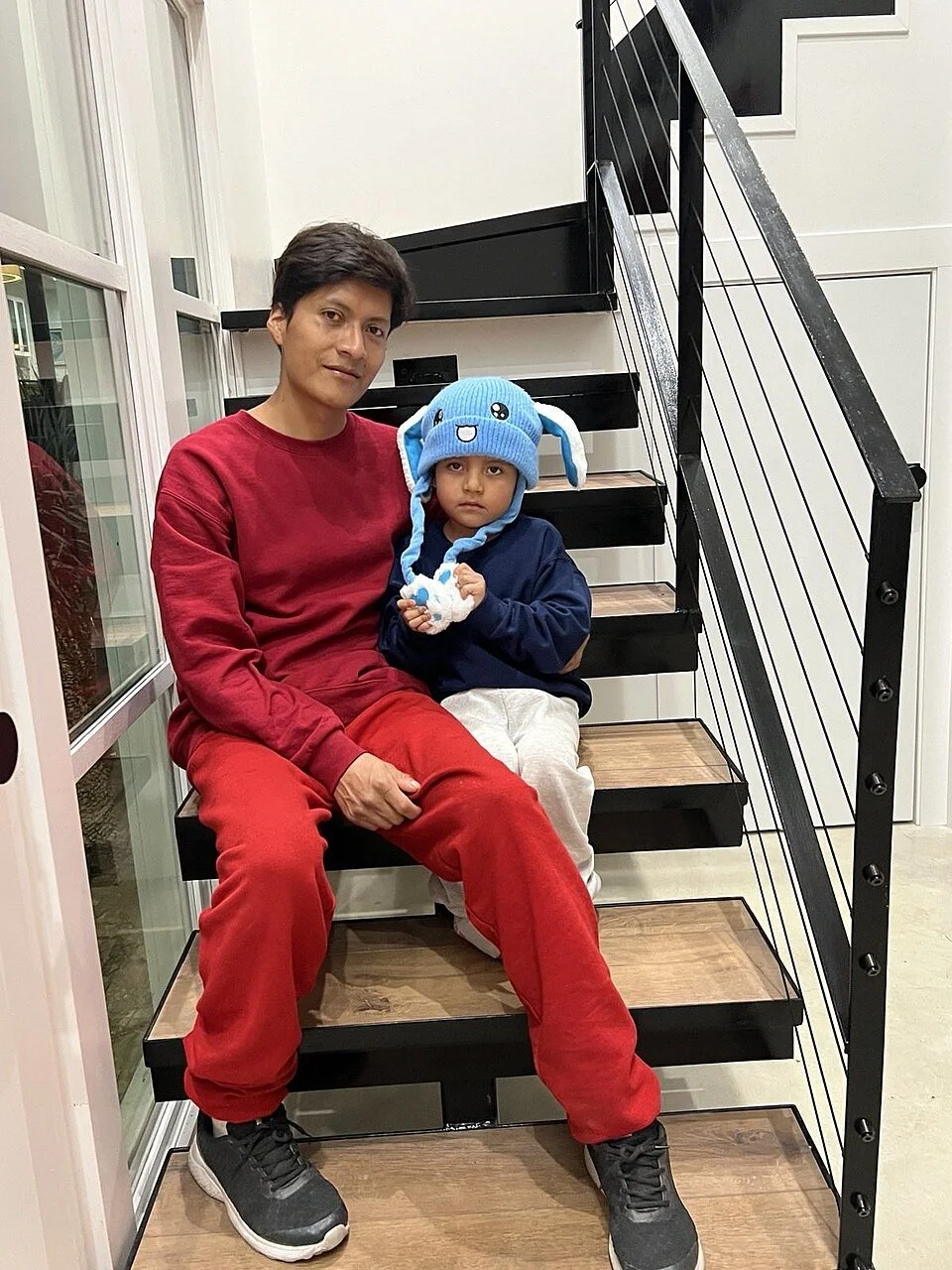
Adrian Conejo Arias and his son, Liam Conejo Ramos, after being released from ICE detention
*This article is being reproduced with permission. See more of Aishwarya’s writings on her Substack.
*The opinions of contributing writers are their own and do not necessarily represent the views of We Are One Humanity. Submissions offering differing or alternative views are welcome

Facing history's darkest truths can liberate individuals and nations