
The Year of Circles and Jagged Lines
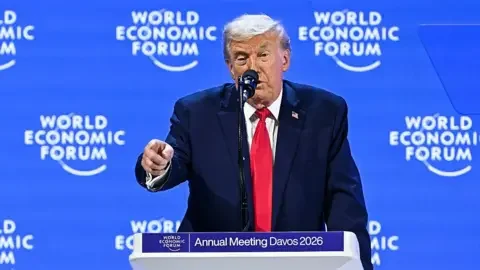
Trump at the World Economic Forum (AP News)
With Venezuela, Greenland, and now Iran, it seems like an entire year has gone by. It’s too early to say how these issues will sort out, or whether they will be sorted out anytime soon. Donald Trump is intent on holding on to Venezuela while praising Iranian freedom fighters and threatening Tehran of doing something – Trump-speak, of course, for severe military action – unless they go easy on protesters.
Meanwhile, María Corina Machado, leader of the Venezuelan opposition, visited him and shared her Nobel Peace Prize with him, even as the Nobel Centre reminded followers that the Prize “cannot be revoked, shared, or transferred to others.”
The latter incident, going by the Nobel Centre statement, echoes all the contradictions of this era. On the one hand, you have liberal critics of the Venezuelan government, who are eager to see the country see through a “peaceful, democratic transition” to a more democratic figure. In their minds, for better or worse, that figure is Machado. On the other hand, you have the Trump administration, which refuses to recognize anyone other than Trump himself as de facto – perhaps de jure – leader of Venezuela.
Sharing Trump’s X post on his meeting with Machado, a friend of mine quoted Antonio Gramsci: “The old world is dying, and the new world struggles to be born: now is the time of monsters.” We are living through an interregnum. And there is no better symbol of that interregnum than, on the one hand, Trump’s invocations of naked self-interest, and on the other, Machado’s cynically self-serving postures. Both reject the norms of the past. Both show themselves to be desperate.
Perspective Shifts
Despite these developments, however, there is still a tendency among officials to view things through the prism of the past. Western leaders, for instance, have been keen on framing the US invasion of Venezuela as a humanitarian operation. Hours after Washington abducted Nicolas Maduro and his wife, the EU, Canada, and other US allies tiptoed around the international law implications of the incident, focusing on Venezuela’s democracy deficit and the need to see through a transition.
Trump’s press briefing after Venezuela unraveled the pretense that his decision had to do with humanitarian concerns. He mentioned “oil” many times – almost 25 – that it is ridiculous to deny oil was his primary consideration. The press briefing was followed almost immediately after by his threats to annex Greenland.
There was a clear difference between Europe’s response to the Venezuela operation and to Trump’s threats over Greenland. Some Western leaders, like Canadian Prime Minister Mark Carney, got on the phone with María Machado, urging Washington to facilitate a transition even as Trump dismissed Machado’s claims. Ukrainian President Volodymyr Zelenskyy, feted for standing up to Russia, celebrated the Venezuela operation and called on Trump to get rid of other dictators the same way. This despite the growing congruence between Putin and Trump. Perhaps Zelenskyy was eager to placate the US President, at a time when US officials are openly saying they do not want to fund Ukraine further given that the war is happening in another continent.
Greenland evinced a very different response. So far, more than five NATO members have pledged assistance to Denmark. Trump has responded by imposing tariffs on these countries – which include Germany and France – and has dispatched a letter to the Norwegian government in which, among other things, he said he was no longer interested in peace after the Europeans failed to give him the Nobel Peace Prize.
As Trump threatens invasion and annexation abroad, he is provoking civil unrest and war at home. Days after the Venezuela operation, the killing of a legal observer in Minneapolis by ICE agents sent shockwaves across the US. While no foreign leader has criticized the killing, opposition politicians – including Ed Davey of the Liberal Democrats in the UK – have warned that Trump will replicate his actions in the US across the world. Trump has now threatened to invoke the Insurrection Act in response to protests in Minneapolis – though the Act itself, as a US political analyst noted in a Facebook post, does not give the president unfettered powers against protestors.
So far, the US President has not revisited his “51st State” claims over Canada. Analysts say it is a matter of time before he does. To its credit, Canada is not watching on the wayside. While Washington has threatened military intervention in Iran, and subpoenaed the Chairman of the US Federal Reserve, Canadian Prime Minister Mark Carney has flown to Beijing and met with Chinese leaders, including President Xi Jinping, eager to take forward what he frames as a “strategic partnership” between the two countries. It is clear that Canada is hedging its bets and sees China as a counter to Washington: something Carney noted when he spoke of a “new world order.” He echoed this in a more resounding speech at the World Economic Forum in Davos.
The Year Ahead
All that makes 2026 a consequential year. January has laid the foundation for a turbulent 12 months ahead. For that reason, those who view geopolitics through the old prisms and vantage points would do well to listen to Trump. For better or worse – I am inclined to say for the worse – it is he and his administration that will spell out how the world should operate. Depending on how the world responds, he will escalate things until he gets what he wants – be it US dominance, or the Nobel Peace Prize.
If there is one takeaway from all these developments, it is that Trump does not care to distinguish between ally and enemy, as conservative and liberal presidents of the US did until recently. The distinctions of the past do not matter to him: he is out to get a deal, and with the powers handed to him, he will do anything to secure it, whether in Cuba, Venezuela, Iran, or Greenland – or for that matter, Canada.
These developments also show that Trump will cajole and coerce Republicans to do his bidding. No matter what they may say in private about the repercussions of his actions on alliances, when push comes to shove, they will vote with him.
This has raised questions about his America First policy, and whether he is sticking to his Make America Great Again (MAGA) pledges. Critics who charge him with deviating from his agenda have their own reading of it. For Trump and his allies, however, “America First”, at this point, can mean anything and everything.
Thus, in the same breath with which it dismisses the Russia-Ukraine War because it’s unfolding on another continent, the US spews rhetoric of reclaiming the “Western hemisphere” via Greenland. Those who thought America First meant no more “forever wars” and outside interventions have woken up and are waging a battle. It is a battle they may lose, but one which they will have to sustain till the end.
Meanwhile, Trump’s actions in his second presidency – including his appointment of old guard Republicans who, during his first presidency, clashed with him – show that he is trying to win the core of the Republican Party and is coveting them. There is a reason for this. If his first presidency taught Trump anything at all, it is that without the support of the old core, he risks alienating the party. He needs them as much as they need him. So he speaks to them, adjusting America First rhetoric to suit them.
In the final analysis, the US is making it nakedly clear that it looks at human rights and democracy through the lens of self-interest. It treats both “autocrats” and “democratic alternatives” with equal contempt. While Democrats are pitted against him on these issues, Republicans are with him. By silence or action, the West seems to be complicit in what he is doing, though the world is slouching towards war. As Europe’s response to Trump’s Greenland claims shows, it is struggling to rationalize Washington’s actions within a framework, even as Trump shows that he does not care for squares and straight lines. It has yet to realize that this is the year of circles and jagged lines.
*The opinions of contributing writers are their own and do not necessarily represent the views of We Are One Humanity. Submissions offering differing or alternative views are welcome
More stories from We Are One Humanity

Facing history's darkest truths can liberate individuals and nations