
America in the Crosshairs
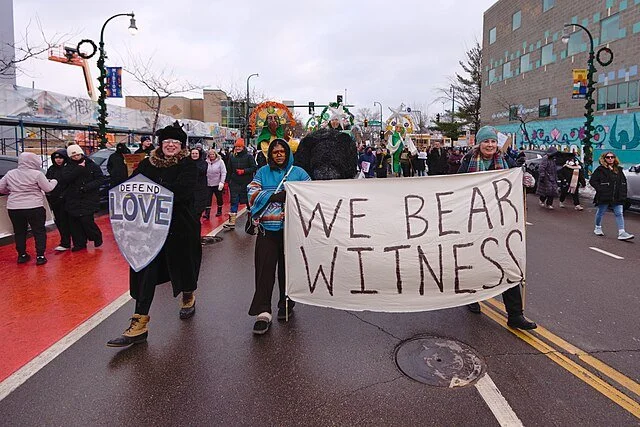
Thousands of people protested against ICE in Minneapolis, marched down Lake Street, and stopped at the spot where ICE killed Renee Good on January 7, 2026 (Wikimedia Commons | Fibonacci Blue)
On January 24, as she announced the program at a packed Cape Symphony performance in Hyannis, Massachusetts, Maestro Alyssa Wang introduced a work by Arnold Schoenberg by describing his situation as a Jewish composer of modernist music in Berlin in the 1930s. With Hitler’s rise to power, Schoenberg’s music was declared “degenerate,” and as he watched the increasing persecution of other Jewish people, he chose in 1933 to emigrate to the United States, a land that stood for tolerance and freedom of expression. Wang urged her audience to bear in mind that Schoenberg’s Chamber Symphony No. 2, completed in 1939, was written against a backdrop of persecution and exile from a democratic state that had fallen captive to fascist thugs.
Schoenberg’s situation speaks to our own today, said Wang. “This morning I looked at my phone and saw…” Before she could finish her sentence, emotion overwhelmed her. Twelve hundred people waited for her to regain composure, and then the majority applauded when she likened the shooting of Alex Pretti of Minneapolis that morning to events in Germany in the 1930s. Some might argue that the world of music is one where we can and should remain politically neutral. Wang decided on Saturday that the world of music would call out fascism when it sees it.
This vignette from a small corner of the United States is significant because it captures in miniature what we are seeing broadly: the seriousness of our situation has mounted precipitously since January 1, and people who might have kept their views to themselves are becoming more vocal.
Speaking out Boldly Incurs Retaliation
Throughout Donald Trump’s first year in office, judges, journalists, politicians, and civic action groups have made their voices heard in opposition. But overall, pushback from the nation at large has been restrained and unfocused. No single person or even group has emerged as the clear hub of the opposition. The Democratic Party, which most would assume is the natural carrier of the torch of defiance, has been disorganized and floundering over whether it should move right or left.
A shift of the mood in America in recent weeks is due in part to the willingness of individuals on the national stage to be more outspoken.
Leaders who have recently criticized Trump’s bid to establish an authoritarian regime include Senator Mark Kelly, a veteran and former astronaut, who stated in November that service members “can refuse illegal orders,” a principle germane to military service. Senator Kelly’s statement was backed by Senator Elissa Slotkin and four House members. On January 5, Senator Kelly received a formal censure by Pentagon chief Pete Hegseth, who said he had taken steps to demote Kelly in retirement. Kelly responded:
“Over twenty-five years in the U.S. Navy, thirty-nine combat missions, and four missions to space, I risked my life for this country and to defend our Constitution – including the First Amendment rights of every American to speak out. I never expected that the President of the United States and the Secretary of Defense would attack me for doing exactly that.”
On January 11, after being served with a subpoena from the Justice Department relating to trumped-up charges that he was responsible for the misuse of funds in the construction of a new building for the Federal Reserve, Federal Reserve Chairman Jerome Powell issued a statement, including in part the following words:
“…this unprecedented action should be seen in the broader context of the administration's threats and ongoing pressure…This is about whether the Fed will be able to continue to set interest rates based on evidence and economic conditions—or whether instead monetary policy will be directed by political pressure or intimidation.”
And in Minneapolis, following the killing of Renee Good in her SUV on January 7 by an ICE agent who falsely claimed that he was in danger of being run over by Good, both Minnesota Governor Tim Walz and Minneapolis Mayor James Frey publicly condemned the ICE action and the federal government’s refusal to investigate it. Walz called upon the administration to pull "violent, untrained officers out of Minnesota" and to institute an official inquiry into the incident. Said Frey, “We're in a position right now where we have residents that are asking the very limited number of police officers that we have to fight ICE agents on the street….We cannot be at a place right now in America where we have two governmental entities that are literally fighting one another."
In response, the Justice Department is now investigating Walz and Frey based on an alleged conspiracy to impede immigration officers.
Civil Protest
Articles that probe the effectiveness of civil protest cite the research of Erica Chenoweth that shows that if 3.5% of the population engages in civil protest against a regime, that regime will fail. But this proposition must, surely, depend on the level of respect a regime has for free speech, the nature of the matters being protested, and the degree of investment the regime has in its policies. Also upon whether all levels of government are equally involved in the oppressive behavior. In Iran’s recent violent crackdown of January 9-12, 6,126 people died, according to National Public Radio, which gives pause to casual pronouncements about the value of protest. A recent article in the Guardian suggested that protest is not so likely to bring immediate change as it is to give people confidence to get involved in other kinds of civic action as a result. In other words, in the right circumstances protest raises people’s energy and excitement and sense of solidarity in the endeavor to bring change.
In the US, we have seen national protests every few months – on October 18, more than seven million Americans were on the streets in a nationwide non-violent demonstration. But 48.3% of all voters opposed Trump at the ballot box, and some who voted for him have expressed regret. 61% of Americans believe ICE and Border Patrol tactics against immigrants have gone too far. Why has the ring of national civic protest seemed so muted?
One answer to this question is that those leading protests are conscious that after the death of George Floyd in Minneapolis in 2020, violence and burning of buildings and calls for “defunding the police” created a backlash. Republicans have used the events following Floyd’s death to give “protest” a bad name. “Peaceful protest” is a form of free speech, and US law protects it as such. But if it gets out of hand, it can easily be used as an excuse for a violent response from the authorities. In Trump’s America, protests that tip into violence will quickly become an excuse to invoke the Insurrection Act and, as a result, bring the military into our cities.
Civil Rights organizations have therefore tried to keep the temperature low. Organizations like Indivisible, MoveOn.org, and Standing Up for Racial Justice (SURJ), as well as churches and other faith-based groups, are in regular online communication with their followers nationwide, have created local chapters, and have joined together to organize national standouts every few months. They have urged people to concentrate their efforts locally by contacting their representatives in the state and federal legislature to urge them to vote on particular bills, and by supporting immigrants in the face of the misuse of deportation norms and laws. These groups underline that the most effective protests have a clearly stated target and therefore are best designed to address particular local situations.
Los Angeles, Chicago, and several other cities where ICE activity has been pronounced have used these networks to push back. But something about Minneapolis has made things qualitatively different.
Why Minneapolis?
Minneapolis-St. Paul is a region well known for its ethic of social support, drawing on its Scandinavian social-democratic heritage. But in addition, the offensive nature of the ICE/Border Patrol presence is much greater than that of federal agents’ activities in other cities.
Greater Minneapolis-St. Paul has currently 3,000 federal agents deployed since January 1, specifically to round up immigrants. The number is five times the size of the Twin Cities’ police force. Trump’s deployment of National Guard and Marines to Los Angeles last year numbered 4,200 National Guard and 700 Marines. But the population of the Greater Twin Cities is less than a third of that of Los Angeles County. In other words, the proportion of troops per capita deployed in the Twin Cities is more than twice that deployed in LA last year.
Large numbers of masked ICE and Border Patrol have been roaming neighborhoods, sitting in their parked vehicles outside buildings where immigrants live, forcing adult immigrants out of their cars while leaving children in the backseat, and requiring people to produce proof of citizenship on demand, which violates federal law. Many of their actions are illegal, but they also upend longstanding norms where deportation of illegals who have committed criminal acts is done with the utmost effort NOT to disrupt neighborhoods. Many reporters have concluded in the past three weeks that the intention of these federal agents, who have been assured that they will be immune from prosecution if they resort to violence, is to strike terror into the population and further the establishment of an authoritarian regime.
But the killing of Renee Good on January 7, followed by the fatal shooting of Alex Pretti on January 24, has seriously raised the stakes in Minneapolis. Video footage shows that while these two individuals may have been unwise to get very close to ICE activity and to take actions that drew the attention of ICE agents, they were not engaging in criminal behavior. Federal authorities have resorted to lies to defend their agents’ aggression, as amply demonstrated by video coming from a number of onlookers.
Assessments in the American Press
“We are witnessing the total breakdown of any meaningful system of accountability for federal officials,” says David French on January 26 in the New York Times, in the body of an article headlined “We Are Creating the Conditions for a Catastrophe.” Charles Homans writes in this weekend’s New York Times Magazine under the headline “Watching America Unravel in Minneapolis.” Says New York Times guest columnist E. J. Dionne on January 25th, “Trump Is Engineering Regime Change, Right Here at Home.”
FoxNews.com reports that Vice President Vance has dubbed the Minneapolis situation “engineered chaos”. Fox dismisses Pretti as a member of a “complex network of far-left organizations with a wide range of causes.”
The American Prospect declares that “Minneapolis Discovered Its Own Strength Fighting ICE Tyranny.” It highlights in addition “the Democrats’ long-awaited spine” noting that Pretti’s murder on January 24 has united the Senate’s Democratic Caucus to oppose funding the Department of Homeland Security, the owner of ICE, until “strict and enforceable limits are set.”
And Minnesota Republican gubernatorial candidate Chris Madel has announced he is leaving the governor’s race because he cannot support the “stated retribution on the citizens of our state, nor can I count myself a member of a party that would do so.”


Facing history's darkest truths can liberate individuals and nations