
A Man Worth Fighting For
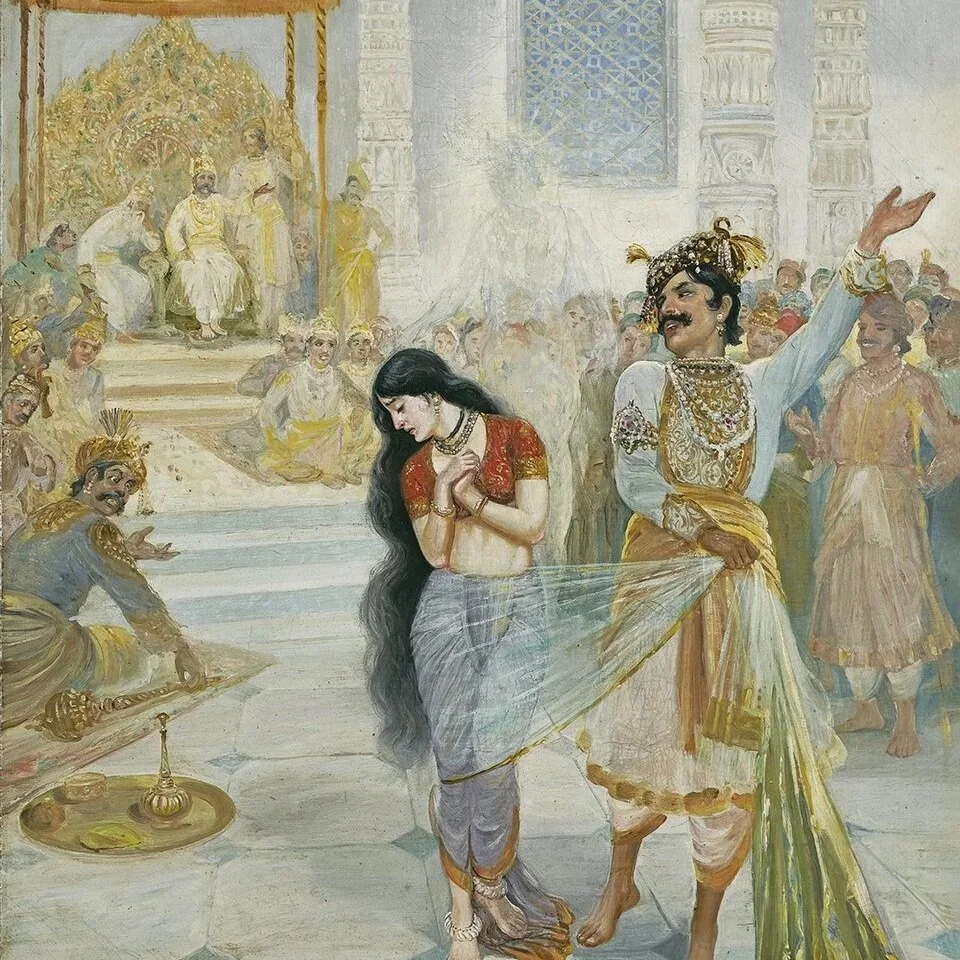
Disrobing of Draupadi by M V Dhurandhar, c. 1922 (Wikimedia Commons)
These days I think quite often about America, India, and the global stage. What kind of a nation is America today and what is it becoming? What about India? Around me, here in San Francisco, is a swirl of conversation about technology, war, democracy, and culture. It makes me wonder, is a nation made great by advancements in these areas? But then my mind naturally drifts towards my area of interest — people. Whether it is technology, war, democracy, or culture, it all comprises the decisions and contributions of people. I generally write about women. This time I want to write about men. What kind of men does a great nation require? I’ll stick to the two nations I know fairly well, America and India.
Reading the Mahabharata as Subversive Text
The abolition of slavery and the civil rights movement reshaped the United States. India secured independence through satyagraha and ahimsa. In 1960s America and 1940s India, the people bent the nation toward a moral horizon. Christianity and Hinduism gave both movements, and the people, the spiritual courage to struggle. Religion feeds culture, culture expands religious practice, and we enjoy the remarkable fruits of that period today.
Nowadays it seems that Christianity and Hinduism are tools for tearing down what they once propped up.
In modern India, Hindu fundamentalism rules. It dictates who India belongs to and how everyone else is to be treated. I am related to about one hundred believers in this ideology. I have discussed issues of religious freedom with them, and it is clear to me their religious faith is entwined with bigotry, which indelibly shapes their moral character.
During the Swadeshi movement for Indian liberation, Hinduism gave the people an inner strength. Now it gives them a perverted kind of strength. Perhaps we cannot call it strength at all. It gives them a sense of superiority, is more accurate. It validates their need to feel superior. Men in my family might laugh at a woman like me who writes entire newsletters on feelings, but what they don’t realize is that I am writing about the very matrix in which they live.
Hindu men, and particularly Brahmin men, feel good about themselves because of their Hindu-ness, male-ness, and Brahmin-ness.
Rather than becoming enlightened minimalists who serve society — the path of the Hindu swami — Hindu men, and particularly Brahmin men, have become more self-absorbed and concerned with wealth and power. Their Hindu-ness, male-ness, and Brahmin-ness all become tools for serving these ends. In such a time as this, what is considered nuanced and sophisticated religious text can easily become propaganda. That is what we see has happened to the Mahabharata.
The Mahabharata is an ancient Hindu epic about the Kurukshetra war between two clans of cousins, the Pandavas and the Kauravas, fighting for the Hastinapura throne. At the heart of the story is a beautiful woman named Draupadi who, like Helen of Troy, is the spark that ignites the war. Draupadi is wife to all five Pandava brothers. The eldest brother, the Pandava King, gambles away Hastinapura to the Kauravas, and, in an act of desperation, he also wagers his wife, Queen Draupadi.
The Kaurava leader — Duryodhana — is delighted to win Draupadi. Overcome with manly glee, he slaps his thigh and beckons her to sit on his lap in front of the royal court of men. Some say it was not his thigh he touched but a more centrally located organ. He then attempts to disrobe Draupadi by pulling her saree. She throws her hands in the air and prays to Lord Krishna who comes to her rescue. Her saree extends forever and poor, horny Duryodhana is unable to complete her humiliation,despite his best attempts.
It is easy to claim the Mahabharata as a story about violence, glory, sexual prowess, and fraternity. It is much more difficult to wrestle with its true central theme — Dharma. Dharma, or duty, is the moral logic that provided structure and order to the ancient Indo-Aryan world, which was an honor-based society.
For me, the war is not the center of the story, but Draupadi’s humiliation and the questions it raises regarding Dharma. In what kind of a society is it considered honorable to wager a woman? What are we to make of the silence of all the respectable men in the royal court who witnessed her humiliation but did not intervene? (The third Pandava brother, Bhima, is said to have at least roared in anger and swore to disembowel Duryodhana; a promise he keeps) Does Draupadi’s shame have no meaning in this society? If she, the adored queen of Hastinapura, was treated as such, what can we assume about the lives of ordinary women in the kingdom?
Hindutva men, living in 2026, are known to say “Duryodhana was not such a bad guy” and “what he did was not so terrible.” Draupadi’s humiliation means nothing to them, just as it meant nothing thousands of years ago to the court of royal men. This tells me that Draupadi’s humiliation is not an ancient scene. It is a modern, domestic one. Many Indian women still live inside a story where they are wagered, silenced, and sacrificed. We call it tradition, but really it is the preservation of male order — a system that stabilizes itself through women’s silence. A system in which men suffer too, given that they are unable to form healthy, happy bonds with women.
The Hindutva men are incorrect in their interpretation, of course, because there would be no Mahabharata if what Duryodhana had done was minor. The Lord God Krishna would not have intervened if morality was not amiss in this scene. To avenge Draupadi, the Pandavas (especially Bhima), along with Krishna, go to great lengths to win the war.
In this way, the Mahabharata can be read as a subversive text about the humanity of a single woman and how Dharma was wrongly interpreted by powerful men. This makes the Mahabharata not some text about Indo-Aryan greatness, but a treatise on the failures of Indo-Aryan society.
What About the American Religion?
I was raised in the Catholic education system and have respect for Catholicism, especially the Ten Commandments and the golden rule of “do unto others as you would have them do unto you”.
However, just because I respect aspects of the religion does not make it immune from my doubts. I was curious if there was a story in the Bible that mimics Draupadi’s humiliation and what that story might tell us about the foundation of the religion.
Well, I did find such a story and it’s called “Levite’s Concubine” (Judges 19-21). It is a story in the Hebrew (or Jewish) Bible, which is called the “Tanakh” or the Old Testament.
A Levite (a Jewish male from the Tribe of Levi) and his concubine are traveling through the city of Gibeah, which belongs to the Benjamite tribe. A group of “wicked men” in the city want to gang-rape the Levite. He gives them his concubine instead. The next day she dies. As an act of revenge against the Benjamite tribe, the Levite dismembers her body and sends her remains to the other tribes of Israel to incite their anger. This launches a war between the tribes and the Benjamites. Throughout this story, the concubine (who has no name) never speaks. Only the men speak, but she is the moral center.
Both Draupadi and the concubine are wagered between men and used as propaganda in war, and it is male moral authority that deems all this acceptable.
This is the same male moral authority that protects members of the Modi regime, such as former MP Brij Bhushan Sharan Singh and Lok Sabha member Prajwal Revanna, despite evidence of their sexual crimes. The same authority that tells Hindu men that raping and dismembering Muslim and Dalit women is honorable. The same authority that saw fit to repeal Roe v. Wade in the United States.
It Is Personal, Actually
I know many great men. They are men who see women as equals, and who know that greatness is not contingent on their ability to intimidate, humiliate, or control. They know it is not measured by the size of their bank account, organ, or influence. Wise men who know we are all measured in the same way — by our ability to know and master ourselves. To know when to listen, and when silence is betrayal.
They are half our population, ladies, and we cannot hope to understand ourselves, or life, without also knowing them. The greatness of any nation, tribe, or community rests in how tightly we are able to link arms and carry one another through life. I say this as a woman who has been carried by great men. Men of caring and sweet nature. My father is one of those men. So is my husband, father-in-law, and brother-in-law. It gives me comfort that these are the men who will help me raise my daughter so that someday when she asks, what makes a great man, I simply need point to them.
*Read more of this author’s writing on her Substack.
*The opinions of contributing writers are their own and do not necessarily represent the views of We Are One Humanity. Submissions offering differing or alternative views are welcome.

Facing history's darkest truths can liberate individuals and nations