
Trump’s Mission: A Weaker America
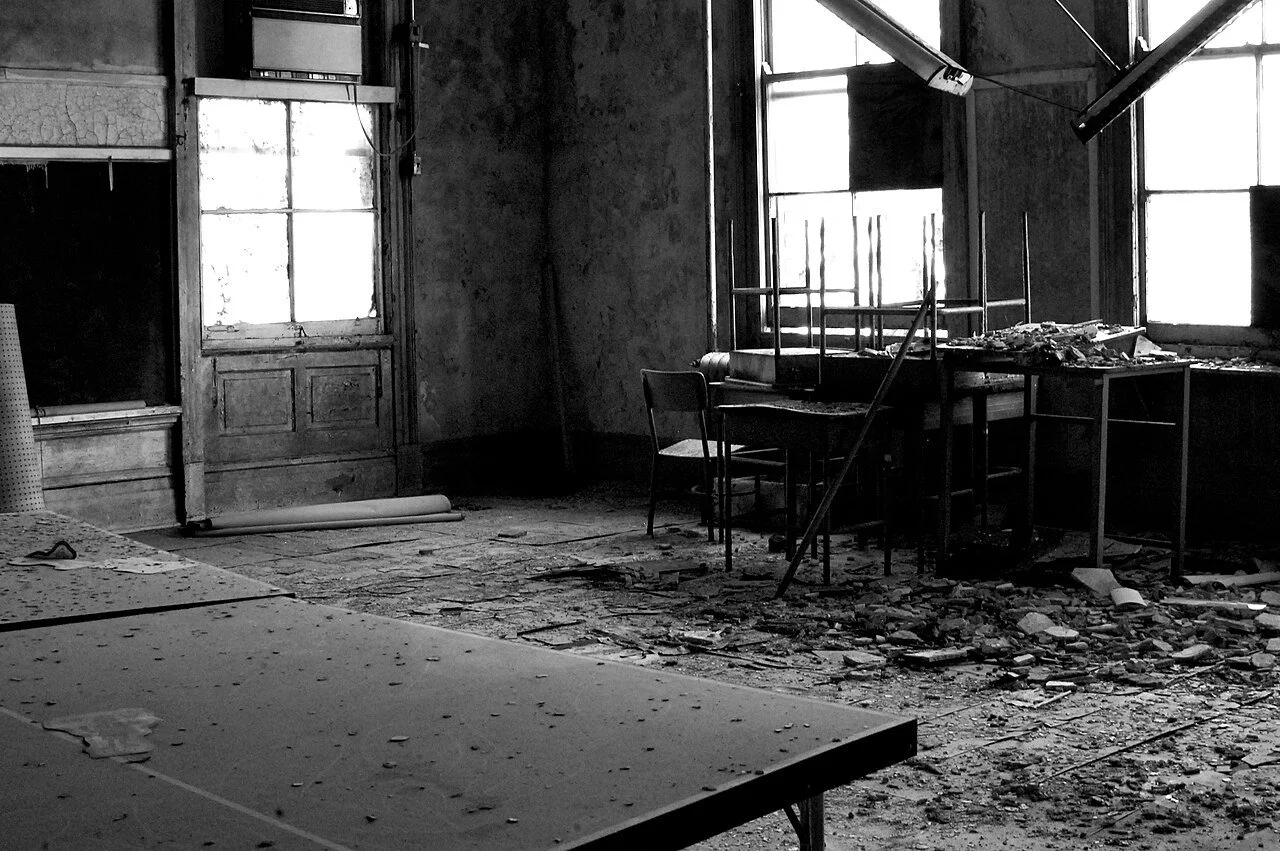
Abandoned art school (Wikimedia Commons)
At times, I’m struck by the way Donald Trump lays out his thoughts in the simplest, most accessible terms imaginable. Like when he told an audience at the Hope Through Education gala last September: “Smart people don’t like me.”
The feeling is clearly mutual—and it shows.
As the country grows more overwhelmed by the day, it’s hard to take a step back and critically look at Trump’s policies as a whole. But once you do, his intent on weakening America institutionally and economically becomes evident.
History shows that economic insecurity and ignorance erode a society’s capacity to resist—a pattern I recognize from my own background in Russia, where I saw how financial instability forces people to focus on immediate survival, leaving little space for political engagement.
Until late February, relatively low gasoline prices had been holding overall inflation down. Those days are gone: the war with Iran has already pushed up the cost of oil. And you don’t need a degree in economics to understand that higher gasoline prices drag the cost of many other goods and services up.
The daily cost of “Epic Fury” for the American people—most of whom oppose the operation—is estimated at around $1 billion. That’s money that could have gone to healthcare and SNAP.
Then there are the tariffs. Trump’s claim that foreign countries are paying for them is one of his most blatant lies. In reality, 90% of the tariff burden has fallen on American businesses and customers. The idea that U.S. producers can replace most imports is pure fantasy. Less competition and less supply lead to one thing: higher prices that hurt most while benefitting a corrupt few.
Unfolding in multiple directions at once is the overall push toward isolationism. In 2025, immigration to the United States dropped by more than 50 percent—and Trump is just getting started. Add to that nearly 230,000 people deported last year, and America's population is on track to stop growing through immigration for the first time in a century.
For a rapidly aging country in need of workers, the implications are straightforward: fewer immigrants willing to do low-paid, labor-intensive jobs means more disruptions and higher prices.
In a recent discussion with Nobel laureate Paul Krugman, historian Timothy Snyder suggested that the Trump administration is flirting with the idea of reverse-engineering the Great Depression, since they did not inherit a weak economy, and a crisis is something they desperately need to consolidate power. Agree or not, the assumption itself says a lot.
Another aspect of this isolationist shift is the shrinking pipeline of incoming talent. International student enrollment fell by 17% in the fall of 2025—a drop that translates into an estimated $1.1 billion loss in student‑related revenue. But who’s counting? After all, that’s about a day’s worth of bombing Iran.
One of the many reasons these numbers will fall even further is the new $100,000 fee now in place for the H-1B visa—the main path foreign students historically used to stay and work in the U.S.
At the same time, the United States is facing a brain drain of its own, with American scientists moving to Europe, Canada, and Asia amid budget cuts, uncertainty, and pressure on universities.
The result will be fewer global perspectives, fewer best practices, and less of the civic awareness that comes from exposure to the wider world.
Just as the demolition of the East Wing of the White House carries symbolic weight, so does dismantling the Department of Education. It signals a retreat from enlightenment.
Beyond that, January marked the ninth consecutive month of decline in international inbound travel to the U.S. The new requirement for visitors to provide their social media handles to the U.S. government before entering the country will only reinforce this trend. Meanwhile, stories of tourists detained by ICE continue to make headlines.
All of this is a tangible blow to Americans’ well-being. A 22% year-over-year drop in Canadian travel to the U.S. in 2025 alone drained around $4.5 billion from the economy.
And it’s not just travel. As public sentiment toward the U.S. is growing, understandably, more hostile, people around the world are withholding their money from American products as a form of protest. When even brands like Jim Beam have to shut down their Kentucky distillery for a year, you know the impact is real.
We can go on and on listing the policies that advance the plan to make America weaker—media takeover and the stuffing of institutions with loyalists will be the subject of numerous books—but we have yet to see a single one that runs counter to it.
It’s a lot to take in — and it’s meant to be. The overwhelm is part of the strategy. This is exactly what pushed me to write about the personal practices that keep me grounded. None of them — learning, gathering, protecting your mental health — solve everything. But taken together, these small practices can keep you upright in moments built to knock us off balance.
*The opinions of contributing writers are their own and do not necessarily represent the views of We Are One Humanity. Submissions offering differing or alternative views are welcome

A multireligious democracy