
Whose History?
In 2025, Uthpala Wijesuriya became the youngest fellow of the Open Society Foundations' Seven Cities Fellowship. His project examines how Sri Lanka's history has been reconstructed to serve the assumptions of those who wrote it.
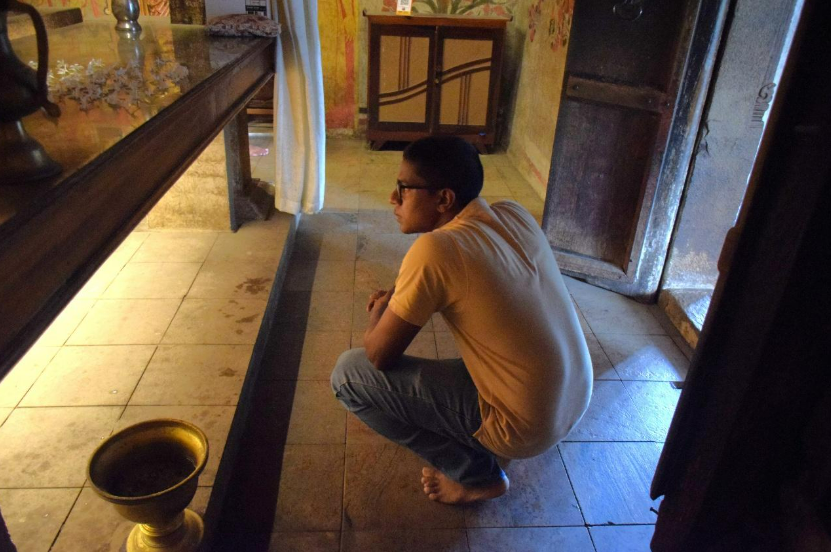
Uthpala Wijesuriya studying murals at the Ridi Vihare, a Buddhist temple at the center of his village, Kurunegala, 2023. Photo by Uditha Devapriya.
Growing up in a village in Sri Lanka, Uthpala Wijesuriya would frequently visit Anuradhapura on weekends and holidays with his parents.
One of the oldest capital cities in South Asia, Anuradhapura had stood for almost 1,500 years before being abandoned in the 11th century AD. It was later excavated by British colonial officials, who positioned themselves as custodians of Sri Lanka's past. Today it is associated almost exclusively with the island's Buddhist heritage.
These visits stayed with Uthpala. They also made him question things.
In March 2025, Uthpala was named a fellow of the Open Society Foundations' Seven Cities Fellowship, the youngest in its first cohort. His project, Five Sacred Sites, examines five historical sites in Sri Lanka that fall outside the usual focus of scholars — two in Kurunegala, three in Jaffna — as a way of probing how history in Sri Lanka has been reconstructed to serve the assumptions of a particular time, or a particular group. "We project our notions of ethnicity and religion to the past," he argues, "and reconstruct the past." His fellowship will produce both a documentary and a publication.
Uthpala is also a law student. He is 22 years old.
I first met him in 2020, at the height of the COVID-19 pandemic. He was, at first, my research assistant. Later, he became a colleague and a confidante.
A Traditional Upbringing
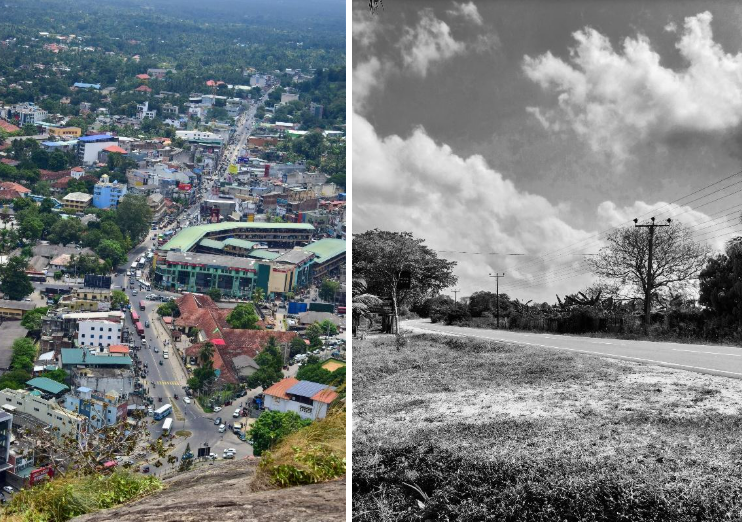
Left: Kurunegala town, 2018. Right: Mataluwawa, 2023. Photos by Uditha Devapriya.
Uthpala was born in the village of Mataluwawa in 2003. Mataluwawa was situated on the periphery of Kurunegala, and it lay close to Anuradhapura, an agrarian heartland which is associated strongly with Sri Lanka’s nearly 2,500-year written history.
With his parents, he would visit Anuradhapura whenever they had time, during weekends or holidays. Those visits would gradually spark his interest in Sri Lankan culture and history.
Abandoned in the 11th century AD, the city was excavated towards the end of the 19th century, when British colonial officials “rediscovered” it. This “rediscovery,” as scholars like Sujit Sivasunderam have noted, formed part of a wider project — it marked an attempt by the colonial government to prove that they could be trusted with protecting, preserving, and excavating Sri Lanka’s past, as supposed custodians of the country.
One of the consequences of these developments was that by the early 20th century, Anuradhapura was occupying a central place in nationalist discourses in Sri Lanka. Today the city is associated almost exclusively with the island’s Buddhist past and forms part of the so-called “cultural triangle”, encompassing two ancient and medieval sites: Polonnaruwa, which succeeded Anuradhapura in the 11th century AD as the capital city of Sri Lanka, and Kandy, the last standing kingdom in the country, which fell to British forces in 1815.
As Uthpala went about Anuradhapura, he read up more about the history of his country. The more he read, the more he questioned.
Like most of his peers, he entered Sri Lanka’s education system at an early age. Though completely free and accessible, most government schools in Sri Lanka taught subjects like language, religion, and history in circumscribed ways. Despite such limitations, however, Uthpala developed a love for these subjects.
In 2013, he took a special exam and secured a coveted spot at a premier school in Colombo. By then, his passion for history had grown considerably.
A New, Different World
Uthpala moved to his new school, Royal College, the following year. There, he explored his interests more widely. Colombo brought him into contact with the English language and a Westernized culture. He found this new environment daunting at first. Eventually, he began pursuing his favorite subjects. He soon found his way to leading research institutions in the city, including the National Museum, National Library, and National Archives. At these places, he discovered new ways of looking at history, culture, and society.
One of the biggest problems Uthpala faced was the English language. Back at his first school in Mataluwawa, English had been taught as a subject for a few periods a week. In Colombo, he had to deal with it every day, indeed almost every hour. Complicating matters further, his new school had students from diverse backgrounds. For many of these students, English was a first language. Among them were Uthpala’s classmates.
By the time he did his Advanced Level exams in 2022, he had progressed far. While speaking in English remained a challenge, he was confident enough to read and write. He wrote his exams in his language, Sinhala, but compensated for this by reading as much as possible in English. Moreover, at the time of his final exams, he had become a member, chairman, or secretary of numerous societies. Among these, not surprisingly, was the College history club. These activities helped him build networks and overcome his limitations.
A Young Researcher
Uthpala finished his exams in January 2023. The following month, he was appointed as a senior prefect. This was the topmost position a student could hold at his school. Soon he joined an elite circle of student leaders and began working with them.
In many ways, Uthpala felt like a fish out of water. Many of his peers were from privileged, Westernized, and highly sophisticated backgrounds. He was a product of a very different environment. Perhaps it was this which caught my eye. Whatever the reason, in 2023, when I began my research career, it was Uthpala who became my first assistant.
In his interview with a local newspaper, published after he received his Fellowship, Uthpala recalls how he worked in those first few months, balancing the demands of prefectship and research work. From January 2023 to October 2024, almost two years, the two of us worked on three projects: an upcoming historical publication on the Anglican Church in Sri Lanka, a collection of essays by a renowned political thinker, and an official publication on an educational institution.
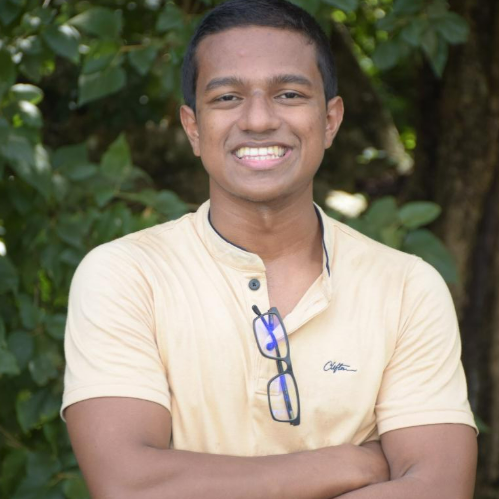
At Ridi Vihare, 2023. Photo by Uditha Devapriya.
Whenever we were free, the two of us would discuss our future and debate history, art, culture, society, politics, and other topics. By now he had enrolled at an international relations diploma program and was studying for his entrance exams at the Sri Lanka Law College. By February the next year, he had finished part of the international relations program and joined Law College. He had also qualified for a government university, the University of Peradeniya, which lay several hundred miles from Colombo.
It was during these conversations that Uthpala began to think about a research project of his own. Though he was focused on a career in law, he remained interested in culture and history. In January 2025, he reflected on these ideas and put them together in his application to the Open Society Foundations. Two months later, he was confirmed as a Fellow.
Rethinking and Reframing the Past
What makes these particular sites stand out is that they do not fit into the usual patterns of popular history in Sri Lanka. But that is precisely the point of the project.
Uthpala is clear that he is not seeking controversy. His concern is simpler: that history as taught tends to project present-day notions of ethnicity and religion onto the past, rather than understanding the past on its own terms.
This is intimately tied to Sri Lanka’s colonial history. As Uthpala put it: “One of the many legacies of colonialism here was that colonial officials, with very little understanding of the dynamics of our society, tried to interpret our history.”
“We have resorted to colonialist reframing of our history and put those in the service of communalist ideologies,” he added.
He does not want to divulge too many details about the project. But he is clear about what he wants to accomplish with it.
“Sri Lanka sits at a crossroads in the Global South,” he said. “Much of our history, and historiography, or the study of how history is written, read, and received, is rooted in colonial assumptions about identity and nationhood.”
This is a point which resonates deeply with my own work. As renowned historians like Sujit Sivasunderam and Nira Wickramasinghe have written, Sri Lanka’s past tends to be framed in line with colonial notions of history. In the early 20th century, for instance, Sri Lanka, then a British colony, witnessed numerous cultural revivals. These led to a consolidation of ethnic identity that, in the longer term, fueled tensions between certain communities.
What interests me more than these ideas, however, is Uthpala’s own transformation. While in Kurunegala and even in Colombo, he says he subscribed to certain interpretations of history “because they were inscribed in stone and we were supposed to accept them.” What is true of Sri Lanka in this respect is, I think, true of many other countries in South Asia, indeed the Global South. The tendency to associate a country or a society with one group, at the expense of others, starts with the classroom and in the textbook.
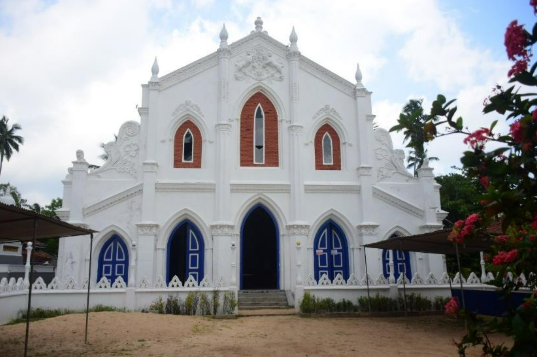
Sri Pushparamaya, a Buddhist temple partly built in the style of a Christian cathedral in Balapitiya, Sri Lanka, 2022. Photo Uditha Devapriya.
With increasing access to knowledge, particularly on the web, one would assume that these notions of nationhood and identity would fade away. But this has not been so. Far from subjecting anachronistic and exclusivist narratives to scrutiny, the internet has in fact helped amplify them. Sri Lanka has been no stranger to this: one of the first global case studies of social media accelerating hate crime was the spate of anti-Muslim riots which erupted in Digana, a village near Kandy, Sri Lanka, in 2018.
In many respects, of course, things have improved considerably since then. Sri Lanka is now in the hands of a government which has,at least on paper, put tolerance and pluralism at the center of its mandate. The country’s prime minister, Harini Amarasuriya, in particular, is an anthropologistwhose workcoincides with some of Uthpala’s own research.
Uthpala, however, left me with these words: “Our interventions as researchers never end.”
A multireligious democracy