
Unmasking the Rules-Based Order
The West has long invoked human rights and international law selectively — harsh toward some governments, silent toward others. Writing from Sri Lanka, Uditha Devapriya uses Pankaj Mishra's recent essay to argue that what looks like hypocrisy is, in fact, the system working exactly as designed – selectively, and in the service of power.
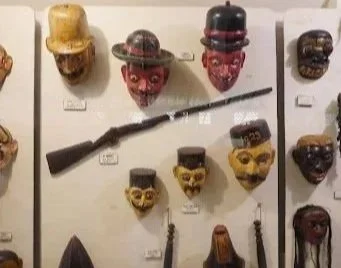
In Sri Lankan society and culture, masks are used to depict diverse social groups, and to bring out the foibles and hypocrisies of human beings. Photo by Uditha Devapriya.
Pankaj Mishra’s essay “Liberal Totalitarianism,” published in Harper’s Magazine in December 2025, is I think the best and most thoughtful piece written about the hypocrisy of what President of the European Union Ursula von der Leyen calls “the West as we know it.”
Von der Leyen’s statement is problematic, and before engaging with Mishra’s essay, it is worth a closer look. Does she, for instance, imply that there is a West apart from the one we now know, and were there other variants of this “West” which could have materialized, but did not? Were these variants of the West more progressive? For a Sri Lankan who writes on international relations by day and art, culture, and history by night, this is a question that is worth pondering, but one which I am afraid cannot be easily answered.
Mishra’s essay draws parallels between the fate of the Jewish people during World War II and the fate of Palestinians and West Asian people at the hands of the Israeli government today. Such parallels are roundly dismissed by Western commentators.
In an article in The Atlantic, for instance, Daniel Bergner criticized Ta-Nehisi Coates’s book on Palestine, The Message, for trying to achieve moral purity at the expense of complexity. The issues Mishra raises in his essay can be read as a response to Bergner’s article: “Complexity,” the latter noted, “not purity, is the essence of the moral and the humane.”
Complexity versus Purity
Part of the reason why Mishra’s essay resonates is that we are living in a world where certain arguments are immediately shut down because they are not complex enough whereas other arguments are automatically accepted even though they are not complex at all.
Take for instance, Tucker Carlson’s parting shots at the editor of The Economist. When he asked her what she thought of the destruction of Gaza, she responded that it was “a disaster for Israel.” But why, Carlson asked, should the war in Gaza be foremost a disaster for any other thing or country than the people and the families of Gaza themselves?
Carlson’s ideology is, of course, what helped shape Donald Trump, and to accept his thinking now while overlooking his contribution to Trump’s ascent then would be wrong. Mishra, on the other hand, makes us ask questions about the old order and the new, which should be a definitive starting point for discussions on these topics.
His point is that “the West as we know it” is as hierarchized and racially bound as the West as it is rupturing and the West as it might become in another five or so years. The dichotomy here, as with Bergner’s critique of Ta-Nehisi Coates’s book, is between purity and complexity, more specifically how the complexity argument is deployed, if not weaponized, to attack those who sympathize with certain communities.
I have been privy to conversations where the killing of Palestinian children has been roundly brushed aside because, apparently, “war is hell, and governments can’t always discriminate between the innocent and the criminal.”
What is interesting is that while this is supposed to be an argument for moral complexity — a government can’t always distinguish between participants and non-participants in war – it ultimately ends up absolving the actions of one party — the IDF and the Israeli government – and reducing our sympathy for the other — the people of Gaza. Images of children dying and being massacred in Gaza have made this line of thinking outdated, but it goes without saying that such arguments are still invoked by those who should know better.
Talking about Trump in Sri Lanka
In my country, of course, these arguments are hardly deployed. Sympathy with Palestinians is high, and the excesses of the Israeli government are seen as a symptom of a crumbling order. Many Sri Lankans, to this end, have come to terms with two things: that Trump represents, as Mark Carney puts it, a rupture, and that the world before Trump was not different in terms of the West’s racially hierarchized view of the world.
In this regard, talking with Sri Lankans in the immediate aftermath of Trump’s war on Iran, I found myself reflecting on Mishra’s point that, throughout history, this rules-based order has been no different to the racist excesses of MAGA and America First. Thoughtful Sri Lankans do not care much to distinguish between the two; for them there is hardly any difference, as Mishra discerns in his essay.
To be sure, the onset of war in West Asia has made many Sri Lankans, and the Global South in general, aware of the geopolitical ramifications of Trump’s ascent. That awareness is not confined to those who follow geopolitics closely. For the first time in my life, I did not hear motorists queuing for petrol in my country cursing their government. Not a few of them criticized certain local ministers, but many of them chose to vent out their rage and fury at Washington. Not a few of them called Trump “pissa,” which is the harshest word in the Sinhala dictionary for a madman.
Unmasking the West
But Sri Lankans also know that the hypocrisies of the West are not at all limited to Trump’s actions. They know that Western governments have pursued some countries in the theater of rules-based order and let others off.
For over three decades, to give one example, my country was brutalized by a war between successive governments and Tamil separatist forces.
For much of that period, Western states threatened sanctions and invoked UN resolutions on human rights abuses against these governments. Allegations of genocide were brought up, though they never made it past flashy press releases.
Yet today, the same governments that invoked genocide charges against Sri Lanka have turned silent over what is happening in Palestine and Lebanon.
A simple example would suffice to show how allegations of inhumanity, valid in all cases, are selectively deployed in some and ignored in others.
In May 2025, a monument was unveiled in Brampton, Canada, as a tribute to Tamils who were killed during Sri Lanka’s war. From the start, the monument attracted criticisms from those who felt that it misinterpreted the complexities of the war, ignored the contribution separatists made towards that war, and marked an intrusion into Sri Lanka’s domestic affairs by another government. I wrote then that these arguments were symptomatic of a state — in this case, Sri Lanka’s – which had failed to come to terms with its past.
Predictably, one of the most vocal advocates of the monument was the Mayor of Brampton. Indeed, he took to X regularly to support the opening of the monument and invoked the genocide label on the last stages of the separatist war in Sri Lanka.
This was all fine — except a perusal of their social media feeds reveals that such officials have been as willing to condemn the genocide of Sri Lankan Tamils as they have been to frame the situation in Gaza through the lens of Hamas’s atrocities. Once again, what you see here is selective complexity in one case — the bombardment of Gaza in the aftermath of October 7, 2023 — and selective purity in another — the bombardment of the northern province in Sri Lanka during the 30-year civil war. To be fair by such officials, however, their position on these issues has changed considerably over the last two years, to the extent that a number of Western governments now recognize the State of Palestine.
Three Contradictions and Ruptures
All this compels a question. Is it that the West is stricter with certain countries and lenient towards others? All evidence points to a resounding yes.
Such hypocrisies have been a hallmark of the rules-based order for 80 years. I do not think many in the Global South will miss it much, should it fade away.
That said, I do not share Ursula von der Leyen’s pessimism about the fate of the West. Regardless of Trump, I believe that, in some form, the “West as we know it” will survive. This is because Trump’s own excesses have mobilized Western opposition to them, as seen in Keir Starmer’s and Emmanuel Macron’s critiques of Washington.
In fact, we can discern three ruptures or contradictions before our own eyes in relation to this order. These ruptures warrant closer assessment, and they underlie both the breakdown and fragmentation of the West-led order and the fundamental malleability and adaptability of that order.
The first and biggest contradiction, in this respect, is between the West and the rest of humanity. This, I think, is best symbolized by Trump pursuing illegal wars in West Asia, while NATO, or more precisely its Secretary-General, coming up with all sorts of excuses for his actions. While Europe is clearly out of step with Trump’s America First policy, the EU continues to pussyfoot around US actions or, in the case of the NATO Secretary-General, rationalize them.
The second is between the U.S. and the rest of the West. This is best epitomized in French President Macron’s and British Prime Minister Starmer’s statements. It indicates that though tied to US economic and military interests, certain European states have taken it upon themselves to question U.S. foreign policy, even if tangentially, in relation to issues like the war in Iran and West Asia and the ongoing war in Gaza.
The third, and the most interesting, is between Trump and the former Make America Great Again (MAGA) crowd. By the latter, I include the likes of Tucker Carlson, Megyn Kelly, and Candace Owens, once cheerleaders for America First, which they still are, who have turned away from the man they thought would be the ideal flagbearer for their cause. A rupture in the America First isolationist right points to the internal contradictions of that movement, but also reveals that America First, or MAGA, is no longer as monolithic as it used to be five years ago.
These ruptures work at multiple levels. To reiterate my earlier point, they underlie the fatal contradictions of the West-led order, but also point to ways in which that order will survive, even if in an altered form. Since I am not a prophet, however, I will not speculate about how they will coincide, contradict each other, and work out at the end.
“Western liberalism,” Mishra writes in the final paragraph of his essay, “turns out to have been a moral mask for an intellectual service class.”
Throughout the 20th century, and for much of the 21st century, it was this intellectual service class — the well-paid commentators on mainstream Western media outlets — that propagated a vision of the West that they knew to be false.
This sentiment was one that certain people in this part of the world subscribed to. Invoking Mishra, I find it tempting to say that, today, the mask of Western liberalism has come off. But for people from countries like Sri Lanka, that mask was always off. All Trump did was to admit that it was never there in the first place.
*The opinions of contributing writers are their own and do not necessarily represent the views of We Are One Humanity. Submissions offering differing or alternative views are welcome

Coming to Terms With a Civil War in Sri Lanka