
Outsiders in Their Own Land
Thai society routinely pins the blame on Indigenous communities for environmental crises, ignoring their traditional knowledge and role as biodiversity stewards amid weak laws and prejudice.
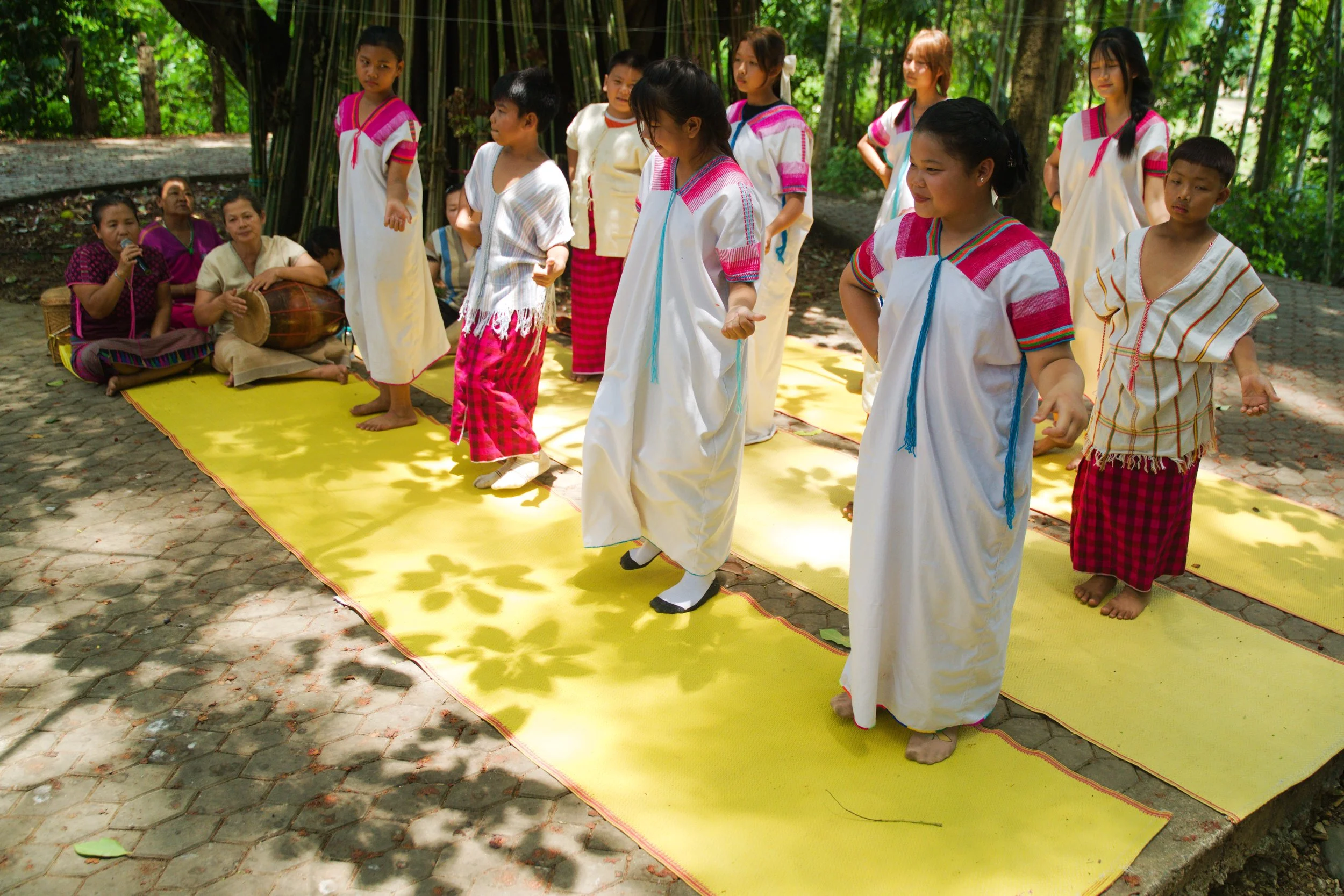
A traditional Tong dance performance by Pwo Karen youth in Dan Chang District, Suphan Buri Province. Photo by Nathaphob Sungkate.
Thailand in March is unbearably hot. The air hangs heavy, making outdoor activities in the middle of the day almost impossible. A few fellow Thai journalists and I set out from Bangkok, heading northwest toward Dan Chang district in Suphan Buri province.
The air was surprisingly cool when we finally arrived at the gathering ground of the Pwo Karen community – huge trees shielding the open space from the harsh sun. The Karen indigenous group is one of Thailand’s 60 ethnic and Indigenous communities known for living in close harmony with nature and protecting the forest’s biodiversity for generations. .
Yet today, the government declared the ancestral lands where they have lived for generations as forest reserves. This reclassification of the land profoundly changed this Pwo Karen community’s way of life by prohibiting them from practicing rotational farming, a method of a highland agricultural system practiced by the Karen, in which short-term crops are cultivated for one year, followed by a long fallow period of 7–10 years to allow the forest to regenerate naturally.
From long-time forest dwellers, the community has become encroachers.
“There must be rotational farming if there is a forest, and if there is rotational farming, there must be people – they cannot be separated,” Laddawan Panya, a Karen leader, said. “Please don’t separate us from the forest.”
Fifteen households use the community’s rotational farms. According to the community, they need 220 acres to be able to live comfortably. But today, the government restricted their land to just 42 acres.
Within that area lies a shared field where community members grow crops together — rice, cucumbers, chilies, long beans and winged beans. For them, the forest is like a supermarket. It provides food and resources, giving Karen communities a level of food security that is often higher than what many urban residents have.
In September 2025, Thailand passed the Ethnic Groups’ Way of Life Protection Act, a law that is supposed to safeguard the livelihoods of ethnic and Indigenous communities. Some senators, however, removed important elements from the final version that was passed into law, including the recognition of protected cultural areas for ethnic and Indigenous communities. As a result, forest laws –continue to restrict the right of Indigenous communities to make a living because they cannot freely follow their traditional practices on their own land under shared agreements with the state.
Despite these limitations, their role in protecting natural resources continues.
The fire season
Thailand’s education system offers virtually no subjects that promote an understanding of Indigenous peoples.
In school, students learn that Indigenous communities in Thailand — many of whom live in highland areas — are backward people who practice shifting cultivation, grow opium, and destroy nature. The reality, however, is very different.
That same month, I traveled north to Doi Chang Pa Pae, a village of the Pgaz K’Nyau (Karen) people in Lamphun province.
Along a winding mountain road, plumes of smoke rose from the forest carrying the familiar prejudice of urban dwellers who are quick to blame Indigenous communities for starting forest fires.
The reality is that most forest fires in Thailand are actually started by outsiders entering the forest to collect forest products or hunt wildlife — not by the Indigenous communities who live there. Because who would want to burn their own home?
In fact, every year between February and March, ethnic and Indigenous communities living in forest areas prepare for the fire season by creating fire breaks – gaps between vegetation meant to slow or stop the progress of wildfire. In this village, the Pgaz K’Nyau community consists of 77 households or about 270 people. They are responsible for helping protect more than 8,300 acres of forest. Their work goes beyond relying on traditional ecological knowledge. They have also begun using modern technology to prevent fires, installing sensors and CCTV cameras to detect fire hotspots, setting up automated water systems and building reservoirs to store water for firefighting during the dry season.
Dee Pu Nu, the leader of the village’s wildfire response team, took me on the back of his motorcycle along narrow forest trails to one of the fire monitoring points. The team was preparing for the annual fire season, which typically runs from March to May.
Their strategy is straightforward but demanding: they create firebreaks around the village, eight to 10 meters wide and stretching for about 30 kilometers.
Blamed for fire and floods
There is a bitter joke often repeated in Thailand. During the hot season, society blames ethnic and Indigenous communities for burning forests and causing the PM2.5 air pollution crisis. This, despite the fact that the same communities spend weeks building firebreaks to prevent those fires every year.
When the rainy season arrives, society accuses them again — this time of destroying forests and causing floods in the cities. Yet the forest is their home, and when flash floods come down from the mountains, it is their communities that suffer first. Their houses are often the ones damaged during the rainy season.
Then winter arrives, and urban residents travel to the mountains to enjoy nature — camping, admiring the landscapes and experiencing the way of life of the very same Indigenous communities they blamed when problems arose.
Thai society often pins the blame for complex problems on those with the least power to defend themselves — a pattern reinforced by decades of media narratives portraying Indigenous peoples in reductive, negative stereotypes.
Refusing to recognize Indigenous Peoples
Media narratives that fuel hatred toward Indigenous communities in Thailand do not come only from newsrooms; They could be traced back to the Ministry of Education that is responsible for designing school textbooks. These materials often portray ethnic minorities and Indigenous peoples as outsiders to Thai society — even though, in reality, Indigenous communities possess unique knowledge systems and represent an important form of Thailand’s cultural soft power.
The problem extends beyond education. In Thailand’s media landscape, Indigenous communities are often treated as convenient scapegoats. Sensational headlines that blame them can easily generate likes and shares for media outlets that do not care about the consequences and implications.
A recent example occurred on Jan. 27, 2026, when a gunman opened fire on police in Chiang Mai, a northern province where many ethnic communities live. Although the suspect’s identity was not confirmed, several Thai media outlets ran headlines describing the attacker as a “Hmong man.”
The Hmong are one of the ethnic communities that has lived in Thailand for generations. For decades, they have often been stigmatized and associated with drug trafficking — a stereotype reinforced by repeated portrayals in media.
This time, however, the response was different. Hmong community networks and lawyers decided to file complaints against eight prominent news outlets for spreading false information.
“We believe this is unacceptable, and legal action is necessary to protect the rights of the Hmong people,” Yongyuth Suebtayart, a Hmong lawyer who helped file the complaints, said. He argued that many media outlets today deliberately create hostility toward groups they consider outsiders. The network called on the media to help promote a better understanding of ethnic groups and cultural diversity in Thai society.
At the international level, important frameworks already recognize the role and rights of Indigenous peoples. These include the United Nations Declaration on the Rights of Indigenous Peoples (UNDRIP) and the Kunming–Montreal Global Biodiversity Framework, both of which formally acknowledge Indigenous peoples as key guardians of biodiversity.
These frameworks represent a shift in perspective — from viewing Indigenous communities as “victims” or “encroachers” to recognizing them as stewards of natural resources who deserve respect.
Yet in practice, particularly in Thai society, prejudice and misunderstanding about Indigenous peoples remain deeply rooted. One of the clearest examples is the continued refusal by various sectors of society – including a number of government officials, members of parliament, mainstream media outlets, and the majority of Thai people – to recognize the existence of Indigenous peoples in Thailand.
Many Indigenous communities have lived on this land for generations — long before the emergence of the modern nation-state. Still, Thai society often clings to the belief that Thailand is made up only of the Thai ethnic group.
In reality, the idea of a single pure Thai ethnicity has never existed. Modern Thai society is the result of centuries of ethnic mixing among Indigenous populations of Southeast Asia, migrants from southern China and neighboring communities across the region.
*The opinions of contributing writers are their own and do not necessarily represent the views of We Are One Humanity. Submissions offering differing or alternative views are welcome
Facing history's darkest truths can liberate individuals and nations