
The Illusion of “Voluntary” Choice
For older OFWs supporting entire families, "voluntary repatriation" means economic death. They trust Qatar's missile defenses more than Manila's job market.
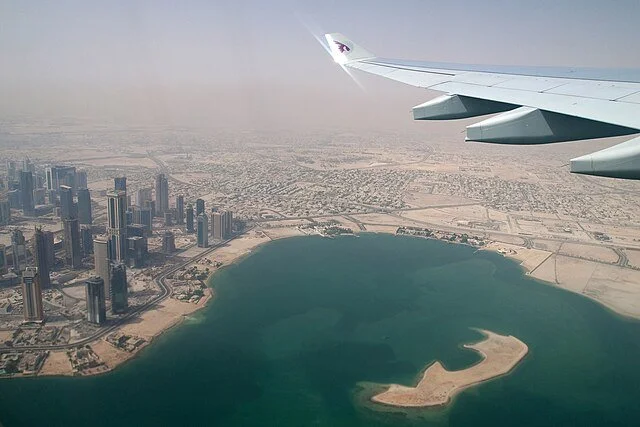
View of Doha, Qatar. Persian Gulf coast. (Wikimedia Commons)
Lily saw flashes of light punctuating the night sky, followed by the thunderous sound of three consecutive booms as intercepted missiles exploded overhead. She has been working in Doha, Qatar, for 17 years, but this is the first time she has felt truly afraid.
“It’s really scary because it’s right there above our homes," she said.
Lily, 50, is among three Filipino women I spoke with who are working as administrative staff in Doha, Qatar, and whose lives are suspended between two different kinds of violence. To the world, the conflict involving Iran and the regional stability of the Middle East is a geopolitical chess match. But for these three Overseas Filipino Workers (OFWs), the reality is a life on standby, where schools have been suspended "until further notice,” they said, and their livelihoods have ground to a halt.
They spoke with me only on the strict condition of anonymity, fearing a government that is swift to penalize those who discuss the security situation.
Yet, despite the fear and the urgent alerts from the Qatar Ministry of Interior telling them to stay away from windows, they refuse to leave.
The Philippine government calls it "voluntary repatriation," a term that suggests a free choice between danger and safety. But for these women, the choice is an illusion. They are caught in a desperate calculation: they are choosing the audible explosions of a foreign war over the silent, certain economic death of returning to a country that views them as “expired.”
"Disposable" at home
At the heart of their refusal to go back to the Philippines is the belief that they are economically disposable in the eyes of the Philippine labor market. They have spent more than 14 years working in Qatar, jokingly noting they have "reached menopause" there.
For many older OFWs, the decision to stay in conflict zones rather than accept "voluntary repatriation" is driven by the knowledge that they have no future in Manila.
"At our age, no one will accept us there," Rose, 47, said.
At 58, Ellen also knows that her chances of finding a job in Manila are non-existent despite her decades of experience as a school administrative staff member.
For them, staying in a potential war zone where they might still earn a $500 (QR 1,800) minimum wage under the new 2025 Unified Contract is a much less violent option than the Philippine reality, where they see no hope of finding work.
Architects of their own survival
These women are not victims waiting for a rescue; they are the architects of their own survival. They do not view themselves as helpless subjects of a geopolitical storm, but as essential providers for a massive multi-generational ecosystem back home.
The money that Lily, Ellen, and Rose send back home contributed to the record $35.63 billion in cash remittances in 2025, according to the Philippine Central Bank. This figure accounted for 7.3% of the Philippine GDP that year.
There is a cruel irony in the fact that while Filipinos aged 45 and older now comprise the largest share of the migrant workforce at 25.8%, the very maturity that makes them reliable anchors for their families – both the young and elderly members – also diminishes their prospects in the Philippine labor market.
Lily, for instance, is a single mother whose child is about to enter college. She also supports two sick, elderly parents who have no income. Ellen has no partner or children, but she supports nieces, nephews, and even great-grandchildren.
For them, unpaid tuition and medical bills are far more dangerous than any missile.
This is why they see repatriation as a trap, not help. They recall the COVID-19 pandemic, when they went six months with "no work, no pay" and cleaned houses for 25 riyals an hour just to survive. They didn't ask to be saved then, and they aren't asking now. They are waiting for their workplaces to reopen so they can return to work.
Nonviolence: not merely the absence of war
Paradoxically, these women feel safer in Qatar than from their own government. They praise Qatar for intercepting every missile. "Nothing falls," they say.
But they feel abandoned by the Philippine embassy. "We tried reaching them, but they never replied," Ellen said. They got more help from local Arabic Sheikhs or Facebook groups.
This reality exposes a fundamental gap in human rights; when a citizen’s only alternative to a war zone is total destitution because of their age, the "voluntary" nature of their stay is stripped away.
The story of Lily, Ellen, and Rose is a powerful testament to the reality that for millions of migrant workers, nonviolence is not just the absence of war, but the presence of economic dignity.
They are not begging for a way out; they are asserting their right to be productive.
"If we still have a chance to work here, we will definitely grab it,” Rose said.
These women find their greatest security in their own agency. They are not waiting to be "saved" from Qatar; they are waiting for the world to catch up to the value of their labor.
Until then, they remain, not as victims of conflict, but as the unbreakable backbones of a nation.
In their calls home, they project calm.
"We are safe here,” Ellen said. “We should just pray all the time.”
*The opinions of contributing writers are their own and do not necessarily represent the views of We Are One Humanity. Submissions offering differing or alternative views are welcome


A Review of Rajmohan Gandhi's James Lawson, Teacher of Satyagraha