
A Democracy in Debt
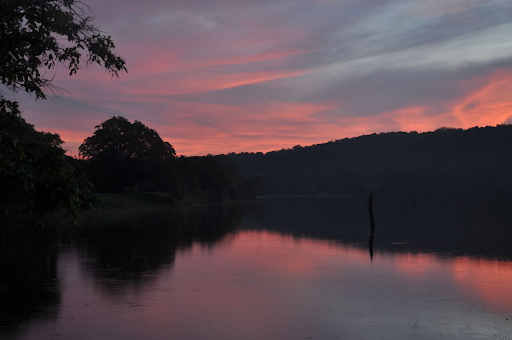
Dawn in Dutuwewa. Photo by Yoshitha Perera.
After a debt crisis nearly broke Sri Lanka, author Uditha Devapriya traveled with filmmaker Beena Sarwar to document its aftermath — finding a stark divide between policymakers in Colombo who call the recovery a success and farmers in the country's agrarian heartland who say they are still only surviving.
Next year, 2027, will mark the fifth anniversary of the economic and political crisis in Sri Lanka, which almost ruptured my country beyond recognition. Nearly five years later, Sri Lanka is still slouching towards recovery. Although it is buoyed by an optimism which has become a hallmark of its people, it remains one of the most vulnerable countries, easily flailing under global shocks such as the recent U.S.-Iran conflict. Indeed, among the catalysts for the 2022 crisis were the price and supply shocks of the Russia-Ukraine war.
The crisis in Sri Lanka was a long time coming, and has a history going back to even before independence. Under British rule, Sri Lanka transformed into a model society, a laboratory in which liberal and radical reforms of the British Empire were enacted and seen through. In 1931, it became the first European colony to receive the unconditional right to vote for all its citizens. Seventeen years later, through a long process of negotiation and constitutional reform, it became an independent state, though still a British Dominion.
By 1948, the country had been ranked among the most promising in the post-colonial world. In terms of economic indicators like GDP and indebtedness and social metrics like health and education, it was far ahead of other countries – including two of its neighbors, India and Myanmar. East Asian countries like Korea had yet to industrialize into what they are today, while Europe was still transitioning from World War II to the Cold War.
Moreover, in the early 20th century, the British government, moved by a sense of pragmatic paternalism, had undertaken reforms in Ceylon which helped raise the birth rate and reduce the death rate. Making education more accessible, it laid the foundation for a welfare state. Today, with literacy and health statistics among the highest in the region and in the world, the country is lauded as a success story in social welfare.
But some economists have noted that this was where problems began. They contend that welfare, though cushioning people against unemployment and the threat of starvation and illness, was not supplemented enough by investment and growth. While the country experienced impressive development in its first few years of independence, by 1960, that growth was stagnating. Social welfare was expanding considerably, but for some it seemed to transform the country too rapidly, putting a strain on its finances.
By 2022 this crisis had become ingrained in the system. In the late 1990s Sri Lanka lost its status as a low-income country. Earlier, it could finance its development with the help of aid from development institutions. With its graduation into middle income status, the country was compelled to resort to commercial borrowings. Between 2007 and 2022, a period of 15 years, it borrowed from various countries and capital markets.
The Easter Sunday attacks of 2019, followed by Covid-19 in 2020, complicated these issues further. In March 2022, the country ran out of foreign exchange to pay for its imports. Sri Lanka was and remains a highly consumerist society. The result was prolonged power cuts and commodity shortages, followed by protests, brutal reprisals by the government – and, eventually, the overthrow of a deeply unpopular president.
Exploring a Village in the Heartland
All this helps explain the broader context. But it does not unearth the human dimension, or human cost, of the crisis. In April 2022, the country announced its first sovereign debt default. Two years later, we were under a different president, albeit with the same political dispensation. It was then that I got the opportunity of working with a renowned filmmaker on a documentary on the aftermath of the economic crisis. Our objective was less to historicize what had happened than how the economic crisis was seen and felt by people on the ground.
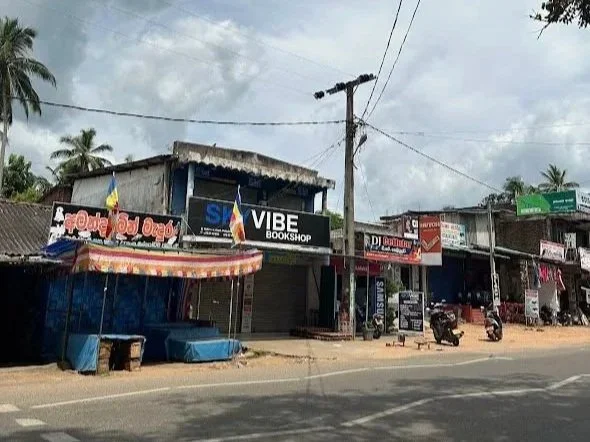
Anuradhapura, near Dutuwewa. Photo by Uditha Devapriya.
The documentary, “Democracy in Debt. Sri Lanka Beyond the Headlines,” was sponsored in part by the Pulitzer Center. It was directed by Boston-based, Pakistani-born journalist Beena Sarwar, who already had an impressive line of credits to her name.
From the beginning, “Democracy in Debt” was planned in two parts, each crisscrossing the other. The first unfolded in a village called Dutuwewa, in Anuradhapura, which forms part of the agrarian heartland of the island.
Here people lived a secluded, though hardly simple, life. Every other person was a rice cultivator, and they supplemented this with an additional job – as a teacher, clerk, or some other professional. For these people, life was always cut to the bone: “We don’t feel like we are living,” they would often say. “Only surviving.”
They lived in the most basic setup, and diligent researchers and writers that we were, we lived the life they led. We checked ourselves into a rundown house and made the best of what we were given. For three days, we went around interviewing villagers, observing them engaging in rice farming and other activities, and spending evenings talking with them casually over a dinner plate and cup of tea. We talked with teachers and principals, including an economics lecturer who contended that although experts were touting that Sri Lanka had recovered, he didn’t see any reason for hope.
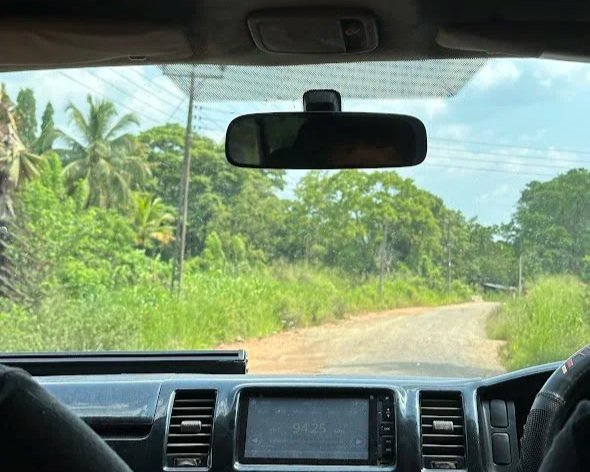
Traveling across Anuradhapura. Photo by Uditha Devapriya.
That, of course, was the prevailing sentiment on the ground. Some villagers articulated it more eloquently than others. One farmer, in particular, lectured us on the origins of the village – Dutuwewa is associated with Dutugemunu, one of the most revered kings of ancient Lanka – before explaining how contemporary politics had ruined the foundations on which their society had stood for centuries.
He had particular scorn for the president who had been chased away by protesters in 2022. As with most villagers we spoke with, he rationalized what happened in 2022 by resorting to metaphors from his household: “If the parent of the family is not a responsible person, then how can the family survive? If the ruler of a country is not equipped to look after his people, how can we expect him to hold his mandate?” These were simple statements, but for him, and us, they underlay a profound truth: people like him were living on the margins, and they were incensed at the rulers’ inability to do the bare minimum for them.
A Clash of Perspectives
If its first part of the narrative delves into the voices of people on the ground, the second part of “Democracy in Debt” offers a counterpoint in the form of perspectives from elite policymakers and political officials in Colombo. Among those we interviewed were two economists, the director-general of the Board of Investment of Sri Lanka, and the then-prime minister. Though we tried to reach out to other politicians, especially opposition MPs, we were unable to do so. The few we interviewed, however, brought up an interesting contrast with the people we had talked with in Dutuwewa.
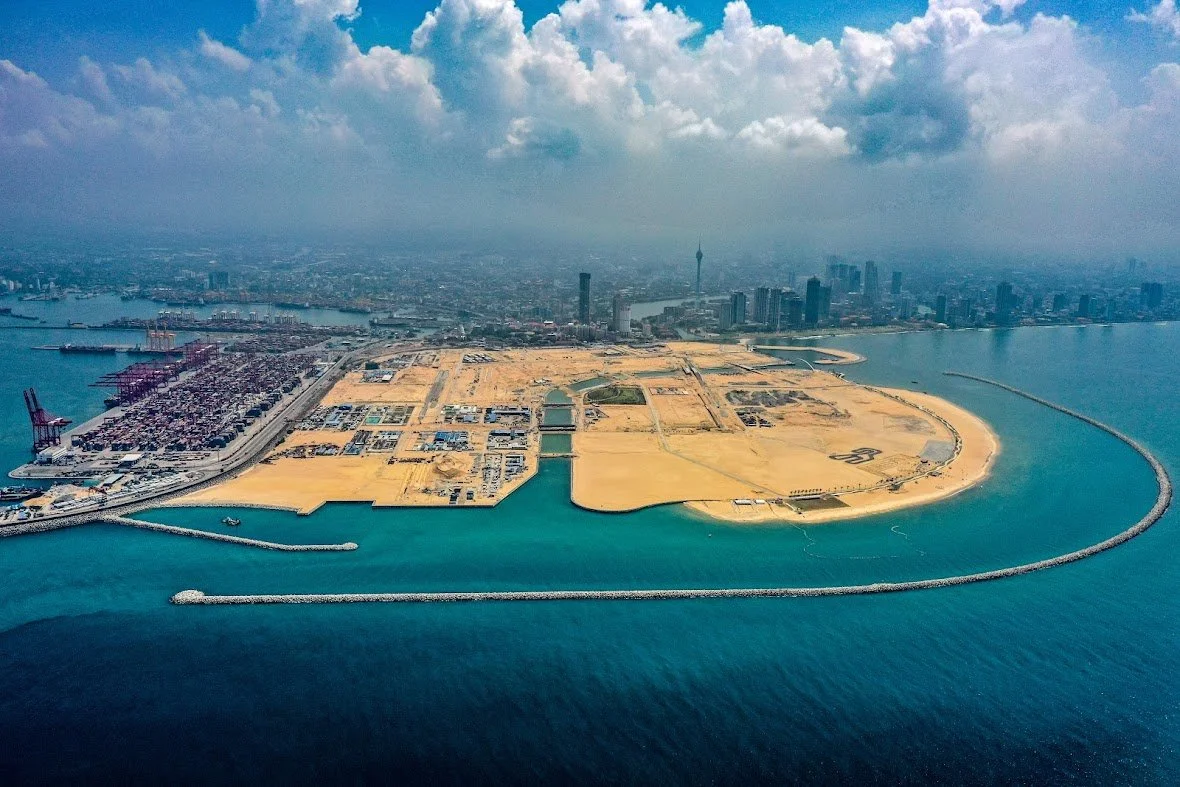
Port City Colombo, touted as a viable investment by supporters and a wasteful project by others (Wikimedia Commons).
The Colombo phase of the documentary helped us gauge a rift, a gulf, between people on the ground who were feeling the effects of the crisis and the reforms that were undertaken to achieve stability, and policy elites who were prescribing these reforms for the “greater good” of the economy. I think this gulf is crucial to the narrative of “Democracy in Debt.” At various points in the documentary, the booming, sonorous voices of policymakers cut into the plaintive laments of villagers. The contrast could not have been more obvious, and for better or worse, it became the centerpiece of the narrative.
This had to do with a different way of looking at not just the crisis, but also the way reforms were framed: on the one hand, as necessary in the country’s interests, and on the other, as inadequate in the context of poorer communities like farmers. By this point a critique had emerged about the then-government’s engagement with the International Monetary Fund (IMF) and its harshest prescriptions. These prescriptions included cost-reflective pricing for fuel and electricity, which sent utility bills for the most deprived skyrocketing.
Arguably the most significant part of Sri Lanka’s comprehensive social welfare system is its universal assistance program. Known as Samurdhi, the program had been a subject of much critique for decades. But the villagers of Dutuwewa whom we interviewed saw it differently from the policymakers of Colombo. The latter framed it as wasteful, in need of urgent repair, and called for a better coordinated alternative.
The villagers, on the other hand, regretted that it had been removed and restructured. For them, Samurdhi was not only a welfare scheme; it was also a program that connected the most marginalized communities to the government of Sri Lanka. It made them feel as though they were a part of the system. Part of the reason for reforming Samurdhi was to depoliticize social welfare. Yet for villagers, this was the antithesis of how they saw welfare: in essence, such programs had made them feel that they were active players, not passive recipients, in the political process.
Such nuances often get lost in the world of economic policymaking. Yet part of the message of “Democracy in Debt” is that, in electoral democracies like Sri Lanka, the human aspect of economic crises and recovery efforts cannot be sidelined.
Sri Lanka’s ranking in the World Happiness Index underlines a contradiction between its potential and its prospects. Most Sri Lankans feel, to paraphrase what one villager said, that they are “only surviving.” Yet they also believe that there are better days ahead, although these opportunities have been squandered needlessly over the last few decades.
One of the biggest electoral rallying cries of the recent past, in Sri Lanka, was the then opposition National People’s Power (NPP) alliance’s harangue about a “75-year-old curse.” The reference was to how long Sri Lanka had been independent, and how political elites of that time had gambled recklessly on Sri Lanka’s future.
Change That Never Ends
As with other countries undergoing painful austerity prescribed by institutions like the IMF, such messaging became widely popular in Sri Lanka. The villagers we talked to aligned themselves with it. They felt a change was necessary. “We can’t say we are stable now,” the economics teacher told us. “It is clear we cannot continue like this.”
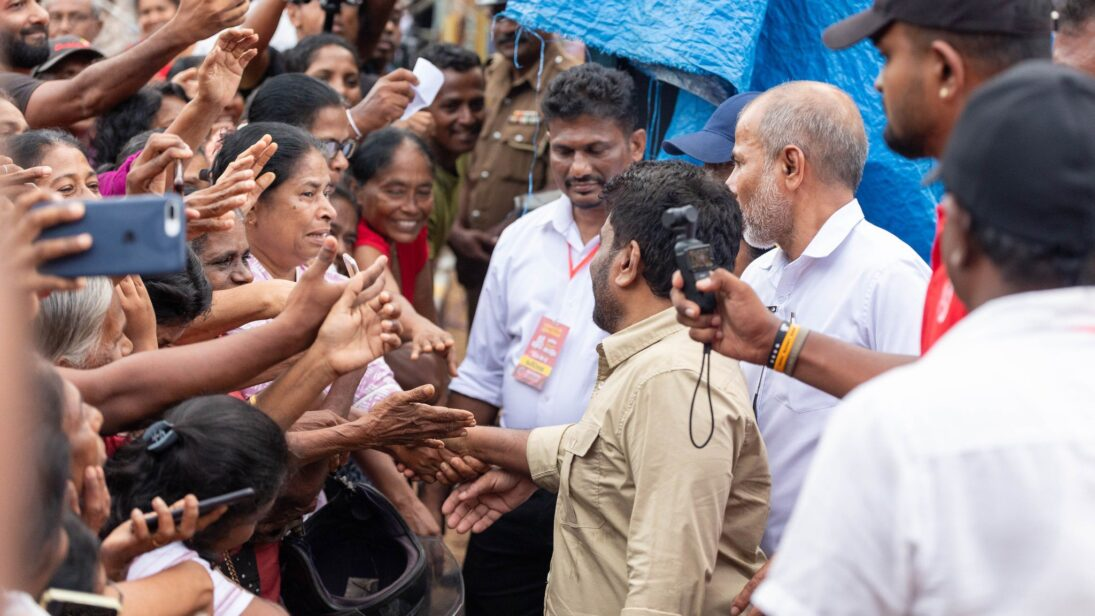
Anura Kumara Dissanayake, presidential elections, 2024. Courtesy South Asian Voices.
It was a sign of things to come. In May we wrapped up shooting the film. Two months later, “Democracy in Debt” had its first international screening in Colombo. Policymakers, diplomats, think-tank heads, and economists, among other groups, watched the documentary. It also travelled to numerous other countries, including the U.S., Pakistan, the United Kingdom and India.
Two months later, presidential elections were held in the country. The winner of the election, Anura Kumara Dissanayake, was a stalwart of the left-populist Janatha Vimukthi Peramuna (JVP), who contested as a member of the wider left-wing NPP alliance. Two further months later, a parliamentary election threw out most of the country’s MPs and brought to power an entirely new generation of politicians.
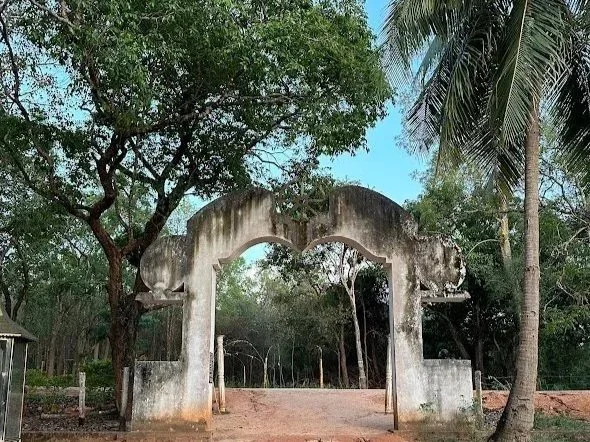
The Buddhist temple of Dutuwewa. Photo by Uditha Devapriya.
As I saw these developments, my mind kept going back to Beena Sarwar’s film. One of the many interviews we had in Dutuwewa was with a Buddhist monk. Young, friendly, and deeply philosophical, he spoke on different subjects.
At the time, the U.S. government was arresting university students for protesting U.S. support for, and involvement in, Israel’s military campaigns. The monk was genuinely puzzled. He did not know why this was happening, especially when – he said – Western governments paraded themselves as harbingers of human rights. He could only quote from the teachings of the Buddha, and urge calm, restraint, and compassion.
Our conversation then returned to the economic crisis. Yet he kept dwelling on the protests and student arrests. Though the monk was one of many, many individuals we interviewed, his reflections stood out. They spoke to a society in quiet transition, but also a point which at once distilled that society and connected it to our wider humanity. At the end of the day, “Democracy in Debt” was about people, how they lived under the most onerous conditions – and how they aspired to not just exist and survive, but also live and thrive.
*The opinions of contributing writers are their own and do not necessarily represent the views of We Are One Humanity. Submissions offering differing or alternative views are welcome.
A Review of Rajmohan Gandhi's James Lawson, Teacher of Satyagraha