
Religious Faith and Fanaticism
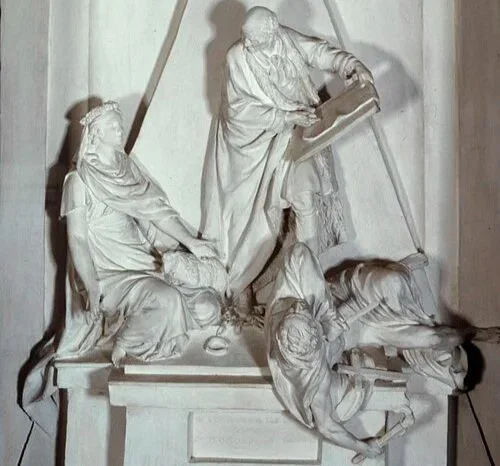
Etienne-Pierre-Adrien Gois, Voltaire defending Innocence against Fanaticism, circa 1791.
Across our suffering world, millions of people work selflessly to help one another, stand up for justice, and rebuild trust where it has been broken. What inspires and sustains them in their commitment is often their religious faith. In communities, networks, and worship, they encourage each other.
So why does this precious gift of religious faith cause so much trouble? The message of God’s love, peace, and justice is almost mysteriously turned into powerful fuel for conflicts and wars. It is not surprising that people think of religion as an obstacle to peace and justice.
Yet, my mind goes to leaders like Martin Luther King Jr., Archbishop Desmond Tutu, Dalai Lama and Mahatma Gandhi. Their religious faith clearly played a significant part in their commitment to life. And thousands of others, not so well-known, stand out in the history of their local communities and countries. In his weekly column on this website, Rajmohan Gandhi has given many examples of people who build trust across the divide between Muslims and Hindus. During my years with Initiatives of Change in Latin America, amidst poverty, violence, and injustice, doors opened into treasures of love and care inspired by religious faith. On our first wedding anniversary, my wife and I had the privilege to visit the Cathedral of San Salvador, where Archbishop Romero is buried. He was murdered for his faithful defence of victims of injustice. At the time of writing, Pope Leo XIV is visiting Turkey and Lebanon, calling us to break down the walls of prejudice and become peace-makers, and he visited the Blue Mosque in Istanbul.
On the other hand, at an in-person meeting of We Are One Humanity in Chicago in April, with the theme ‘Democracy on the Ropes,’ one person in the audience asked: Can religion and an open democracy co-exist? His own answer was that they are incompatible. Looking at things from this angle, it must have been amazing to witness Zohran Mamdani, a practicing Muslim with clear democratic credentials, being elected as the mayor of New York.
The perceptions of the effects of religious faith clearly differ.
Fanaticism vs Faith
Many of us may have experienced heated discussions where a few of the participants take over. They cut others short, steamrolling over their attempts at voicing their opinions. There is no listening. You see people being humiliated. And if you imagine thousands of such persistent, sometimes aggressive, participants in a demonstration on the streets with charismatic leaders at the front, they have become a threat. The anger is whipped up, and what comes next?
What is at work here? Quite possibly fanaticism. Being passionate is good, but this is poisoned passion.
Anyone sincerely committed to building a world where human dignity is respected, where basic moral guidelines of honesty and integrity are upheld, and where love of our fellow human beings prevails regardless of class, colour, or religion, will feel the bruising effect of fanaticism at some point. We need insight to see what we are up against.
Fanaticism has many ways of presenting itself. From subtle and friendly persuasion with lies and tempting illusions, to shouting and bullying, frightening and humiliating people. It may also take people to the extreme of violence and terrorism. History tells of numerous damaging consequences of fanaticism motivated by religion, politics, or something else.
However, I want to focus on religious fanaticism and faith. As a leader of the Christian Union at school, I faced narrow-minded and divisive attitudes towards those of a different denomination from their own. Not fanaticism, but the seeds of it. Since then, I have wondered how we can meet people of different beliefs with an open heart and mind. Several years later, news of violent religious conflicts in different parts of the world caught my attention, and the attack on the Twin Towers in New York in 2001 took our world into confrontations that have poisoned human and national relations since.
First of all, I believe we easily mistake religious fanaticism for religious faith. Seemingly, religion is the source of both, but there are some fundamental differences. Only God knows the full truth. We don’t. We can share what we have discovered, but we have no right to impose our faith on others. Their insight can enrich ours. We need humility.
Religious fanaticism, on the other hand, makes people adamant that they know the divine truth and have the right to force others into their religious fold. It kills dialogue.
Fanaticism is unfortunately not only about ideas and religious teaching, but it is also about what happens to people suffering brutal oppression when they constantly feel humiliated. Not surprisingly, a burning hatred can be born and grow out of control. Then religious faith and networks may strengthen people’s resolve to take action. This is something those in power may not want to understand, because it reveals their own part in causing the humiliation and suffering leading to fanaticism. This applies to the Western world’s attitude to Islamic extremism and understanding of the Middle East, but is equally true in other parts of the world. Those in power may also stir up religious fanaticism deliberately to strengthen their own grip on power and exclude minorities.
Fanaticism grows in more friendly environments, as well. Being wholehearted in our work and commitment is satisfying and attractive to others. Fanaticism can be the fake version of this human quality, luring us astray.
Sometimes the reality of our world frightens us with all its dangers and uncertainties. My Christian faith gives me truths to hold onto in an unpredictable world, but is accompanied by doubts and questions that I don’t find answers to, like how a loving God can allow so much suffering. In fear of the unknown and longing for certainty, people may run to movements and religious communities where everything is set in stone, and everyone marches in step. Religious faith becomes an escape from the real world into the safe fortress of an illusion.
Some religions, including my own, encourage people to pass on the good news and convert others. Where do we draw the line between respectfully convincing someone and imposing our faith? This is not easy, especially in societies where religious faith is strongly tied to cultures and ethnicities. Even so, it is not religious faith itself that is the problem, but our attitude towards those with a different faith from our own.
Faith as a Vital Piece of Democracy
A core truth in most religions is that God loves every human being, no matter what their race, social background, or culture is. It is an invitation to a society where we learn to love everyone and live in harmony with those of other beliefs. There is space for everyone.
Reflecting on the topic of this article, I realize how coloured I am by distorted perceptions of religion in European society. I feel religious faith often is reduced to spiritual support for the pursuit of well-being and happiness, or is seen as a threat because of religious fanaticism. However, the belief in God’s love for every human being makes religious faith vital for a thriving and open democracy. Too many people are belittled and excluded. As individuals and groups, we can initiate dialogues where everyone’s dignity is respected, and thereby build trust in an increasingly polarized and divided society.
There is a helpful expression in English: My point of view. Your point of view.
I imagine myself and others sitting on different mountain tops. Below us is the same landscape. We marvel at what we see. But no one has exactly the same view. No one can claim that “mine is the complete and true picture”. We can all share and appreciate what we learn with each other.
More stories from We Are One Humanity

Facing history's darkest truths can liberate individuals and nations