
Forced Into Fraud
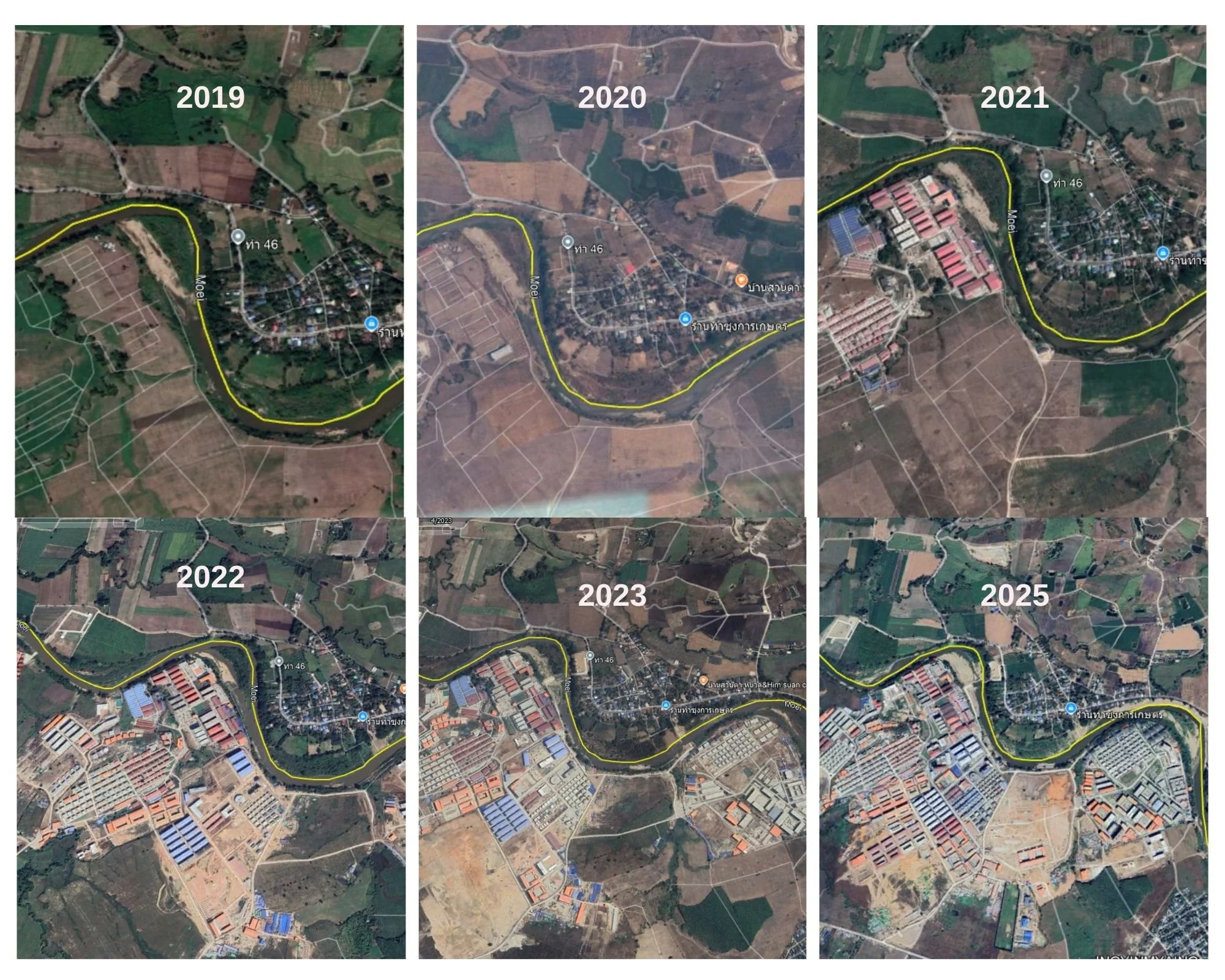
Satellite images showing rapid growth of the scam operation “KK Park” between 2019 and 2025
Across the Moei River, which separates Thailand from Myanmar, rows of tall buildings rise just beyond the Thai border. They look out of place, like a foreign body that appeared almost overnight. Satellite images from Google Earth show the rapid growth of a scam operation known as “KK Park” between 2019 and 2025. What was once empty land has become a hub for transnational crime networks originating from China.
At one point, a photographer and I tried to document these buildings. We were stopped by local Thai police and told to leave the area. No photographs were allowed.
Behind the silence of those buildings, survivors have confirmed that tens of thousands of people are trapped inside. They come from across the world: Southeast Asia, South Asia, the Middle East, and Africa. Many were lured by job offers in Thailand, only to be trafficked onward to Myanmar, Cambodia, or Laos.
Inside, they are forced to commit online scams targeting victims around the world. Those who refuse to work are punished. Others are sold on to different companies, treated as commodities within a criminal supply chain.
I have interviewed several survivors who managed to escape. Their stories are rarely driven by greed alone. More often, they begin with inequality and the lack of access to basic needs — especially decent work. These gaps draw people from around the world into the hands of transnational criminal networks, many of them illegal enterprises with roots in China.
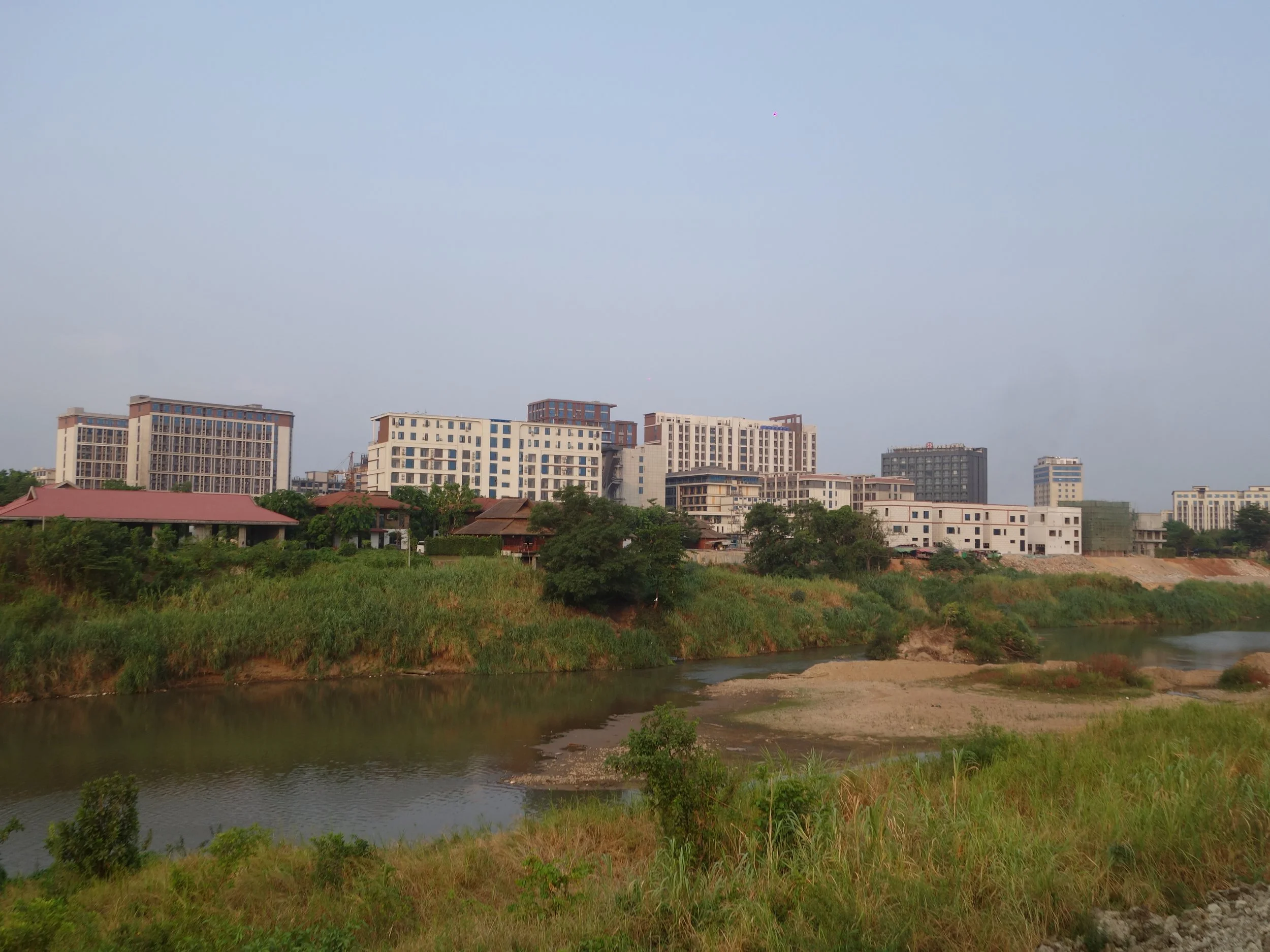
A scammer’s base of operations along the Thai-Myanmar border
Driven by Greed or a Better Life?
In late 2023, when I began closely following cases of people being deceived into scam work in countries such as Myanmar and Cambodia, I met Ice, a 33-year-old man from northern Thailand. He had just been rescued by Thai authorities and had passed the official screening process as a victim of human trafficking after being lured to work in Laukkai, Myanmar.
Ice told me that in August 2023, he lost his job and returned to his hometown in northern Thailand. His family was trapped in debt to informal lenders and was regularly threatened by loan sharks. The pressure forced him to urgently look for work to repay the debt.
He and his girlfriend joined Facebook job-search groups. There, they came across a job advertisement that read:
Customer service admin
Based in Mandalay, Myanmar
Work 20 days, rest 10 days
Salary: 25,000 baht ($792 per month)
Accommodation and facilities provided
“We talked for three or four days,” Ice said. “Then they asked if I was ready to travel. I told them I wasn’t, because I was scared.”
As he hesitated, the pressure at home intensified. Loan sharks began harassing his family. Stones were thrown at their house as a warning. Ice said he could no longer live in peace.
“My life conditions forced me to go,” he said.
In the end, Ice accepted the offer and agreed to travel to Myanmar. He admitted he suspected it might be a scam, but the recruiters arranged all the documents and transportation, which made him feel slightly more at ease. During the journey, he met other Thai nationals. Some knew the work was illegal but chose to go anyway.
For Ice, the moment he realized he had been deceived came too late. He no longer knew where he was in Myanmar. Armed groups were guarding the compound where he was held.
There, he met a Thai man who recruited him. The man confessed that he, too, was being forced to do so, under threat of punishment. Ice’s girlfriend was assigned to work as a call center operator, scamming people over the phone. Ice was forced into online investment fraud.
Both were trained by experienced scam operators and given step-by-step manuals to follow.
Ice was made to work up to 15 hours a day. His task was to create fake luxury profiles on dating applications to lure victims. Each day, he had to hand over the contact details of at least three to five people. Meeting the quota meant avoiding punishment and being allowed to stop work on time.
“One day, I secretly messaged my mother,” Ice said. “I told her that if I didn’t reply in two or three days, she should assume I was dead. I couldn’t take it anymore. My mother was being attacked by loan sharks. My girlfriend was being tortured. At that point, dying felt easier.”
Ice was rescued in late October 2023 during a military operation known as Operation 1027, which targeted illegal Chinese business networks in Myanmar. More than 200 Thai nationals were freed and returned to Thailand. Meanwhile, some senior Chinese figures behind these operations remain at large, continuing to develop new methods to deceive people around the world.
People Forced Into Crime, Real Criminals Walk Free
One year after Ice’s story, from late 2024 to early 2025, I was informed by the Immanuel Foundation that the number of trafficking victims deceived into traveling to Poipet, Cambodia, was steadily increasing. This time, the networks had shifted their tactics. Instead of forcing victims to scam directly, they exploited the victims’ financial identities to fuel online fraud operations.
Khae was trafficked to Cambodia on March 11, 2024. Before that, she worked selling yogurt drinks at traffic intersections to earn money for her vocational studies.
She lived alone because her home was far from school. Khae rented a small room near campus and worked part-time to support herself. When the summer break began, she started looking for full-time work. But in her northeastern province of Thailand, job opportunities were scarce.
That was when she found a restaurant server job posted in a Facebook job group. The advertisement promised a monthly salary of 15,000 to 20,000 baht, with free accommodation and meals.
“I took a long time to decide,” Khae told me. “I didn’t dare tell my family. I just wanted to earn money to help my mother.”
In the end, she accepted the offer. The recruiters told her to open additional bank accounts to receive her salary. They arranged to meet her in Aranyaprathet district, Sa Kaeo province, near the Cambodian border. From there, brokers — both Thai and Cambodian — led her across an informal border crossing into Cambodia. Her phone and bank accounts were taken from her.
Many victims trafficked to Cambodia are forced to give criminals access to their bank accounts. These accounts are used as “mule accounts” to launder money obtained from online scams. Victims are locked together in shared rooms and repeatedly forced to undergo facial scans so the criminals can authorize transfers. This continues until the accounts are frozen and can no longer be used.
Once the accounts are no longer useful, the networks often abandon the victims. In Khae’s case, she was sold to another company and forced to work as a call center scammer.
During nearly a year in captivity, Khae said she was physically abused and locked in a dark room when she tried to escape. When the group decided she was no longer able to work, they took her out and left her in the middle of a rice field. Local Cambodian villagers found her and helped her return to Thailand.
Khae was later diagnosed by a psychiatrist with post-traumatic stress disorder. But her ordeal did not end there. Because her bank accounts had been used to launder money, Thai police issued an arrest warrant against her on fraud charges and under the Computer Crime Act. She is currently detained in prison, fighting to prove her innocence.
“I cried all the time and kept saying I wanted to go home,” Khae told me when she returned to Thailand — shortly before she was arrested for crimes she had been forced to commit, with no real possibility of refusal.
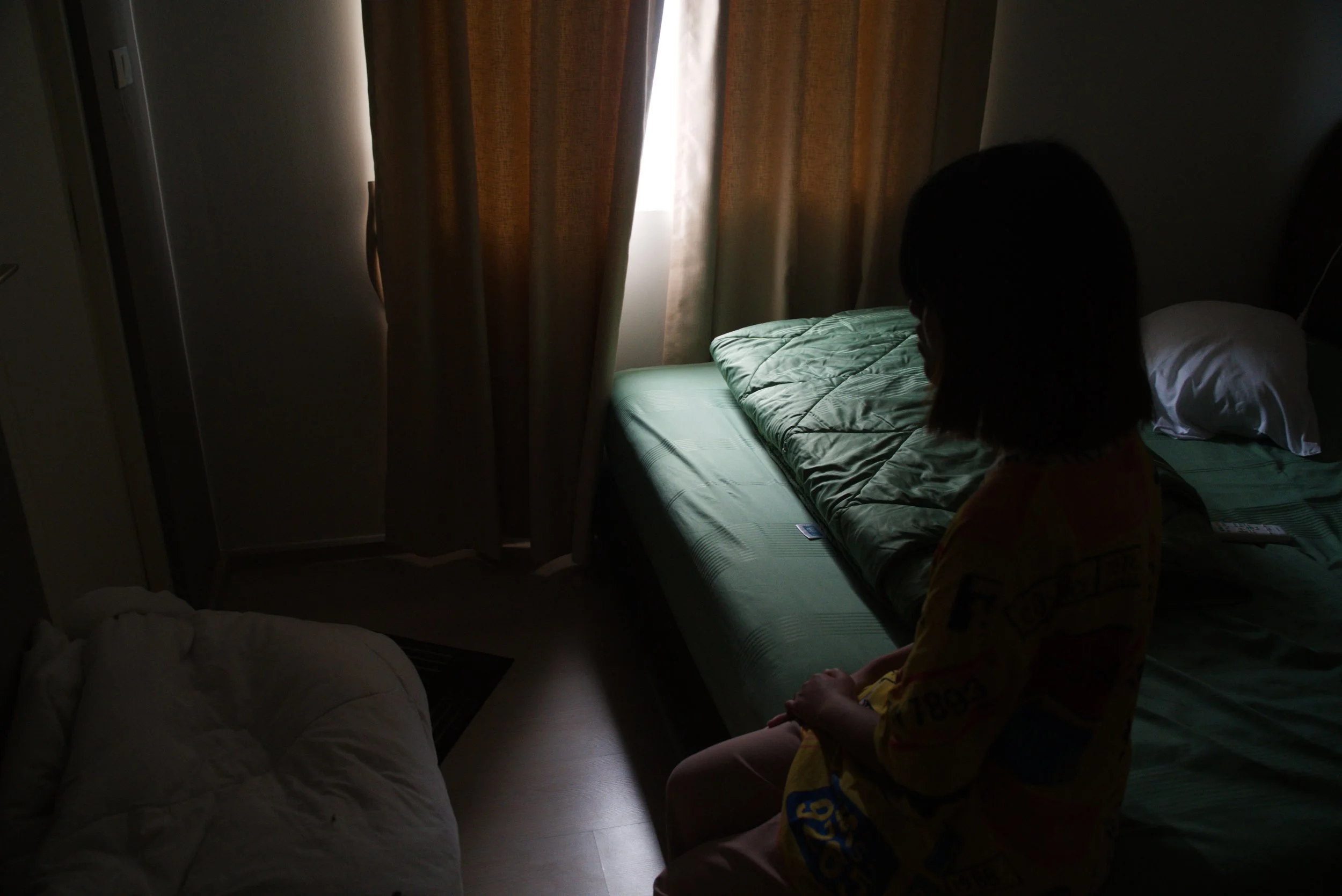
Khae, a scam trafficking victim
Using Other People’s Hands
After nearly three years of reporting on scam networks in Southeast Asia, I have come to see two elements at the heart of cybercrime operations.
The first is people who are forced into labor and made to deceive others. According to estimates by the Office of the United Nations High Commissioner for Human Rights, at least 120,000 people in Myanmar and around 100,000 in Cambodia have been coerced into committing crimes.
The second is mule bank accounts. These accounts are essential to moving and laundering money for scam operations.
Without these two elements, scam networks in Southeast Asia would not have the capacity to drain money from people around the world on the scale they do today. Yet stopping this system cannot be done by targeting one factor alone. It requires international cooperation, grounded in the United Nations Sustainable Development Goal 8 on decent work and economic growth.
The assumption behind this framework is simple: many people fall into these traps because they cannot access decent work where they live. That is why victims of scam trafficking come from almost every region of the world. It reflects a deeper reality — that access to stable jobs and fair income remains concentrated in major cities, pushing millions to seek work far from home.
If we continue to look at this problem in fragments — seeing those who lose money to online scams as greedy, or assuming that everyone behind a keyboard or phone is a willing scammer — we miss a critical truth. On the other side of the screen, many people are themselves deceived, threatened, and forced to follow orders.
As long as the world fails to recognize these connections, the greatest beneficiaries will remain untouched: the Chinese bosses who use other people’s hands to do their work and move their money as they remain hidden in the shadows, beyond the reach of accountability.



Facing history's darkest truths can liberate individuals and nations