
Emma Lazarus’ Song for 2026 America

Lazarus, c. 1872 (Wikimedia Commons)
At a time of celebration, I like to have a song in my heart. In this strange moment, when we observe 250 years since the Declaration of Independence while our profoundest assumptions and most valued institutions are being trashed by our present administration, what song meets my mood and offers the inspiration and meaning I need?
We have plenty of possibilities, each of them registering some core element of America’s past. The coming days will be filled with music. The “Star-Spangled Banner” will be there, iconically rallying us round the flag, reminding us how Francis Scott Key rejoiced that the flag was still flying after a day-long British naval bombardment of Fort McHenry in Baltimore during the War of 1812. His song taps the post-Revolutionary zeitgeist, whose deepest question was whether the new nation would survive the first full-fledged war since independence. These days its theme seems quaint and out of touch with 21st-century preoccupations.
The far more deeply loved “America, the Beautiful,” written in 1893 by our very own Cape Cod-born Katherine Lee Bates, captures the natural grandeur that fires our most romantic notions of America. Her second theme — “brotherhood” — grounds us in our post-Civil War search for reconnection and justice after an excruciatingly painful chapter. She acknowledges God’s immense gifts and asks God to crown all of that with the supreme gift of reconciliation. Her twin messages stand tall for any age, and perhaps more than any song provide a succinct subtext for America. But I'm looking for something more right now.
Going back a few decades, to the start of the Civil War in 1861, an earthy abolitionist song “John Brown’s body lies a moldering in the grave,” was Union soldiers’ song of choice when Julia Ward Howe and her husband traveled to Washington from New England. Howe befriended soldiers returning from the front in Northern Virginia and brought her powerful soprano voice to their communal singing. She later described how she was seized with inspiration one night in her room in Washington’s Willard Hotel and wrote new words to “John Brown’s Body,” broadening its message to a more universal and religious vision of the battle against slavery, expressed as part of a Christian vision of ultimate transformation. The Atlantic magazine paid her $4 for her poem — “The Battle Hymn of the Republic” — and published it in 1862. After the war, the song gradually transcended its earlier abolitionist ties and became, according to Jake Lundberg in this month’s Atlantic,“our national hymn.” Martin Luther King Jr. referenced words from the hymn repeatedly in his speeches, most memorably in his last speech on April 3, 1968, which ended with the words “Mine eyes have seen the glory of the coming of the Lord.” This past week, when The Atlantic’s July 2026 edition came through our mailbox, we found that its cover is a music sheet of “The Battle Hymn of the Republic.” The Atlantic offers us the “Battle Hymn” as the song for the moment.
What are my other candidates? In 1938, soprano Kate Smith asked Russian Jewish immigrant Israel Beilin, who had taken the name Irving Berlin, to compose something for her to sing in an event commemorating 20 years since the end of the First World War. Berlin rummaged in his piles of unfinished music scores and found “God Bless America,” drafted in 1918 but never completed. The song was an instant success and has remained an American staple.
But for those who felt that America’s struggles in the Great Depression were ignored by the jingoistic “God Bless America,” Woody Guthrie wrote a response, framed as a protest song. In the 1960s, Guthrie’s song became part of the canon of the anti-Vietnam War and Civil Rights movements, and folksingers like Pete Seeger and Bob Dylan expressed their debt to Guthrie, who had led them into the folk singing tradition. Today “This Land Is Your Land,” our greatest American folksong, perhaps has the most down-home popularity of any national song and coexists with “God Bless America” and the others enumerated above, in capturing elements of our national story.
Today, with the Vietnam War a demi-century behind us, things are no less complicated in America. The ongoing struggle for Civil Rights once again is forced to raise its game in the face of the shafting of the Voting Rights Act and a host of firings and discriminatory actions against Black people. Now, in addition, our immigrants are taking the brunt of the wrath of white nationalism.
Last week the Supreme Court rejected international norms of asylum by resorting to a picky, mean-spirited claim that you cannot apply for asylum unless your foot is already over the threshold. On the same day it revoked Temporary Protected Status for Haitians and Syrians — a promise of welcome given, and then summarily rescinded. At one stroke, all the 1.3 million immigrants who have Temporary Protected Status have been rejected from the lives they have built here. What options do they have? Return to the dire insecurities of their home country? Find some legal path to citizenship by other means? (Our experience has shown us few are able to do this.) Or remain as undocumented members of the population, hiding from Immigration and Customs Enforcement (ICE) and contributing to an underground economy?
Commentator Timothy Snyder has, rightly, called the tandem actions by the Trump administration and the Supreme Court “ethnic cleansing.” It is particularly focused on the Haitians in Ohio, who have been credited with “bringing back” the moribund economy of Springfield, Ohio, and who, as a result, have borne the brunt of our vice president’s lies and nauseating disparagement. But Springfield is not alone in benefitting from our immigrants. In a time of declining birthrate, immigrants have, for 20 years, been the backbone of our workforce.
What better song could there be for this moment than the words of Emma Lazarus, “Give Me Your Tired, Your Poor,” written in 1883 at the time of the raising of the Statue of Liberty, set to music by Irving Berlin in 1949. Lazarus, born into a Portuguese Jewish fifth-generation American family in New York City, devoted her life to helping Jewish immigrants who had escaped Russian pogroms. She offered her poem “The New Colossus” as part of a fundraiser for the plinth upon which Miss Liberty would stand. Lazarus died in 1887, just over a year after the erection of the statue, believing her poem had had its day. But 20 years later, the poem was resurrected and placed on a plaque below the statue. Berlin would make the final five lines into a song that touches hearts today just as much or more than it did when it was first sung.
The New Colossus
Not like the brazen giant of Greek fame, With conquering limbs astride from land to land; Here at our sea-washed, sunset gates shall stand A mighty woman with a torch, whose flame Is the imprisoned lightning, and her name Mother of Exiles. From her beacon-hand Glows world-wide welcome; her mild eyes command The air-bridged harbor that twin cities frame. "Keep, ancient lands, your storied pomp!" cries she With silent lips. "Give me your tired, your poor, Your huddled masses yearning to breathe free, The wretched refuse of your teeming shore. Send these, the homeless, tempest-tost to me, I lift my lamp beside the golden door!" - Emma Lazarus, 1883
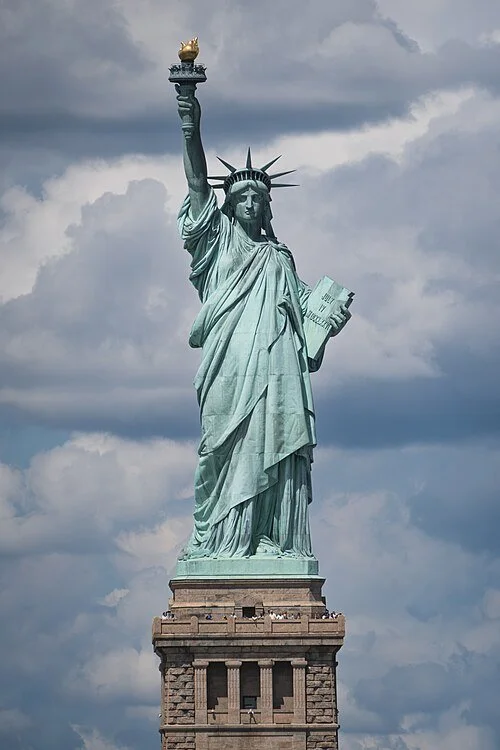
The Statue of Liberty. Liberty Island, New York City (Wikimedia Commons)
There are a host of wonderful recordings of “Give Me Your Tired, Your Poor,” and in the past week my husband and I have listened to many of them. Here is “Give Me Your Tired, Your Poor” sung by the Zamir Chorale at the 19th Annual North American Jewish Choral Festival in 2008, conducted by Matthew Lazar.


Facing history's darkest truths can liberate individuals and nations