
A Quiet Heroism
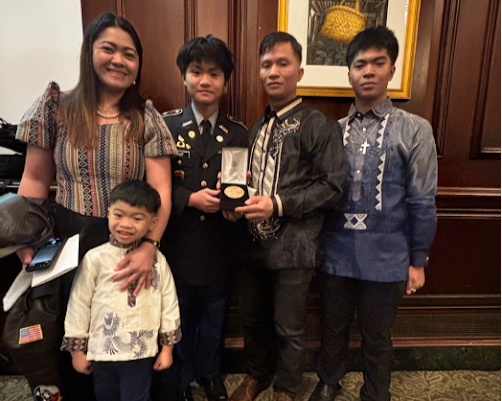
Retired Philippine Navy pilot Rio Tingson Pacit (3rd from left), together with his family, received his grandfather’s Congressional Gold Medal for fighting alongside U.S. soldiers during World War II. Photo by Che delos Reyes-Ferrer
At the Philippine Center in New York City, families have gathered for the 84th Araw ng Kagitingan or Day of Valor to receive the U.S. Congressional Gold Medal on behalf of Filipino veterans who fought under the U.S. command during World War II.
Among them was retired Philippine Navy pilot Rio Tingson Pacit, who received the award for his grandfather, Corporal Angelo Tingson. Pacit’s grandfather was among the 100,000 Filipinos and 10,000 American soldiers comprising the United States Armed Forces in the Far East, or USAFFE. A single faded certificate of that service had been enough to inspire Pacit to enlist years earlier. Now he had brought his son, Rio Michael, 17, hoping the moment would do the same.
The ceremony commemorates the fall of Bataan on April 9, 1942, when 76,000 starving and ill soldiers (66,000 Filipinos and 10,000 Americans) surrendered to Japanese troops after months of resistance and were forced to endure the more than 100-kilometer “Bataan Death March.” Thousands of Filipino and American soldiers did not make it to Capas, Tarlac – the march’s endpoint. More than 20,000 soldiers died at the POW camp there shortly after.
The Unseen Decision to Keep Going for Others
The Day of Valor began as a day of remembrance but now reflects wider resilience, like first responders during Super Typhoon Reming (international name: Typhoon Durian) in Albay, Philippines in 2006. Nonstop rains and volcanic ash from recent eruptions of the nearby Mayon Volcano resulted in massive mudslides that buried entire communities.
Colonel Ralph Y. Hibionada, then a young pilot, watched soldiers wade in the mud – not because they were ordered to, but because people needed help. They carried children to safety, guided the elderly, then returned for more.
"Sometimes, the truest test of a soldier is not how he fights," Hibionada said. "It is how he saves."
Now a Military and Police Adviser to the Philippine Permanent Mission to the United Nations, Hibionada defined kagitingan – valor – “not just courage in a single moment of battle; It is the quiet decision to stand firm, again and again, despite fear, despite uncertainty, despite the cost."
This, he said, is what kagitingan looks like now: not a single act of bravery, but the daily, unseen decision to keep going for others.
Telling the Stories of Heroism
The Gold Medal honors some 260,000 Filipinos who fought under U.S. command, their benefits stripped by the 1946 Rescission Act and not fully restored until much later. Families now receive the awards for veterans who did not live to see them.
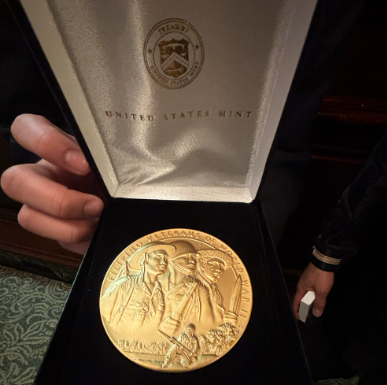
Caption: The U.S. Congressional Gold Medal is the U.S. Congress’ highest civilian award. Photo by Che de los Reyes-Ferrer
Colonel Sonny Busa, Regional Director of the Filipino Veterans Recognition and Education Project, described his years lobbying Congress. He would walk into the office of senators representing states with few Filipino constituents and try to convince them to support the policy. "It's not going to cost you a dime," he would tell them. "And it's the right thing to do."
What worked, he said, was persistence: showing up and making the case in person.
Busa knows the weight of this history firsthand. His father-in-law survived the Death March. When Busa met him as a young West Point graduate, the man said nothing about his own service.
"The true heroes never talk," Busa said. "You can tell by their mannerisms, by their eyes."
Ceremonies like this one matter because they tell the story anyway. "You have to have a ceremony," Busa said. "You have to show. You have to tell the story."
For Rio Michael, the long delay in recognition for his great-grandfather “doesn't really matter.” “I'm just glad that he got it in the end," he said, adding that he hopes more families see their ancestors honored because of the example it sets.
"This opens my eyes to how deep the courage runs in the blood of the Philippines," he said. He is in high school and said he hopes to attend West Point after graduation.
Everyday Endurance Abroad
Hibionada took the idea further, extending kagitingan beyond the uniform – to the millions of Filipinos working abroad whose sacrifice, he argued, is just as heavy and just as worthy of honor.
He praised Overseas Filipino Workers – more than 10 million abroad – for carrying a courage as real and heavy as any soldier's. They endure years apart from family, long hours in unfamiliar places, all to secure a better future back home. Their 2025 remittances hit $35.63 billion, over 7% of the Philippines' GDP.
Filipino nurses, who make up 33% of U.S. immigrant RNs, held the line on COVID frontlines far from their own families.
In the Middle East, OFWs weigh conflict risks against poverty at home. Seafarers manage emergencies at sea that rarely make news. New York's Filipino communities keep bayanihan alive – mutual aid that preserves language and ties without fanfare.
The 84th Araw ng Kagitingan arrived amid ongoing crises: wars displacing millions, borders closing to the same migrants whose labor sustains economies, and institutions bending under pressure.
In a world that often forgets, these ceremonies insist on the telling. Soldiers wading in mud, nurses at bedsides, workers opting to stay in conflict zones so that they could continue sending money home, fathers passing certificates to sons. Kagitingan endures as the choice to keep going for others, again and again.
That spirit did not end in 1942. "It simply changed form,” Hibionada said.
“Today, heroism is not always loud; It is not always seen,” he added. “More often it lives in quiet, consistent acts of service.”
Listening to many roots in a restless, unfinished democracy