
Unhappy Island
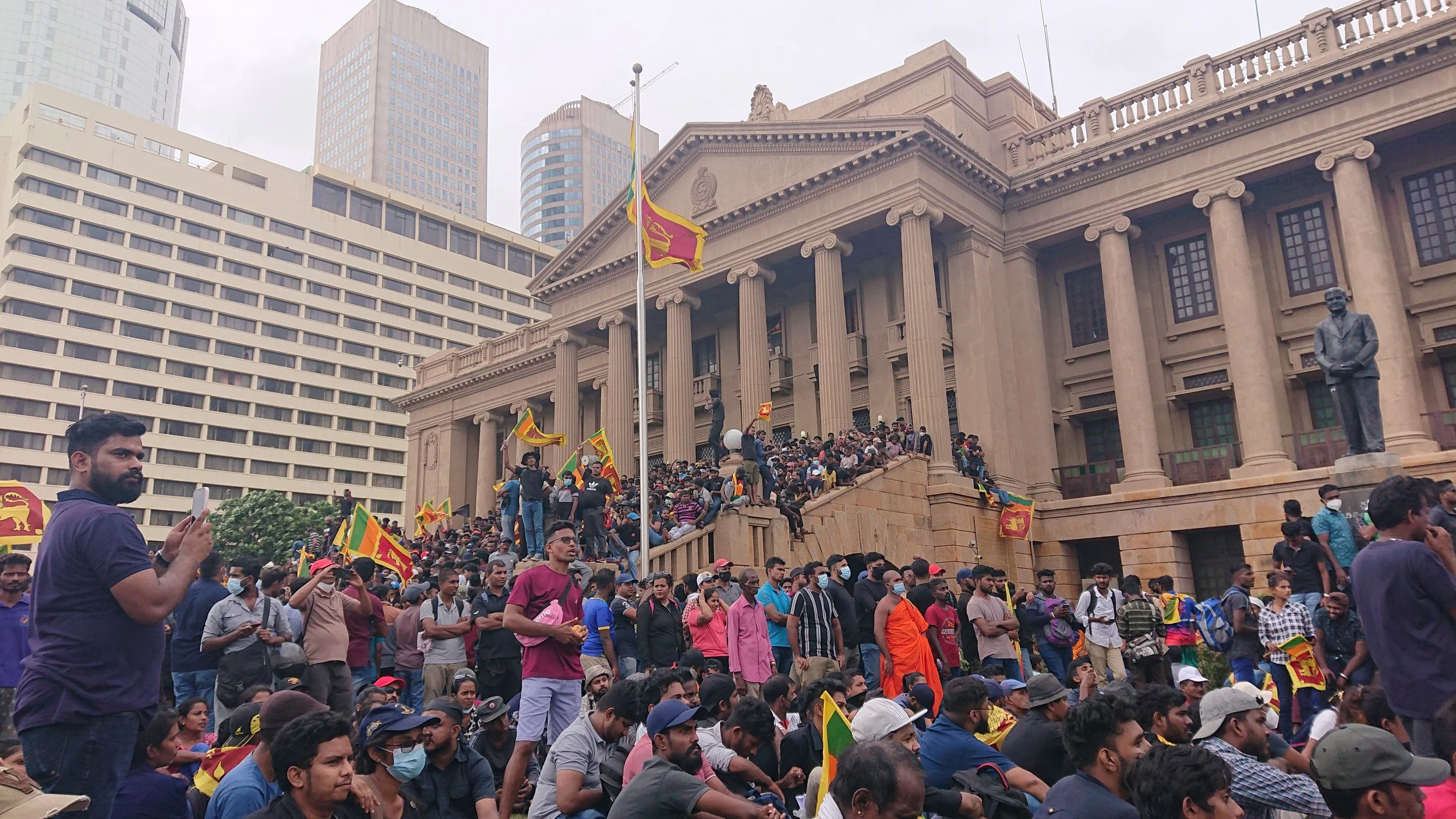
Sri Lankan protesters at Galle Face Green, Colombo, July 9, 2022. Photo by Dhananjaya Samarakoon
My country, Sri Lanka, ranks 134th in this year’s World Happiness Report. That’s 134 out of 147 countries. Sandwiched between two African nations, Zambia and Ethiopia, it lies ahead of countries like Egypt, Lebanon, Botswana, and Yemen – all in Africa or West Asia – and trails behind India, Pakistan, and Myanmar. Indeed, it is the least happy South Asian country, barring Afghanistan, which is the unhappiest of them all.
The World Happiness Report ranks countries on the basis of six factors: GDP per capita, social support, healthy life expectancy, freedom to make life choices, generosity, and perceptions of corruption. It also uses a benchmark it calls “Dystopia,” which is “an imaginary country that has the lowest scores observed for each of the six variables.” All countries are then compared with Dystopia, the report said. While it is hard to quantify happiness, these criteria go some way in explaining why some countries are happier than others and why others are not happy at all.
What is interesting is that Sri Lanka ranks even lower than several countries that are currently caught in war, civil war, and ethnic unrest, including Myanmar and several other African states.
A Double Whammy
Of the six factors, it is GDP per capita that explains Sri Lanka’s dismal position. In terms of the other factors, such as health expectancy and social support, the contribution to the total score is minimal or barely visible. Thus, the dominant factor appears to be economic – which is striking, given that Sri Lanka is often portrayed as an economic success story even if the numbers say otherwise.
We need to put this in context: four years ago, Sri Lanka experienced its worst economic crisis since its independence in 1948. I witnessed young and old people alike on the streets, cursing the government and hoping for something better. For the longest time, Sri Lankans have felt that a better society was within their grasp, but that various factors have kept them from progressing. The 2022 crisis was the last straw. For more than six months, people camped together to drive out a government.
Sri Lanka has made some progress toward recovery since the crisis, according to some metrics. The government back then negotiated an agreement with bilateral and multilateral creditors and implemented a debt restructuring program that cut the country’s external debt but at the cost of structural and fiscal reforms. These reforms had wide-ranging impacts and disproportionately affected the poor and the vulnerable.
Among the most radical and impactful of these was cost-reflective pricing for energy and other commodities, which were subsidized before the crisis. With artificial controls lifted, markets allowed prices to fluctuate freely, inflicting a double whammy on those who could least afford it.
Crisis and Recovery
As a millennial growing up in the 1990s, I have witnessed Sri Lanka going through several cycles of crisis and recovery. The 2022 crisis, which will have its 5th anniversary next year, felt different. There was an economic aspect to the crisis – decades of fiscal indiscipline underpinned by years of unhealthy borrowing from capital markets and other lenders.
But there was also a social dimension: for the first time in its post-independence history, citizens mobilized to demand not only reform but to rupture the status quo. They called this vision “system change” and described their rebellion as an uprising – an “aragalaya.” The question was simple: would the political system transform to accommodate them or would it remain the same?
There has been progress in some respects. Elections have changed the country’s political trajectory and, in many ways, its political culture. Calls to end elite impunity were central to the 2024 elections. Those calls have largely been met within the framework of an electoral democracy. Entire political families and dynasties have been swept out of power. These electoral shifts followed elsewhere, especially in South Asia and Southeast Asia.
Yet in many ways, people in Sri Lanka feel that more needs to be done. The view is that the uprising of 2022 has not run its course but has instead meandered into compromises and patchwork solutions that have delivered little justice for people.
A Vulnerable State
I believe this conundrum explains the sentiments on the ground as reflected in Sri Lanka’s World Happiness Report ranking. Sri Lanka’s GDP per capita and its social support system have fundamentally ruptured since 2022. Indeed, one could argue they began to unravel in 2020, with the onset of the COVID-19 pandemic.
Once you consider these points, it becomes easier to understand why freedom to make life choices, the next key factor that explains the ranking, has taken a hit. Sri Lankans have lost hope in the economy, not just in the prospect of recovery – which, to many, seems distant – but also in the support systems that were in place before the crisis.
In foreign press coverage, Sri Lanka is touted as a paradise getaway – the pearl of the Indian Ocean – or conversely, the teardrop of the Indian Ocean. A diverse and multicultural society, it has been through wars and conflicts, yet was able to pull itself together despite an unstable political order and economic system.
Sri Lanka is also a vulnerable state, especially to aftershocks from conflicts and tensions elsewhere. The situation in West Asia – the US-Israel attacks on Iran – has again brought home the country’s inherent fragility. Against this backdrop, the low ranking comes as no surprise. It is what Sri Lankans feel, and it reflects the mood of other states which can do little to absorb aftershocks from crises not of their own making.
In 2024, I was the research lead of a documentary production – Beena Sarwar’s “Democracy in Debt: Sri Lanka Beyond the Headlines.” I spoke with villagers in the rural heartland of Sri Lanka and was struck by how people on the ground conveyed their displeasure at a political system that they said had careened out of control into what they perceived to be an abomination. The people in power ceased to represent them and lost accountability. One farmer put it in perspective: when the rulers renege on their duty, the entire country suffers
All this is to say that Sri Lanka is still an unhappy nation. Perhaps it feels that unhappiness is its fate. This is driven by factors not of their choosing. If recent developments, including a fuel crisis, are any indication, people still hope for better days. Yet they know that those days remain as far away as they were four years ago.
*The opinions of contributing writers are their own and do not necessarily represent the views of We Are One Humanity. Submissions offering differing or alternative views are welcome

Reflections of a wanderer