
Nostalgia for the ‘Raj’
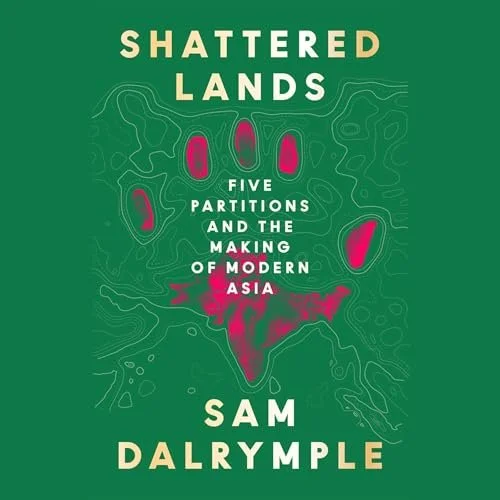
Author and former Indian diplomat Pascal Alan Nazareth takes a critical look at Sam Dalrymple's "Shattered Lands," an exhaustively researched account of the British Indian Empire's collapse into 12 fractured nations — arguing that its selective silences betray a nostalgia for the "Raj" that serious readers should approach with caution.
“Shattered Lands” narrates how the “Crown Jewel in the British Crown — a vast swathe of Asia stretching from the Red Sea to the jungles of South East Asia and home to a quarter of the world’s population” — shattered in just 50 years and 5 partitions into the 12 nations of India, Pakistan, Bangladesh, Burma, Bhutan, Nepal, Bahrain, Kuwait, Oman, Qatar, United Arab Emirates and Yemen.
The author, Sam Dalrymple, provides detailed information on all the five partitions and has cast their prime aspects into historical perspective. This testifies to his deep knowledge of history and wide spectrum research, and enhances this book’s value and impact. However, the great surfeit of detail in every chapter has given this book its mammoth 520-page size and made it a daunting challenge to go through and review.
Examples of the surfeit of details are the three pages given to The Simon Commission’s five-week travel from London to New Delhi, with even quotes from Sir John Simon’s letters to his mother en route to New Delhi included in them. Muhammad Ali Jinnah is given five pages. Among the innumerable details written about him are his initial keenness to be a Shakespearean actor, “scandalizing Bombay High Society by courting and marrying 18-year-old Ruttie Petit, the most envied debutante of her generation,” his great disappointment that Gandhi’s “religious politics” proved more popular than his, and his finally leaving the Congress Party “after many months of despair.” The book also included the founding of this “former Ambassador of Hindu Muslim Unity” of “the World’s first Islamic republic” 20 years later.
The first chapter, titled “The Great Uprising,” is about Burma’s partition from India and the 15-month “anti-partition Saya San Rebellion it spawned.” It is averred to be “the biggest and most sustained revolt in post-1857 British Raj.”
The chapter also pointed out the following notable facts:
In its entire 14-month travel from Bombay to Rangoon from February 1928-April 1929, the Simon Commission “conspicuously failed to meet Mahatma Gandhi, who along with Jinnah, would change the face of Asia forever.”
Gandhi was “one of the last few people to traverse the vast distance from Aden to Rangoon while it was still part of the British Empire.”
Gandhi visited Rangoon to meet his law school friend Pranjivan Mehta who had "bankrolled his Satyagraha activities in South Africa as also the Burma wing of the Congress party.”
The Burmese were greatly disappointed that Gandhi did not support them on the Partition issue. Worse still, in an address to Rangoon’s Gujarati community, he averred "Burma was not a part of India’s ancient geography.”
Gandhi’s 1930 Salt Satyagraha is lauded “an act of political genius and one of the last major political movements to unite Indian and Burmese nationalists.” It is averred that for him, “the political and spiritual were inseparable, and his message of non-violent struggle transformed him into a pan-Indian figure and perhaps, the single most famous person in the world.”
Surprisingly, no mention is made of Gandhi’s March 2, 1930 letter to Viceroy Lord Irwin, written on the eve of the Salt Satyagraha, in which he rued British rule as a "curse” which had “impoverished India through economic exploitation, reduced its people to political serfdom, undermined their culture and degraded them spiritually.”
In the chapter titled “The First Partitions of India,” the separation of its eastern and western wings is presented, and the following notable developments pointed out:
"Brand new questions arose in the newly fragmented Indian Empire. What would happen to Indians in Burma, to Burmese in Aden, and Arabs in India.”
With Burma’s separation from India, one-fifth of the Nagas were left in Burma and four-fifths in India. This created the thorny problem of cross-border insurgency.
In the chapter titled “The Drums of War,” it is averred that within five years of its separation from India, "Burmese politics took on a dark turn and embarked on the road to an ethno-nationalistic state.” In this context, the following notable facts are pointed out:
In December 1939 U Saw’s Myochit Party received a seal of approval from “Volkeischer Beobachter,” the Nazi Party newspaper.
Indians were systematically boycotted. In the first trickle of Indians departing Burma, was future Nobel laureate Amartya Sen, whose father was a Visiting Fellow at Mandalay University.
Even in India, the World War II story is still told as if it was Eurocentric despite it being “the most widespread conflict in Asian history since the Mongol conquest.” In a few months, it had spread from eastern China to western India and had claimed 30 million lives.”
In the chapter titled ‘The Long March’, the hasty evacuation from Rangoon of diverse communities as Japan’s Army advanced towards it, is presented and the following notable facts are pointed out:
Whereas British citizens, Anglo-Indians, Goans, “big merchant Chettis and Gujarati banias” were evacuated by air and ship, “ordinary Indians” had to do this “Long March” to India over the Patkai Hills on foot. At that time it was “the largest mass migration and refugee crisis recorded.”
“The speed of the Japan Army’s advance towards Rangoon was astonishing.” Within a month of the Pearl Harbor bombing, half of Burma’s southern isthmus had been captured. Its success was partly due to the 20,000-strong Burmese Independence Army (BIA) led by the “Heroic Thirty Comrades” that accompanied it.
In the chapters titled “Liberation” and “The Partition of Pakistan,” the author averred:
"The year 1971 remains the most significant in the history of postcolonial South Asia. In just nine months, 10 million Bengali refugees crossed into India, thousands were rendered homeless, Pakistan was cut in half, the U.S. and Soviet Union risked nuclear war and the South Asia map was entirely changed."
Time Magazine reported that 563 Bengali women were forced into sex camps at Pak Army’s Dacca cantonment. Subsequently more evidence emerged to corroborate this report. This made these sex camps “the most vile and contemptible aspect of the 1971 Bangladesh war.”
The 1971 Bangladesh War is the first subcontinental war since World War II. In its first three days (Dec. 3-5), India established supremacy in the eastern sector. In the western sector its success initially looked uncertain but “by December 7, President Nixon felt he was "backing the losing side.” He instructed Kissinger to prepare a plan to counter this. The plan the latter made envisaged Iran and Jordan sending American aircraft to assist Pakistan, China massing troops on the Indian border and the USS Enterprise aircraft carrier being moved into the Bay of Bengal. This “harebrained plan, if implemented, would have brought South Asia and the world to the most critical point since the Cuban Missile crisis as this aircraft carrier was being tailed by a Soviet nuclear submarine.” Luckily, for South Asia and the world, Premier Zhou Enlai assessed East Pakistan could not be saved and by the time the mentioned carrier entered the Bay of Bengal, “Bangladesh was already a fact, Pakistan was half its size and India had emerged as South Asia’s only major power. Most ironic of all, Pakistan, once billed as the homeland for South Asia’s Muslims, now had fewer Muslims than India and Bangladesh!”
In the Epilogue, the author averred:
“In just 50 years between 1931-1971, five partitions divided the Indian Empire into 12 separate nation states. Today, these lines have become so embedded in our consciousness that it is easy to forget there were other possibilities for a post-colonial South Asia.
Prominent South Asian leaders like Jawaharlal Nehru and Aung San had spoken of an “Asiatic Federation in the not distant future encompassing India, Pakistan, Burma and Ceylon. But Asia’s new states were born resentful of one another and suspicious of their minorities.”
“For almost two millennia, South Asian communities and cultures had spread across Asia from east Africa to South East Asia. As European empires collapsed, these ancient links could have been rekindled; instead new national identities have been hardened and many communities have been left on the wrong side of new borders and suppurating wounds that bleed into the present have been created.”
Bengal was annexed by the British East India Company in 1757, just 50 years after the Act of Union with Scotland and nearly 50 years before the Act of Union with Ireland. The region of modern Bangladesh was once crucial to the very formation of Great Britain yet today most Brits are unaware of this.”
These assertions of the author, along with his earlier ones extolling the benefits of a "vast swathe of Asia, which used the Indian Rupee, issued Indian Empire passports and enabled people holding them to travel freely through all parts of it," “modern Bangladesh being crucial to the very formation of Great Britain” and “the new borders having created suppurating wounds that bleed into the present” are clear indications that the prime purpose of this book’s author is to extol the benefits of the “Raj” and ensconce its many evils. That he has made no mention of Gandhi’s March 2, 1930, letter to Viceroy Lord Irwin about British rule of India being a "curse,” despite it having been written on the eve of the Salt Satyagraha, which he has extolled as a “stroke of genius” is further weighty proof of this.
Reputed scholars who have researched why British rule of India was a "curse” have written as under:
Angus Maddison, in his book “Contours of the World Economy”: "India's share of world income in 1700 was 22.6% and was comparable to Europe's share of 23.3%. In 1950, India's share had fallen to 3.8%."
Nobel laureate Amartya Sen, in his “The Idea of Justice” book, has pointed out that in the 1770-1947 period there were 11 major famines in India in which 46 million people died, four million of them in the 1943 Great Bengal Famine. He has averred, “Famines, a persistent feature of the British Indian Empire, ended quite soon after India independence.”
Will Durant, in his “The Case for India” book, has written: "In India, I saw a great people — one-fifth of the human race — suffering poverty and oppression greater than any found elsewhere on earth. The British conquest of India was the invasion and destruction of a great civilization by a trading company utterly without scruple and greedy for gain."
Hugh Tinker, in his book, “A New System of Slavery: The Export of Indian Labor Overseas 1830-1920,” has pointed out that during the mentioned period British India transported 1.6 million Indians to labor in its plantations and railway projects in colonies as far apart as Fiji in the east and the Caribbean in the west, “as a substitute for slave labor, following abolition of the slave trade in the British Empire in 1833.” He has also indicated the first such transportation was on the Atlas voyage to Mauritius in 1834.
Regarding the author's assertion that “new national identities have created suppurating wounds that bleed into the present," the facts are as follows:
India was partitioned on religious lines by the British despite it being a multi-religious society for many centuries and its Gandhi-led nonviolent freedom struggle being waged by patriots from all its religious communities.
The new state of Pakistan created for India's Muslims had two parts, one in Punjab, the other in Bengal with 1,500 miles of Indian territory between them! This amazing geographical surgery was made on the basis of a “Partition Line” drawn by a British Cartographer who had never been to India and knew nothing of its political and social complexities. Worse still, the “Partition Line” was announced two days after India and Pakistan attained Independence. This was the prime cause for the mass panic and exodus of Hindus and Sikhs from Pakistan to India and Muslims from India to Pakistan and the ensuing worst communal massacres in India’s long history, in which at least 600,000 people were killed.
Despite being divided on religious lines, India adopted a secular constitution based on universal adult franchise. It has steadfastly safeguarded it despite attempts by ambitious and bigoted politicians to replace it.
Within 15 years of India's Independence, Jawaharlal Nehru created the Non-Aligned movement and brought over 100 Asian, African and Latin American countries into it. It was and still is the world's largest “anti-war” peace movement.
Gandhi’s “Soul Force” revolution ended not only the British “Raj,” but all European Empires. Between 1947-1997, over 100 of their colonies were decolonized. This was the most radical transformation of the global power structure and its democratization and trajectories of progress, in history.


Reflections of a wanderer