
Ukraine, Gaza, and the Realities of Settler-Colonialism
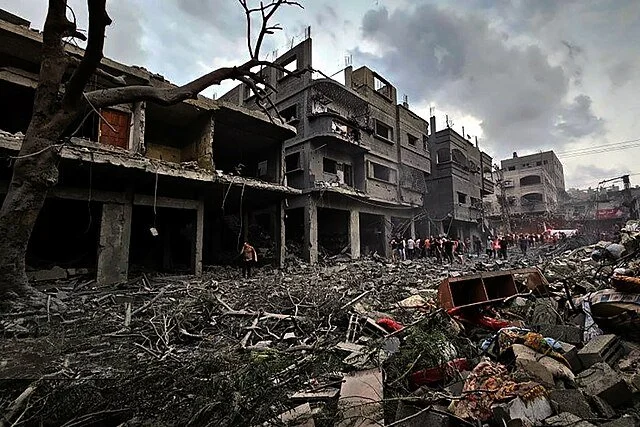
Photo of Destruction in Gaza Strip during 2023 War (Attribution: Fars Media Corporation, Wikimedia Commons)
In the days following the 7 October attacks in 2023, there was a wellspring of support and sympathy, first for the families of those abducted by Hamas, second for Israelis in general, and third for Israel as a state and a country.
It did not take long before sympathy for the first and second of these groups became justification for the most horrendous tactics by the third. The result, two years on, is that despite a staggering number of experts, activists, and institutions – including Israeli human rights organizations – using the “G” word – genocide – there is also a staggering level of denial about those accusations.
The argument that Israel was within its rights to defend itself against these attacks quickly gained traction. On the face of it, the argument made sense. No sovereign country deserves invasion and incursion – though if this principle is applied in general today, we would have to censure powerful states for doing the same in other sovereign nations: the US’s actions in Venezuela being but one example.
But very soon the Israeli government, led by the most far-right set of leaders in the world now, weaponized the self-defense argument against a group of defenseless people. The situation has only worsened since.
Blue eyes and white skins
As a member of the “Global South”, I found it intriguing, if not appalling, that the most virulent critics of Russia’s invasion of Ukraine were sidestepping or overlooking the issue of Israel’s counterattacks on Palestine, in Gaza and the West Bank. The excuses given ranged from Israel’s right to self-defense to Hamas’s use of human shields. These were arguments which in other contexts, including in my country Sri Lanka, had been rejected by the same governments which were now defending Israel.
This was, of course, not the first time such selectivity was on display, nor will it be the last. When Ukrainian refugees found their way to Europe in 2022, we had analysts, whom one thought should have known better, who expressed their sympathy for them based on blue-eyes, blonde hair, and white skins. At the time, rather cynically, I noted on social media a rather telling exchange from Woody Allen’s Deconstructing Harry.
Harry: If a Jew gets massacred, does it bother you more than if it’s a Gentile or a black or a Bosnian?
Doris: Yes, it does. I can’t help it. It’s my people.
Harry: They’re all your people!
To which Harry’s half-sister replies: “You’re a self-hating Jew.”
The passage reveals very clearly the contradiction in the European reaction to Ukraine. On the one hand, there was a feeling that Ukrainians were “my people”, and that everything must be done to prevent the plight that has befallen “third world countries”, seemingly “lesser” civilizations or societies, from swamping theirs.
The paradox of Ukraine and Gaza
On the other hand, there were attempts, particularly by Western governments, to frame the Russians as colonizers and the Ukrainians as victims of colonialism. Ukrainian President Volodymyr Zelenskyy tried to sell this line in countries like India and other parts of the Global South which had not taken concrete positions on his country. As I noted in a short podcast I did with two friends around the time, however, this argument did not quite parse, for three reasons.
The first was the barely concealed racism in the European reporting on the Russia-Ukraine War. When you have newscasters and journalists openly bemoaning immigrants because they happen to be white, then bemoaning the situation in Ukraine as something out of a “Third World country”, how can you invoke colonialism and all its negative, racist discontents to justify support for Ukraine in the Global South?
The second was the rift between the moral justification for the Ukrainian cause and the massive amounts of military aid which Western governments gave to the country, along with a huge uptick in profits of arms corporations.
The defense industry quickly became the beneficiary of increased Western assistance to Ukraine. This was on a bill footed, as critics of US intervention in Ukraine claimed, by the American taxpayer. The resulting backlash against Ukraine, under the current Trump administration, has led to an impasse in that country and in Europe in general. Simply put, Ukraine and the EU are caught between a US which thinks it has been subsidizing NATO at the expense of Americans, and a Russia that thinks it has nothing more to lose from protracting the war but very little to gain from pausing it.
The third, and to my mind the most consequential reason, was Gaza. I have personally witnessed, at seminars and other gatherings, Western ambassadors and political leaders asking officials from my government to take stock of our colonial past and to treat Russia as she would any colonial state.
This was, of course, before Gaza. The realities of Israeli occupation have only hardened over the last two years. And yet, Western governments, barring the occasional cosmetic press release, seem loathe to describe what is happening in Gaza and the West Bank as settler-occupation, despite Israeli historians, journalists, and human rights activists themselves being brave enough to do so. That even Ukrainian citizens themselves are breaking the taboo here only begs the question why these governments are unwilling to call an ongoing destruction of an entire population for what it is.
Bottom line: Solidarity with everyone, everywhere
None of this is to undermine the Ukrainian cause, whatever Western governments may make of that cause. As countless op-eds have pointed out, it is possible to be morally consistent on Ukraine and Gaza. Yet Western governments, which urge countries in this part of the world to take firm positions against settler colonialism, while framing Russia’s intervention in Ukraine as a colonial enterprise, seem unwilling to look at the faces of the people of Gaza. It was only a year or so ago, at a Democratic Party convention in the US, after all, that party supporters reacted in the most grotesque ways to protesters holding pictures of victims of drone and bomb attacks in Palestine.
We are better than this, and we should be. To be morally consistent, to take the same stance regardless of the time and place, is not too much to ask for. Looking at the Western response so far to these issues, however, it seems that for some governments, it is. Not so when it is in Ukraine, but especially so when it is in Gaza.



A Review of Rajmohan Gandhi's James Lawson, Teacher of Satyagraha