
The Ripple Politics of Conversation
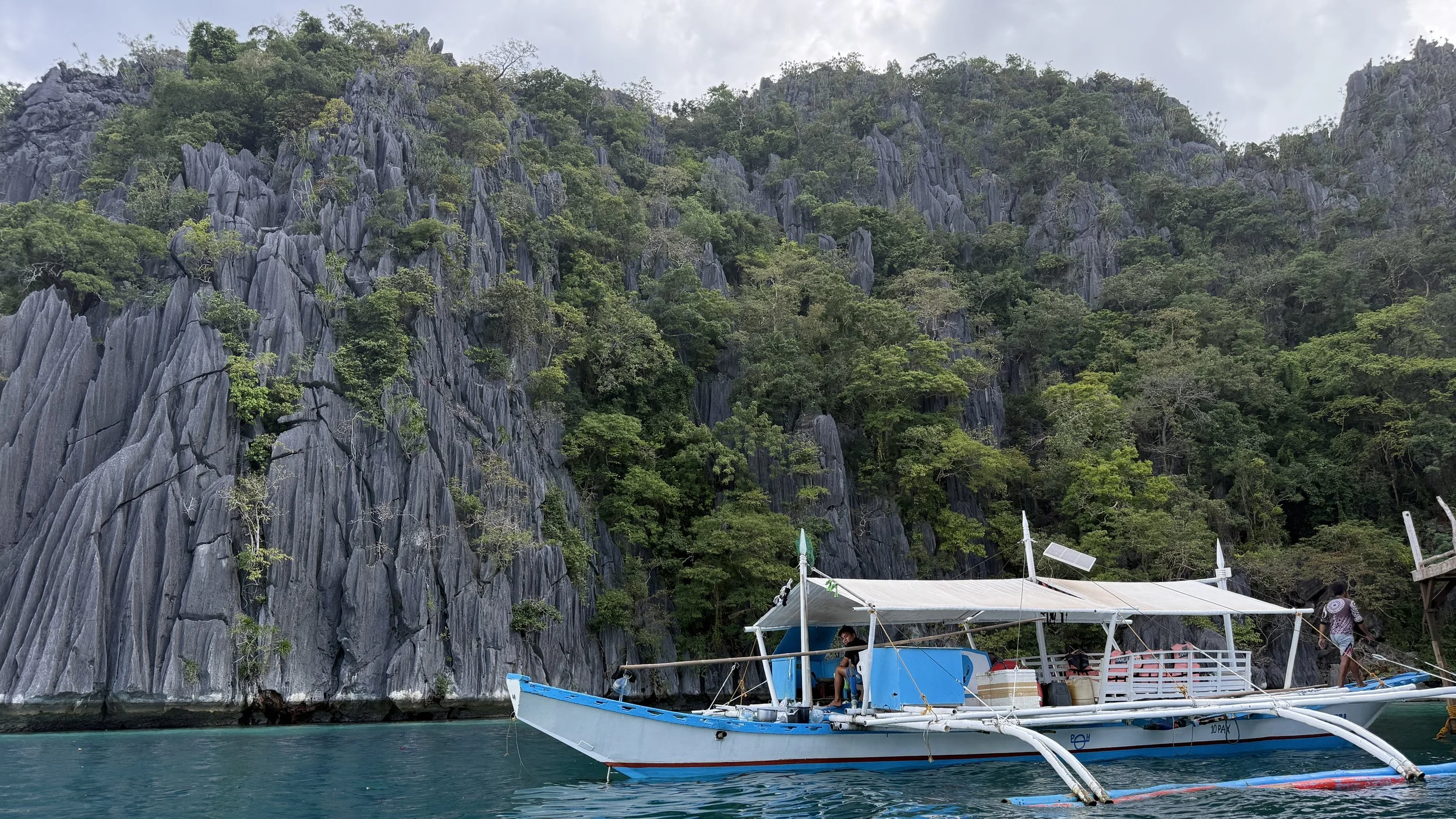
A spider boat in Coron, an island in the Philippines transformed by mass tourism (Photo attribution: Carol Chen)
In late December 2025, China conducted one of its largest military exercises around Taiwan to date. The People's Liberation Army deployed 18 naval vessels and 14 China Coast Guard ships in what it called an "encirclement" operation, testing blockade tactics and firing missiles closer to Taiwan's coast than ever before. By the time I landed at Songshan Airport in Taipei a week later, the drills had concluded, but the tension had settled into the air like humidity.
As our plane hovered over the island, I could see the outline of its coastlines from only a few hundred feet up. For me, Taiwan was not geographically distant—I grew up on the opposite coast, a mere hour-flight away. It was not culturally or linguistically foreign either. I had read its most famous writers growing up—San Mao, Pai Hsien-yung—and I spoke its language, Mandarin.
But I had waited a long time to be here. Travel between the island and mainland China has always been fraught. Taiwan dropped its ban on Taiwanese citizens traveling to China in 1987, but China did not lift its ban until 2005. In 2020, under pandemic policy, China banned all tourism to Taiwan again. The tension felt palpable before I even landed: a gentle voice over the intercom announced, "Please do not take pictures over the airport."
I stepped off the plane nervous, expectant. I wondered how locals would react to mainland visitors. While uncommon, those with long-term residency in third countries were still allowed to visit. What surprised me was not hostility or wariness, but something closer to indifference—the good kind, the kind that says you're allowed to just be a person here.
My taxi driver, an unassuming middle-aged man, loaded my suitcases into the car and pointed out all the best eateries on the way into the city. We got to talking about food. He assumed I would be used to eating spicy dishes because that's the stereotype about central China, but I told him we actually ate a lot of simple dishes where I'm from—soy sauce poured over vegetables, freshly caught fish, typical of coastal cities like Taiwan. I remember the surprised look on his face and a genuine delight that I would likely appreciate his cuisine recommendations.
The conversation turned to the economy. He asked about unemployment in mainland China. I told him about the official youth unemployment rate, which was about 17 percent, and about my college roommate who moved back in with her parents after months of rejection emails. He nodded slowly. His nephew graduated with an engineering degree last year, he said—now he's working in a convenience store. Taiwan's youth unemployment is officially lower, around 12 percent, but the statistic doesn’t capture the frustration. He'd seen social media posts claiming Taiwan was collapsing while China prospered. But hearing me, he realized both shared similar struggles.
At a Confucian temple in Eastern Taiwan, an old grandmother noticed me fumbling with the incense sticks that one would offer on the altars, looking frantic and clueless. She waved me over and gave me a map of the temple with the order of the deities one is supposed to pay respects to. I went to temples with my grandmother when I was little too, but Chinese and Taiwanese confucian traditions differed by quite a bit. When I got flustered that I had been sticking the incense in the completely wrong direction, she said with a kind smile that it was okay to have different rituals, as long as we share the same reverence for those who have powers beyond us. She must have known that I was mainland Chinese but, despite that, she offered me a hand in shared heritage and kinship.
These interactions didn't erase the military exercises or tamper the inflammatory political rhetoric. But they created small refusals. Refusals to accept that I was a threat, that she or I was an enemy, that our differences mattered more than our similarities.
Months later, I visited Coron, a place known for its dramatic ocean-mountain landscapes in the tourist-heavy Palawan province of the Philippines. I found myself on a spider boat, so named for its eight sprawling legs extending from its body into the water. The arachnid-like vehicle carried me through waterscapes, sliding inside caves and around jagged coastlines—it was more agile than its shape suggested.
My captain for the day was Erald, a quiet, young guy who was new to being a boat guide for tourists. He had only started after the pandemic. Before that, he was a fisherman all his life and still fishes when he doesn't have trips booked.
I asked him what it was like to see his town transformed by mass tourism. He didn't romanticize it. A day with tourists pays ten times what fishing does, he said, but the wealth doesn't distribute evenly. The Philippines ranks among the world's most unequal countries, and he feels it directly. He can only get clients through his tour agency, which takes around 40 percent of the total booking price, leaving just 60 percent to split between him and his two fellow crewmen. All the boat maintenance costs fall on him.
I thought about something I'd read before my trip. Just weeks earlier, the Philippines had implemented a new visa-free policy allowing Chinese nationals to enter for up to 14 days. It was a calculated move to revive tourism—China had been the Philippines' second-largest source of tourists before the pandemic, with 1.8 million Chinese visitors in 2019. By 2024, that number had collapsed to just 312,000. The government was betting that easier access would bring them back.
So I helped Erald set up an account on a popular Chinese social media platform so he could connect directly with travelers. This week, he got his first Chinese client.
This is where the limitations and possibilities of these small exchanges become clear. My conversation with Erald couldn’t change the structural inequality of tourism economies. It didn't reform labor practices or redistribute wealth. But it did create a practical pathway for him to bypass an exploitative middleman, even if just for one booking.
Political scientists talk about "bridging social capital"—the connections that link different communities and create pathways for cooperation. These conversations are acts of bridge-building, tiny infrastructural improvements in the landscape of human understanding. They don't replace policy. But they create the cultural conditions that make better policy possible, or at least make cruel policy harder to sustain.
These exchanges can also scale through storytelling. The taxi driver might tell his family about the mainland visitor who challenged his assumptions. Erald might tell other fishermen about the tourist who helped him get clients directly. I'm writing this now, sharing what these people taught me. In concentric circles, we carry these stories back to our communities. Over time, this builds something like cultural antibodies against propaganda that requires dehumanization to function.
I don't believe we can achieve diplomacy simply by talking to each other. That would be naive. But I do believe that ordinary people refusing to accept simplistic narratives about each other lays groundwork that policy can build on—or at minimum, creates friction against policy that relies on seeing other people as monoliths or monsters. It's harder to wage war against people you've shared a meal with, harder to write cruel policy about communities you've listened to.
*The opinions of contributing writers are their own and do not necessarily represent the views of We Are One Humanity. Submissions offering differing or alternative views are welcome

A Review of Rajmohan Gandhi's James Lawson, Teacher of Satyagraha