


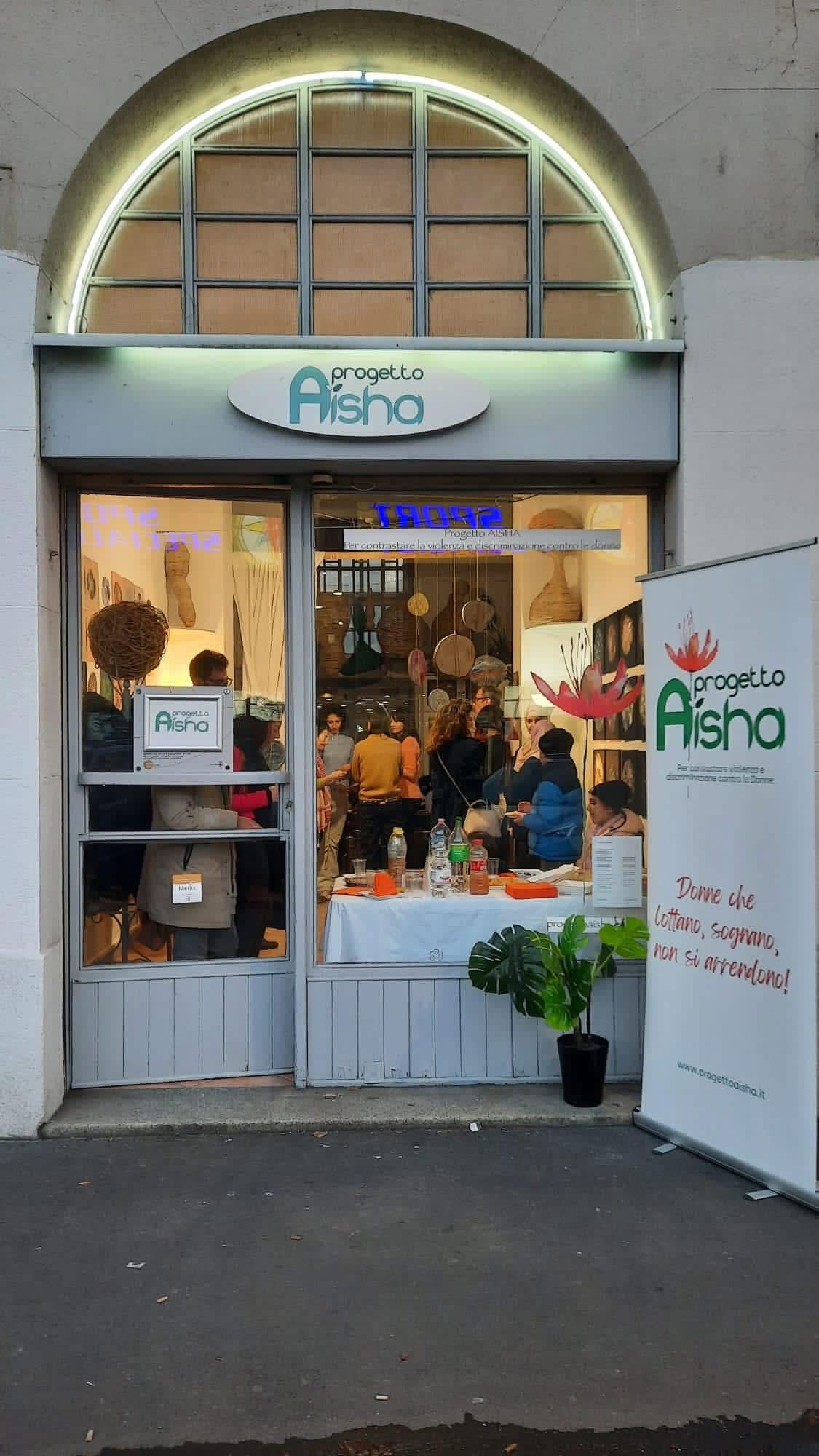
Through psychological, legal and spiritual support, the Milan-based association Progetto Aisha helps women facing domestic violence find a safe space where they can be heard without judgment. Its work also challenges the stereotypes that portray Muslim women as victims who need to be freed from their religion, arguing that faith and women's freedom are not incompatible.
When Amina Natascia Al Zeer conceived Progetto Aisha (Project Aisha) with other volunteers from the Coordination of Islamic Associations of Milan, Monza and Brianza, she did not imagine that they would be fighting not only domestic violence but also prejudice.
“On the one hand, some sections of the Muslim community regard anti-violence work as destructive for families and fathers,” Al Zeer said. “On the other hand, after years of anti-Islamic political and media propaganda, society at large now regards all Muslim women as victims in need of being freed from their own religion.”
“I am a believer and a practicing Muslim woman, and I am also one of the co-founders of an association that fights violence and discrimination against women,” Al Zeer said. “I have never experienced these dimensions as incompatible; on the contrary, for me they are deeply connected.”
Born in Modena to an Italian mother and a Palestinian father, Al Zeer is a mother of seven, a member of the board of a mosque and she has been president of Progetto Aisha since 2023. In her small office in Milan, just outside the city center, she continues to listen to women struggling to seek help from local services. It’s a problem that many immigrant and Muslim women face.
“But from the very beginning we have supported any woman, regardless of her origin or religious affiliation, and our initiatives are attended by everyone,” Al Zeer said.
Progetto Aisha provides psychological support, legal assistance, philosophical counseling and spiritual support to those who ask for them, thanks to a multidisciplinary team of psychologists, lawyers and other non-Muslim collaborators and volunteers. It also has the “murshide” or women with training in Islamic religious studies who can play a role in spiritual guidance.
When Institutions Feel Distant
When Progetto Aisha was founded in 2016, there were already anti-violence centers and local services in Milan, but Al Zeer said many women had difficulty accessing them. It has always been difficult to ask for help while suffering from violence, but that is even more difficult for Muslim and immigrant women, she said.
Al Zeer said this stems from “limited knowledge of the language and of their own rights, little familiarity with the area and with how institutions work, and difficulty in finding their way through services and bureaucratic procedures.”
In some cases, a mistrust of institutions or law enforcement linked to negative experiences they have had previously, including in their countries of origin, also contributes to this difficulty. Some fear being misunderstood because of their cultural and religious identity, and fear that their negative experiences will be attributed solely to their affiliation, Al Zeer said.
A Space Without Prejudice
But Progetto Aisha’s experience showed that it is not enough to make women aware of the protections available to them and to accompany them in accessing services. “For a woman who fears that her story, her culture or her religious identity will not be understood, finding a space where she can feel listened to without prejudice can make a great difference,” Al Zeer said.
Layla, who asked to be identified by a pseudonym to protect her safety, was referred to Progetto Aisha by an anti-violence center. She was able to take part in the organization’s workshops on topics such as parenting, navigating relationships with children, self-awareness and setting boundaries. “It was important for her to find a space where she could express herself freely, without feeling judged,” Al Zeer said.
Myriam, another Muslim woman who asked to be identified by a pseudonym to protect her safety, “suffered a very difficult family situation and decided she could no longer go on living with her husband. She was subjected to pressure and judgement from the community. They told her she was overreacting and that she would destroy her own family,” Al Zeer said.
“Our aim, then, is also to remind people that Islam does not teach that a woman must accept violence or give up her dignity in order to keep a marriage,” she added.
Challenging Patriarchy From Within
Al Zeer said she herself has experienced judgment from several sides, such as people questioning whether women come to Progetto Aisha to destroy men.
“At times, I sense a fear that our intervention would lead to the destruction of a family or to children being separated from their father,” Al Zeer said. “But if there is violence under the same roof, we cannot consider that family safe just because it continues to live together.”
She said she finds it even more disconcerting that there are men who would invoke verses of the Quran or hadith to impose certain choices on women or limit their freedom. “A religious reference cannot be taken out of context and used at will according to one’s desire for control while forgetting everything else: justice, mercy, respect, responsibility and the duty not to harm others,” she said.
“The Quran contains the principle that there is no compulsion in religion,” she added. “So how can one invoke faith to coerce a woman, deprive her of freedom or make her believe she has no right to choose?”
According to Al Zeer, there is also a need to distinguish between the principles of Islam and cultural customs that are sometimes presented as religious precepts. “They also have a duty to avoid generalizing, because Muslim communities are not uniform realities,” she added.
Progetto Aisha also works with imams, or the men who lead communal prayer in Islam and serve as religious and moral guides for practicing Muslims. Some of them have even devoted the khutbahs, or Friday sermons, to addressing the issue of gender-based violence and advised women to seek help from the organization.
“This shows that it is possible to address these issues within Islamic communities too, because there is not necessarily a conflict between the religious dimension and our work,” Al Zeer said.
Beyond the ‘Victim’ Narrative
When it comes to the stereotypes and prejudices concerning Islam, Al Zeer speaks with passion.
“I do not accept that situations of violence and discrimination are automatically confused with religious affiliation,” she said. “Why should women’s emancipation and Islam be incompatible?”
Al Zeer said there is often a very propagandistic representation of Muslim women in Western public debate where they are almost always portrayed as victims who must be freed from their own religion.
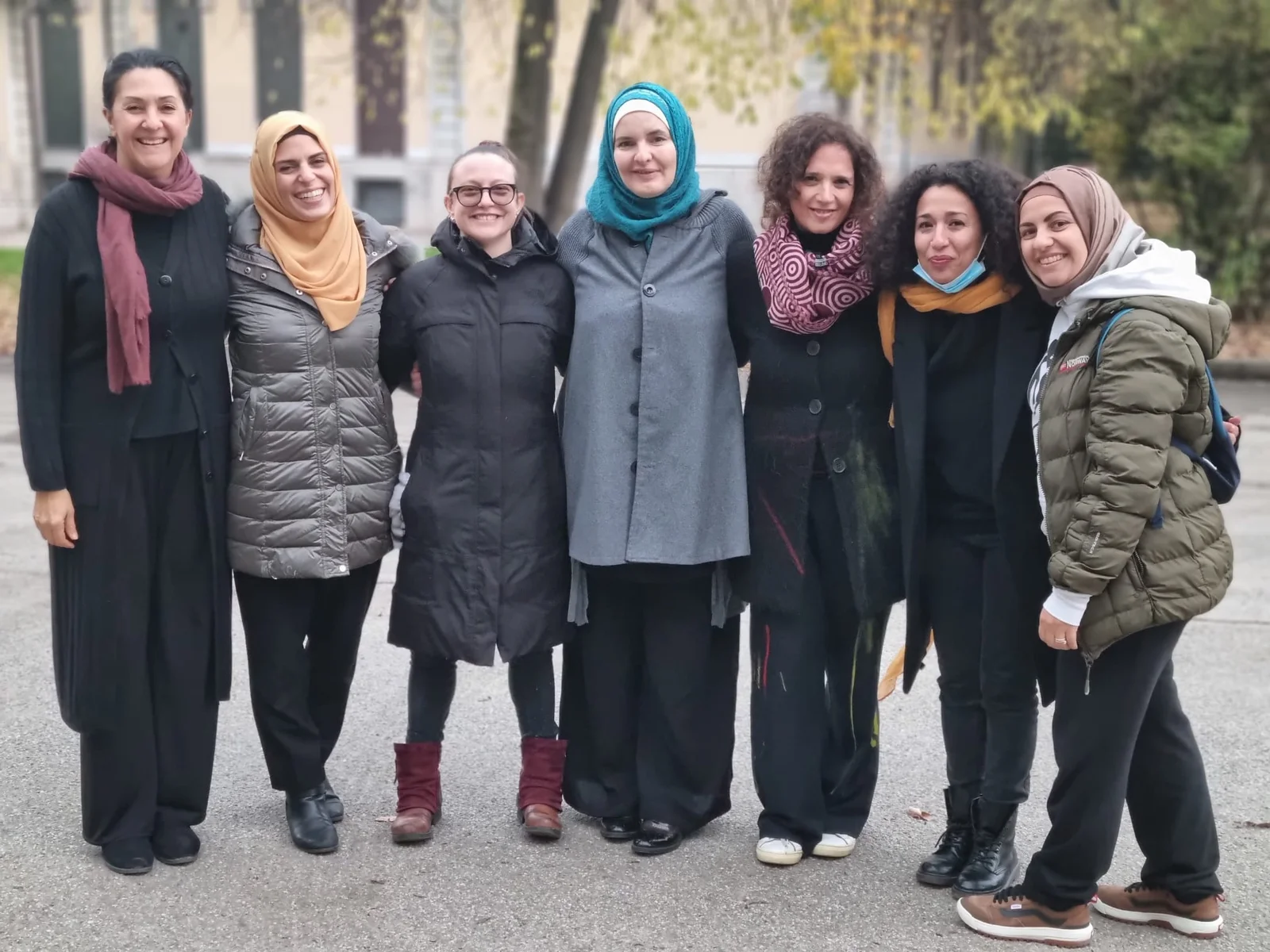
“I believe this is a very reductive representation, which does not correspond to the complexity of the experiences we encounter,” she said. “There are Muslim women who work, study, practice professions, make decisions and take part in public life; there are others who choose to devote themselves more to their family and to caring for their children; and there are still others who combine both dimensions. These are all experiences that deserve respect.”
In this sense, for Al Zeer, self-determination means that “a woman must be able to choose whether to work, pursue a career, devote herself to motherhood, look after the family or combine these dimensions, without anyone deciding from the outside which of these lives is the more emancipated.”
“The fact that a woman wears the veil or chooses to live her faith does not automatically tell us how free she is, how educated she is, what her aspirations are or what decisions she is capable of making,” she added.
Al Zeer is speaking from her own experience of being judged on how free she was just because she wore a veil.
“We cannot talk about women’s freedom if we are willing to recognize it only when they make choices that match our own idea of freedom.”
The way she sees it, freedom does not require abandoning one’s faith, just as it does not require embracing a faith.
“Freedom is the possibility of choosing to believe or not to believe, to practice or not, without coercion and without discrimination,” she said.
“Self-determination means not being forced to live according to a model imposed by my family, my community, society or even by those who claim to want to free me,” she said. “It means being able to live my identity without having to constantly ask for permission or justify myself.”
A More Inclusive Understanding of Women's Rights
Progetto Aisha’s decade of experience has taught Al Zeer and her colleagues how important it is to know each woman’s story, to listen without prejudice and to not take for granted that her religious or cultural affiliation necessarily determines her needs, her choices or her way of living.
“We must stop setting faith and women’s freedom against each other,” Al Zeer said. “It is not a battle of Muslim women against their own religion, nor a battle of one community against another … but a common battle of women and men, believers and non-believers, institutions, associations and civil society for the dignity, freedom and rights of all.”
