


Nearly half a century after its release, Sumitra Peries' "Gehenu Lamai" returns in a new restoration. Its portrait of two sisters and the weight of class and gender still feels startlingly close to home.
In her lifetime, Sumitra Peries (1935-2023) was widely acknowledged as the leading woman filmmaker of Sri Lanka. I got to know her much later; she eventually became a mentor of mine. When she passed away at the age of 87, I penned two tributes to her, one for the British Film Institute and the other for Outlook India. In my Outlook piece, I tried to explain the scale of her contribution to South Asian cinema.
I noted that Sumitra, who migrated to Europe when she was not quite 21, trained as an editor in the U.K., and chose to return to Sri Lanka, then the Dominion of Ceylon, was the first South Asian woman filmmaker to not come to the director’s chair as an actress. Almost all her contemporaries in the region, including Fatma Begum, Parveen Rizvi, Shamin Ara and Kohinoor Akhter, were actresses before they became directors. In that sense, Sumitra was a predecessor to the likes of Mira Nair — who of course came much later. She was also a contemporary of Gillian Armstrong, Lina Wertmüller and Chantal Akerman, who were revolutionizing women’s cinema in their own countries. Armstrong’s My Brilliant Career (1979), for instance, came out only a year after Sumitra’s debut.
This contribution is often not acknowledged, even by scholars of South Asian cinema. As I wrote in my article on Martin Wickramasinghe, that may be because international reporting on Sri Lanka has focused on its ethnic conflict to the exclusion of aspects like art and literature. Of course, in her own time Sumitra was recognized abroad, including in India. Yet it was not until last year, when several institutions got together to release the 4K restoration of her first film, “Gehenu Lamai” (1978), that she became a subject of discussion again.
“Gehenu Lamai,” translated as “The Girls,” was based on a novel by Karunasena Jayalath, one of the pioneering, popular writers of post-independence Sri Lanka. The film is in itself popular among Sri Lankans. Though younger people may not have seen it, they at least know about it. Yet its relevance is hardly limited to Sri Lanka. Released at a time of great social and economic change in the region, it also offers insights into South Asian femininity that remain startlingly fresh and relevant after almost half a century.
It was against this backdrop that “Gehenu Lamai” was restored by Film Heritage Foundation India, in association with the Lester James Peries and Sumitra Peries Foundation in Sri Lanka, last year. This was under an interesting institutional arrangement called FISCH. FISCH stands for France-India-Sri Lanka Cine Heritage — Saving Films Across Borders, and it involved four institutions: Film Heritage Foundation, the Embassy of France and the French Institute in India, and the Embassy of France in Sri Lanka and the Maldives.
The restoration of Sumitra’s film took several years. When it came out last year, it created a huge stir. In May 2025, it was screened at the Cannes Film Festival. I was told that this was the first time a Sri Lankan film received a red-carpet treatment there. The response was quite overwhelming. From Cannes, it traveled through Europe and Asia, before receiving its Sri Lankan premiere in September. For Sri Lankans, the restoration became a matter of national pride. Yet it also marked the revival of a form of cinema which was once current in South Asia — the sort that echoed our common, basic humanity.
A Deceptively Simple Plot

The plot in “Gehenu Lamai” is deceptively simple, partly because the novel it’s based on was rooted in a sentimental teenage romance. It tells the story of two sisters, Kusum (Vasanthi Chathurani) and Soma (Jenita Samaraweera), who aspire to better lives in their own way. Their father, once a laborer, lies crippled and sick in bed, while their mother, Jenny (Trilicia Gunawardena), ekes out a living selling things from a basket that she carries on her head. Even today, such women are called “vatti ammala” or “basket women” in Sri Lanka. At several points, certain wealthy girls denigrate Kusum and Soma as “vatti ammage duwala,”or “that basket woman’s daughters.” The phrase carries classist connotations and is used as a mark of contempt for “lower class” women in the country.
Jenny’s sister, Kusum and Soma’s aunt, is Kamalawathie (Chitra Vakishta). Kamalawathie is quite wealthy. Staunchly conservative, she is immensely proud of her son, Nimal (Ajith Jinadasa), who enters university. The story begins when Nimal returns, presumably after his graduation. He immediately falls in love with Kusum. In most popular South Asian films, this would be the staple for a whirlwind romance: rich boy meets poor girl, and the two marry despite class differences. Yet Sumitra’s film shows the difficulties Kusum faces on two fronts: Nimal, who asserts himself and forces her into a romantic interlude, and his mother, who has other goals for her son.
“Gehenu Lamai” is narrated from Kusum’s perspective, and we are privy to her thoughts. From the beginning she feels guilty about the affair. She herself is traditional and respectful of her elders, a quality that endears her to her aunt. By contrast, her sister Soma is rebellious and nonconformist. A huge film fan, Soma dreams of becoming an actress. To her mother and sister’s consternation, she receives letters from anonymous male pen pals. At a certain point Soma enters a beauty contest. Against great odds, she wins. Yet this proves to be a pyrrhic victory for her: she does find fame as a movie actress, but is raped by a director who soon abandons her. Soma bears a child. Initially, she decides to give it up for adoption, but later she decides to bring it up herself. Meanwhile, a series of events leads to Kusum and Nimal’s affair being discovered. All this puts Kusum through even more strain.
Two Faces of Femininity
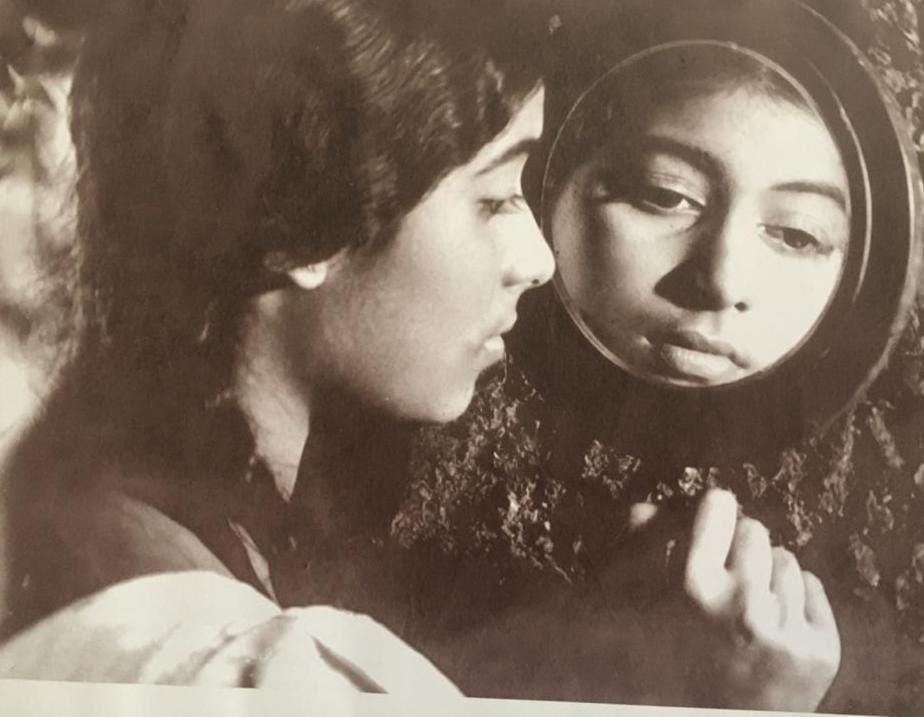
From then on, the story takes a few twists and turns, though I won’t dream of revealing how it ends for Kusum, Soma and Nimal. Suffice it to say that from the beginning, “Gehenu Lamai” reflects on the class and gender hierarchies of South Asian rural society and how they hinder and oppress women. Sumitra Peries herself came from a village and, in a conversation with me, she recalled how women who did manual labor, including on rubber estates, struggled to put food on the table for their families. Kusum comes from a similar background. Her social status is constantly highlighted — by her aunt, her classmates and ultimately, Nimal himself — and it hinders all her attempts at finding fulfillment for herself and her family. When Soma wins the contest, for instance, a group of girls contemptuously pore over a photo of her in the papers. “Ah Soma,” one of them shrieks, “that ‘vatti amma’s’ daughter, Kusum’s sister?” In their scheme of things, the two sisters are fit only for the gutter.
Perhaps the most sobering aspect of “Gehenu Lamai” is that it presents two faces of femininity — Kusum the obedient and Soma the nonconformist — and tells how patriarchy bears down equally on both. Soma is undone by her hunger for fame in the same way Kusum is undone by her devotion to others. When her aunt tells her what she has planned for Nimal, for instance, Kusum feels guilty and tells him to break off their relationship. When Soma decides to bring up her child, Kusum neglects her studies to look after it.
Although Nimal comes across as a playful and sympathetic figure here, willing to disobey his mother’s wishes, eventually he also falls in line with the patriarchal structures in his village. When Kamalawathie discovers their affair, she manipulates Kusum’s feelings to keep Nimal away from her. Despite his promise to marry Kusum no matter what, Nimal changes course at that point. He starts climbing the social ladder, first as a schoolteacher and then as a high-ranking village official. Ultimately, in a final encounter, Kusum breaks down in front of him and asserts herself in quiet dignity. In the end, we are left with a sense of despair, as Kusum looks into a mirror and wonders what she did to deserve her fate.
A Reflection of A Rupturing Society
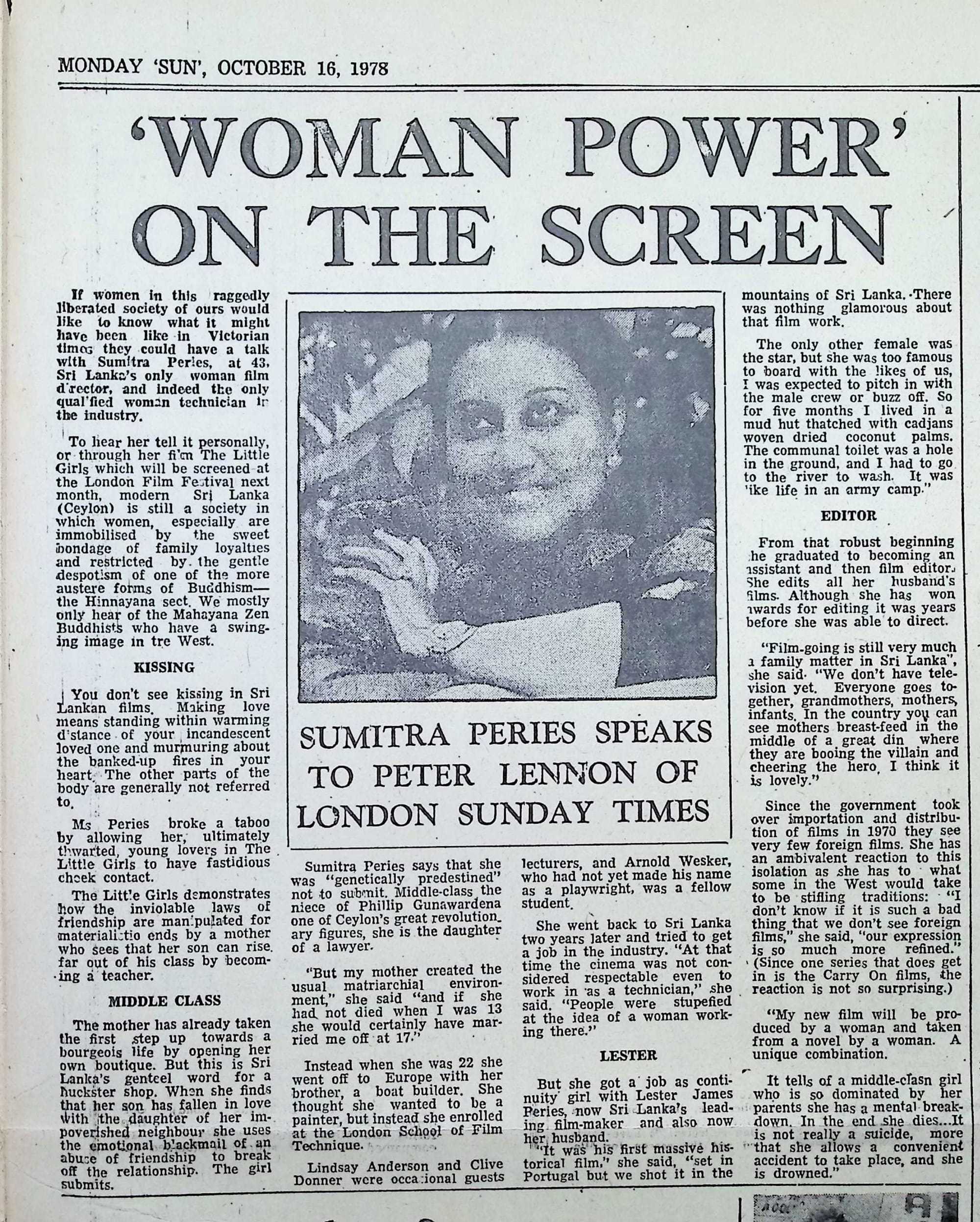
For its time, “Gehenu Lamai” was revolutionary and radical. It was released in 1978, when Sri Lanka became the first South Asian country to liberalize its economy. Almost overnight, women from far-flung villages migrated en masse to cities, finding work at factories in new, unfamiliar and often exploitative conditions.
In that sense, “Gehenu Lamai” reflected a society that was already rupturing from within. Yet its feminist overtones remain as relevant now as they did then. The acting in particular — Vasanthi Chathurani, who played Kusum, was a newcomer, only 17 at the time — reflects these qualities well. More than anything, though, it is Sumitra’s direction that infuses it with a level of authenticity rare in most South Asian films at the time.
That had to do with Sumitra’s own background. Ultimately, “Gehenu Lamai” was a South Asian film about South Asian women, directed by a South Asian woman. “It may have been my most personal film,” Sumitra once told me. When it was originally released in 1978, a number of Western critics, including in London and Germany, discerned this quality, and revealed as much in their reviews, as documented by the Film Heritage Foundation. David Robinson of The London Times for instance, said that the film was “a rarity, maybe unique, as work of a wholly feminine sensibility.” Similar reviews appeared in Germany and Madras when it received screenings there that year. There was much praise for its acting and editing. The German publication Mannheim Morgen in particular, lauded its “exceedingly delicate photography” that “leaves a deep-rooted impression on one’s memory.”
But perhaps The Guardian’s Peter Bradshaw distilled it better than most, in his review of the restored version earlier this year: “It is a story through whose entire running time I wistfully hoped for a happy ending,” he said. “But that is what Peries ruthlessly withholds from her audience.” Ultimately, as I saw Kusum shedding tears in the final scene, hoping against hope for the future but uncertain about what it holds, this is what I felt. But I also felt as though I was going back in time, to a time and place that — at least from the perspective of the women of my society — seemed strangely familiar.


