
Ukraine: Battered But Unbowed

Memorial in central Kyiv to soldiers who died defending Ukraine against the Russian invasion (courtesy of John Bond).
After three years of war, a visit to Ukraine reveals the deeper history and stubborn will behind a nation's refusal to yield.
When Russia launched its full-scale invasion of Ukraine in February 2022, most Western Europeans thought Ukraine had no chance of withstanding the onslaught. President Volodymyr Zelensky was immediately offered asylum by Western countries.
“I need ammunition, not a ride,” he reportedly said, turning down an offer of evacuation by the U.S.
Today, Ukraine is still standing, against a far larger, well-armed opponent, and may be gaining the advantage.
It was not just Zelensky who refused to give in. Ukrainians in their millions made the same choice. Despite deep divisions – of language, of region, of political party, of religion – they were determined to withstand the Russian invasion.
What enabled this instant unity, on a challenge that to the outside world seemed impossible? How have Ukrainians stayed firm despite losing hundreds of thousands of soldiers and more than 50,000 civilians to enemy action?
I have just visited Ukraine, and asked these questions.
Invasion Came ‘Too Late’
A Ukrainian answered by pointing to the Holodomor – translated as “death by hunger.” In 1932-1933, when Ukraine was part of the Soviet Union, the harvest failed widely across the Union. Ukraine was one of the worst affected areas. Yet the Soviet Government forcibly removed food from Ukraine, and at least 3 million Ukrainians starved to death. Most Ukrainians are convinced that the Soviet leadership implemented this policy to punish them for their nationalist tendencies.
My informant saw the 2022 invasion as an extension of this punishment. The Russian forces captured a small town, Bucha, and held it for two months. When the Ukrainians recaptured the town, they found the streets littered with the bodies of civilians.
Ukrainians have always resented being forced into Russian ways. In Ukraine, Western and Eastern Europe meet. In Western Ukraine the predominant religion is Catholic, in Eastern Ukraine it is Orthodox, and this mixture has created a culture distinctly different from Russia’s.
A Ukrainian writer said to me that the Russian invasion came too late for Russia. The Soviet Union collapsed in 1991. Thirty years had been time enough for Ukrainians to restore their heritage. They know that rule by Russia would destroy their democracy, their prosperity, their rule of law, their country, and they have no intention of letting that happen.
A Dramatic Contrast
Since 1991 the Ukrainians have revelled in their freedom from their Soviet overlord. In contrast to Russia, where governance has grown more authoritarian in recent years, Ukraine has seen democracy flourish. This has not been straightforward. Mistakes have been made. But when Ukrainians conclude they are on the wrong path, they take action. In 2013-2014, when most Ukrainians wanted to strengthen links with the European Union but the government refused, 100,000 Ukrainians stayed in the center of Kyiv for the four coldest months of the year, defying all attempts to force them out, until their President gave up and fled to Moscow.
And this spirit continues. Last year, when President Zelensky approved a bill limiting the powers of the anti-corruption body, demonstrations outside Parliament forced him to drop the bill.
Ukrainians have learnt that if they want something done, they had better do it themselves. When Russia invaded, the Ukrainian Army was deficient in many aspects. Spontaneously, citizens raised money for their regiments and provided the needed equipment. Everyone feels involved, many are devoting their skills to the task, and out of this have come ingenious technical solutions, which compensate for their smaller armed forces – solutions which are transforming modern warfare and bringing the world to Kyiv.
This is a dramatic contrast to the Russian approach. President Putin took the decision to invade, and demanded each member of his Government approve it on national TV. There was little popular sentiment for war, and Putin has had to force acquiescence by ramping up the threats and propaganda. Russia fights with First World War tactics, losing 20,000-25,000 troops a month to injury or death, and is increasingly outplayed by Ukrainian innovation. More than a million Russian soldiers have been killed, wounded or are missing. Gradually, Russian media commentators are asking what is the point of a war that is costing Russia dearly, and making little progress towards its aims.
But the war goes on, and Ukraine is hurting. Five million Ukrainians have left the country, and 4 million have been internally displaced. More than three years of living under the constant threat of missile attack have left many exhausted. There is anguish at the 20,000 Ukrainian children taken to Russia and indoctrinated into Russian culture. No one I met thought the war would end soon, as they recognize that Putin is not yet under sufficient pressure.
Willing to Fight for Their Future
Meanwhile, they are grappling with the challenges the war has thrown up. I met a former helicopter pilot, shot down during the Russian incursion into Eastern Ukraine in 2014. Though in a wheelchair, he was determined to create a center where wounded veterans and their families can learn how to adapt to their new reality. He trained in psychology, raised the money, and the center is now up and running. He dreams of a network across the country, and hopes that Western Europe and the U.S. will help.
And some are thinking for the future. The leader of a Ukrainian think tank invited me for a discussion on a social contract that he and his colleagues have drawn up, outlining the kind of society they want for Ukraine after this war. The end of a war offers opportunities for dramatic change – Britain gained a national health service after the Second World War, and Europe launched a Common Market. But such developments have to be planned during the war, otherwise the opportunity may be missed.
Ukraine could not have withstood the invasion without the support of Western Europe and the U.S. It is also true that the West has supported them in part because they are shielding Western Europe from Russian aggression. Ukrainians hope that the West will express its gratitude by giving Ukraine membership to the European Union and NATO. Both have welcomed Ukraine in principle, but have stopped there. The European Union calls for significant change in Ukraine, especially in reforming its justice system, developing a market economy, tackling money laundering, modernizing its public administration and protecting the rights of minorities. Ukraine has responded positively. During my visit, I met people working for improvement in all these aspects of governance.
A British diplomat told me that he found it refreshing to live in Ukraine.
“People here care far more about our values than we do,” he said. “And they – unlike many in our countries – are willing to fight for their future.”
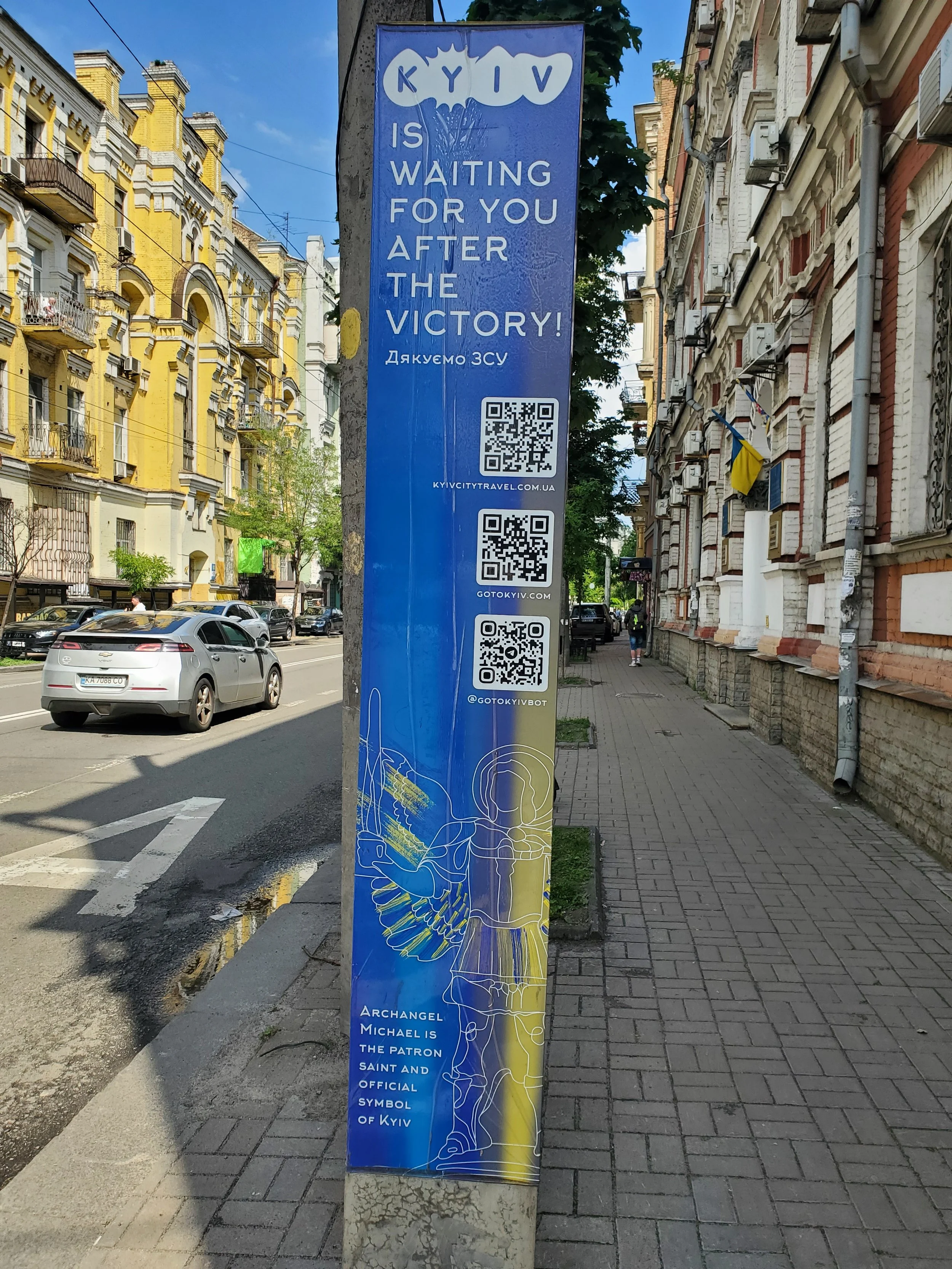
Bus stop sign in Kyiv (courtesy of John Bond).
*The opinions of contributing writers are their own and do not necessarily represent the views of We Are One Humanity. Submissions offering differing or alternative views are welcome.


Mainstream media is losing a generation, and the Cockroach Janta Party is merely a symptom.