Decolonizing Identity, Ethnicity and Difference
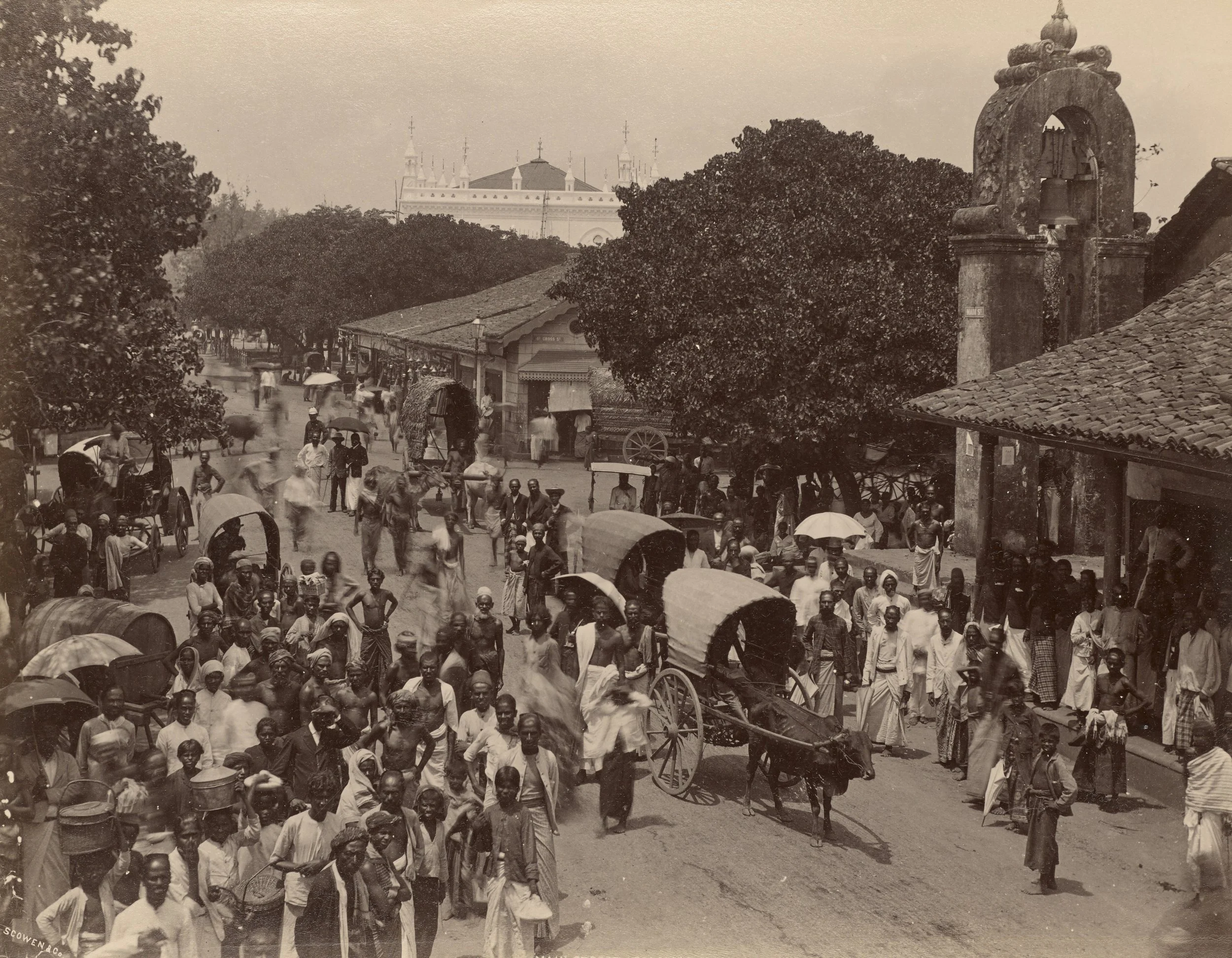
Main Street, Colombo, late 19th and early 20th century. Photo by Charles T Scowen and The Colombo Apothecaries Co Ltd. Original public domain image from Getty Museum.
I was recently trying to explain the history of Sri Lanka to a group of tourists from Australia and Canada. I began by bursting some of the myths and stereotypes associated with the country. The most persistent among them, of course, is that Sri Lanka is a small country, too small to contain the kind of diversity that other countries — including India — have. The flip side to this is the belief that Sri Lankan society is homogeneous to a fault, dominated by one ethnic or religious group or another.
Nothing could be farther from the truth. Geographically, Sri Lanka is a fraction of the size of a single Indian state. Yet ecologically, culturally, socially and I daresay politically, it is not so small as to preclude the kind of heterogeneity that other countries possess.
As the historian Senake Bandaranayake once wrote, “To the archaeologist and historian, it is an island of modest proportions, not so large as to have great internal variations, and not so small as to lack heterogeneity and a complex history.”
I feel compelled to emphasize this because, for the longest time, Sri Lanka was engulfed in an ethnic conflict that has still not fully ended. In large part, that battle continues today over the question of who controls — and who writes — historical narratives.
Labels that widen divides
Sri Lanka has been through the thick of almost everything: three centuries of European occupation, followed by more than 75 years of ethnic and political discord. If it is difficult to think of a long stretch of time during which the country enjoyed stability, this is not because Sri Lankans are inherently hostile. Rather, it is because many continue to rely on categories and labels that heighten difference and widen division.
Part of the reason for this is that we have projected particular visions of the past onto the present, allowing them to dominate our definitions of who we are in relation to one another. In the 1950s, for instance, the major political battle in this country was over language. At stake were the two main ethnic collectives, the Sinhalese and the Tamil.
By the 1930s and 1940s,as scholars have noted, the main criterion of difference between these two groups had shifted from religion to language. Most Sinhalese are Buddhists and most Tamils are Hindus, though there are also Sinhalese Christians and Tamil Christians. Following independence, the battle over language — specifically, over its use in the civil service and every other sphere of activity — gradually congealed into a struggle over which linguistic group would dominate and shape the country’s future.
Eventually, these struggles culminated in a series of laws that sought to neutralize the other side in terms of access and privilege. The first of these were the language acts of the late 1950s. They enthroned one language — Sinhala — at the expense of the other — Tamil. The legislation led to protests soon after, andto the first of many ethnic riots which marked a rupture in the country’s social fabric: one that has never been fully resolved.
Constructed under colonial conditions
I would argue that a large part of the problem lies in how categories such as ethnicity and religion are projected, or extrapolated, from the past into the present. During the 1960s and 1970s, historians and social scientists, both from Sri Lanka and abroad, took great pains to study these categories and demonstrate that, in precolonial times, they did not demarcate difference in the way they do today. Among them was R.A.L.H. Gunawardana, who sought to challenge popular assumptions about ethnicity in Sri Lanka.
As Gunawardana noted inan essay written in 1979, nationalists projected contemporary categories such as race onto terms like Sinhala and Tamil. The problem was that these terms originated in precolonial times and were understood very differently then. By viewing the past through the prism of the present, Gunawardana contended, we run the risk of creating divisions where none previously existed.
His other point — one that has not been appreciated enough, despite being evident for all to see today — was that many of these differences were largely constructed under colonial conditions. As I noted in my article on Uthpala a few weeks ago, historians such as Nira Wickramasinghe and Sujit Sivasundaram have observed that colonial officials laid the foundations for contemporary nationalist ideologies in countries like Sri Lanka. This is not to suggest that everything was harmonious or perfectly balanced before colonial rule. Rather, these categories were understood, deployed, and experienced differently.
The irony of using colonial categories to “advocate for decolonization”
Take a simple example: the census. Censuses existed in ancient and precolonial times as well, but under European colonialism they acquired a different meaning and function. The first major census in Sri Lanka was undertaken in 1911. The document,which is available online, offers a fascinating glimpse not only into Sri Lankan society at the time but also into how the country was analyzed and segmented by colonial officials. Distinctions were drawn not just between Sinhalese and Tamil, but also between Low Country Sinhalese — located along the coastline and in regions demarcated under colonial rule as “maritime provinces” — and Kandyan Sinhalese, who inhabited the interior and hill country.
The census is only one example among many that can be traced to colonial rule. Of course, it is easy to blame colonialism for everything. Yet colonialism itself can become a convenient scapegoat. True, it helped create categories of difference that are in use today. But the fact that these categories are still being deployed — and have become tools or weapons in the hands of nationalists claiming to speak for one collective — suggests that we have failed to discard them when defining who we are in relation to one another.
What is particularly ironic is that some of the most vociferous ethnic nationalists in Sri Lanka advocate for decolonization, even though the very categories they employ are deeply embedded in colonial attitudes. Such ironies have not been lost on scholars, who, since at least the 1960s, have undertaken the difficult — and often impossible — task of demonstrating just how fluid and historically contingent categories like ethnicity can be.
That nationalist narratives have seemingly drowned out these voices of tolerance in an increasingly polarized society is, ultimately, a tragedy.